



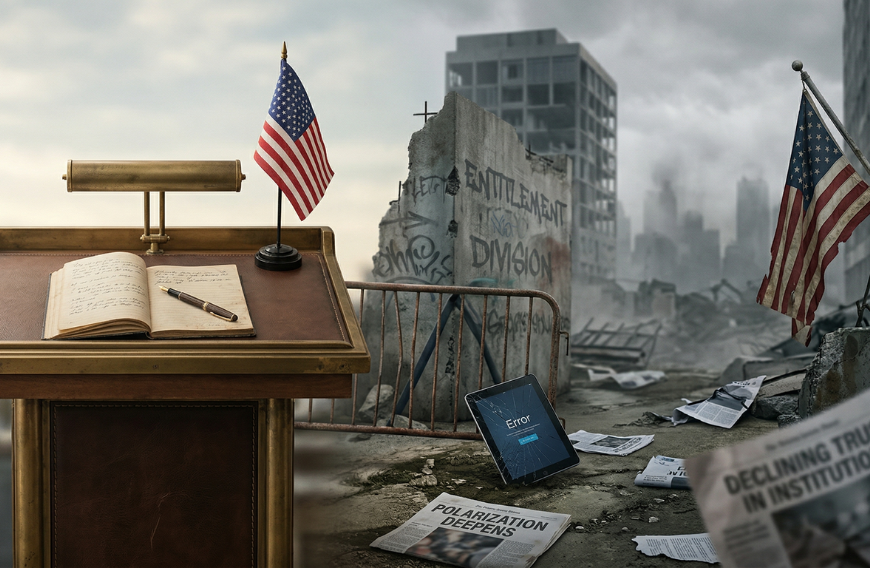
On January 20, 1961, a forty-three-year-old man who had won the presidency by the thinnest popular vote margin in modern history, two-tenths of one percent, stood in the Washington cold and delivered fourteen minutes that would echo across sixty-five years and counting. That day, JFK did not promise new entitlements, did not enumerate grievances, and did not flatter a base or demonize an opposition. He issued, instead, a summons: “And so, my fellow Americans: ask not what your country can do for you, ask what you can do for your country.”
Could that speech win a Democratic presidential nomination today?
The answer, I believe, is no.

Competing emotional constitutions
Every American carries within them two competing gravitational forces. The first is oriented toward duty, obligation, and responsibility, the conviction that citizenship is a burden freely chosen, that the republic demands something of you before it owes you anything. The second is oriented toward rights, entitlements, and privileges, the belief that the state exists primarily to serve the individual, to redress wrongs, to guarantee outcomes.
Kennedy’s genius was to speak directly and unambiguously to the first impulse. He addressed a nation whose dominant emotional register was sacrifice. The generation seated before him on that January afternoon had survived the Depression through collective endurance. They had stormed Normandy and Iwo Jima not for personal advancement but because the idea of America, flawed, incomplete, but aspirational, was worth dying for. They had come home and built suburbs and highways and universities not merely for themselves but for a civilization they believed was worth perpetuating. When Kennedy asked them to give rather than receive, he was not introducing a foreign concept. He was articulating what they already felt but had not yet heard spoken so beautifully from the highest office in the land.
Today, both political parties have made a calculated and civilizationally corrosive decision to speak almost exclusively to the second impulse. The language of modern American politics, left and right, progressive and populist, is overwhelmingly the language of what is owed. What the government owes you. What the elites have stolen from you. What rights are being denied you. What privileges others enjoy that you do not.
I am not trying to make a partisan observation, but a structural argument. The Democrats promise expanded healthcare, student loan forgiveness, guaranteed income. The Republicans promise tax cuts, deregulation, protection from undocumented immigrants and foreign competition. The verbs differ, but the grammar is identical: the state as instrument of personal benefit, the citizen as customer rather than stakeholder.
Disintegration
According to recent polls, only 17% of Americans say they trust the federal government to do what is right “just about always” or “most of the time,” one of the lowest readings in the nearly seven decades since the question was first asked. In 1958, when the National Election Study began tracking this measure, that number was 73%. Is this a gradual collapse or a free fall from a civilization that once believed in its own institutions to one that regards them with something between contempt and indifference?
The Pew Research Center reported recently that 65% of Americans say they “always or often feel exhausted” when thinking about politics. Just 10% say they feel hopeful. A recent Gallup survey found that trust in all three branches of the federal government ranges from a low of 32% for the legislative branch to 49% for the judicial branch, all figures that would have been unimaginable during Kennedy’s era. A report from seven leading think tanks, the State of the Nation Project, found the United States tied with India, Mexico, and Pakistan for the highest rates of polarization among nations surveyed. Barely one in ten Americans believes the government represents them well. Seven in ten believe that corporations and the wealthy control government and that politicians are in it only for themselves.
The moderate center, the ideological territory Kennedy occupied, the terrain where duty-oriented politics might still find purchase, is slowly vanishing. Gallup reported that the percentage of Americans self-identifying as politically moderate reached a record low of 34%. Among Republicans, 77% now identify as conservative, a new high. Among Democrats, 55% identify as liberal. The middle is not holding because it is emptying.
The polarization is more emotional than ideological. Researchers have consistently found that Americans are less divided on actual policy questions than they believe themselves to be. The divide is affective; they simply despise the other side. In 2022, 72% of Republicans and 63% of Democrats viewed the opposing party as more immoral than other Americans, up from 47% and 35% just six years earlier. We have become a nation that hates first and disagrees second.
The citizenship deficit
Kennedy’s “ask not” was a theory of citizenship and not merely rhetoric. It produced the Peace Corps, which sent tens of thousands of young Americans into service abroad. It catalyzed a generation’s commitment to public life, in government, in the military, in civil rights activism, in community organizing. It assumed that the health of the republic depended on the active, sacrificial participation of its citizens.
What would that theory encounter today? Consider volunteerism, perhaps the most direct measure of whether Americans are willing to give without expectation of return. According to the U.S. Census Bureau and AmeriCorps, formal volunteering hit a historic low of 23.2% during the 2020 pandemic. While the rate recovered modestly to 28.3% by late 2023, fewer than three in ten Americans over the age of sixteen can be bothered to volunteer formally even once in a year. The percentage of American households donating to charity has fallen from 66% in 2000 to under 50%. Rural volunteerism, once the hallmark of tight-knit, high-trust communities, has collapsed since the Great Recession and never recovered.
READ: The Review by Ajay Raju | They know too much: A pessimistic and cynical generation (March 23, 2026)
Military service, the ultimate expression of the duty-first orientation Kennedy championed, tells an even starker story. The Army missed its active-duty recruiting goals by 25% in fiscal year 2022, and both the Navy and Air Force missed their targets for the first time in over two decades in 2023. Only 23% of young adults are physically, mentally, and morally qualified to serve without a waiver. The Department of Defense’s Joint Advertising Market Research Studies found that propensity to serve among youth ages sixteen to twenty-one declined from 16% in 2003 to just 10% by 2022, a nearly 40% drop in willingness, not just capability. Confidence in the military among all Americans fell from 82% in 2009 to 60% by 2023. The Brookings Institution has documented an ongoing “male drift,” with young men disengaging from higher education, career advancement, and civic institutions, including the military, at alarming rates.
This is the landscape onto which Kennedy would be parachuting his speech about duty and sacrifice. He would be asking a generation raised on self-care mantras and algorithmic feeds to subordinate the self to the collective. He would be asking citizens who do not trust their government, do not volunteer, do not serve, and increasingly do not even vote in local elections, to find within themselves the impulse to give.
The Convention Hall
The Democratic Party of 2026 is a party grappling with a crisis of identity after its 2024 losses across nearly every demographic group. Its progressive wing speaks the language of structural injustice and systemic remediation, a framework in which the government owes citizens redress for historical wrongs. Its moderate wing has adopted a cautious economic populism designed to win back working-class voters who feel abandoned. Neither wing has any incentive to tell its constituents that they should be asking less of their government and more of themselves.
The Republican Party, for all its rhetorical invocation of self-reliance, is no better. “America First,” as deployed in the current political lexicon, does not mean what it appears to mean. It does not mean the nation as a unified whole comes first. It means “my” America comes first, my tribe, my demographic, my cultural cohort. It is particularism dressed in the costume of patriotism. It is the language of rights and privileges for the in-group, obligations and restrictions for everyone else.
Kennedy’s formulation was radically different. His “country” was indivisible. His “you” was universal. When he said “ask not,” he was speaking to every American, the steel worker and the banker, the sharecropper and the senator. The very idea of addressing the entire nation as a single moral community has become almost unintelligible in a political culture organized around micro-identities and algorithmic segmentation.
Differences first
So, what has changed since January 1961? When two Americans met in Kennedy’s era, they recognized each other first as Americans. They might then discover they were Catholic or Protestant, Northern or Southern, union or management. But the category “American” came first, and it carried weight.
Today, when two Americans meet, the first act is classification. Blue or Red. Progressive or Conservative. Woke or MAGA. Coastal or Heartland. The subcategories have proliferated into a taxonomy of mutual suspicion. A Johns Hopkins poll in late 2024 found that nearly half of Americans believe members of the opposing political party are “evil.” Not wrong. Not misguided. Evil. We have transformed political disagreement into moral condemnation, and in doing so we have made Kennedy’s unifying rhetoric not merely unfashionable but structurally impossible.
The 2025 Wall Street Journal description of “a total breakdown in trust” between the parties is not hyperbole, but a diagnosis. Eight in ten Americans, according to Pew, say that Republican and Democratic voters cannot even agree on basic facts, not policies, not priorities, but facts. We do not merely inhabit different political parties. We inhabit different epistemological universes.
The greatest generation
Was the Greatest Generation our last cohort of America First citizens? The question haunts because it carries within it the seeds of a larger fear: that the conditions which produced the Greatest Generation, shared sacrifice, existential external threat, cultural cohesion forged in genuine hardship, were historically anomalous, and that what we are witnessing now is not decline but reversion to a more natural state of human selfishness.
Lincoln presided over a nation that was literally killing itself over the question of whether its founding promise applied to all people. He held it together through will, eloquence, and 620,000 dead. Kennedy inherited a nation unified by the Cold War’s existential clarity. The Soviet Union provided the external enemy that made internal solidarity possible. In both cases, the leader’s call to collective sacrifice was credible because the threat was visible, immediate, and shared.
What is the shared existential threat today? Climate change divides along partisan lines. Pandemics became culture wars. Economic anxiety produces not solidarity but blame. Even foreign adversaries, China, Russia, Iran, cannot produce the consensus that the Soviet Union once generated, because each has been incorporated into domestic political narratives as ammunition against the other party rather than a common challenge requiring unified response.
Foreign adversaries today do not need to outmuscle America. They need only to wait. If the current trajectory of polarization holds, and every data point suggests it is accelerating, not moderating, the United States will continue to weaken itself through internal combat. A nation in which 89% of local officials say polarization is negatively affecting the country, in which trust in the federal government has collapsed from 73% to 17% in a single lifetime, in which citizens view their fellow citizens as enemies rather than compatriots, is a nation doing its adversaries’ work for them. American attention is consumed by its own civil wars, wars fought not with muskets but with algorithms, cable news segments, and congressional subpoenas.
READ: The Review by Ajay Raju | Insurance premium: The most powerful weapon in the Iran war (March 16, 2026)
The recessive gene
Here’s some good news. The duty-oriented impulse has not disappeared from the American character. It has become recessive; present in the genome but no longer dominant in expression. You can still find it in the volunteer fire departments, in the teachers who stay in underfunded schools, in the military families who serve generation after generation despite a nation that increasingly does not understand or appreciate what that service means. You find it in the immigrants who still arrive believing the original promise, who start businesses at higher rates than native-born Americans, who sometimes understand the idea of America better than those who inherited it.
Can a political leader today reactivate this recessive gene? The data suggests it would be a losing strategy in either party’s primary. Populist anger is easier to monetize than civic virtue. Grievance fills stadiums. Duty fills only hearts, and hearts, in 2026, do not trend on social media.
But there is a difference between a losing strategy and a wrong one. Kennedy knew, on that January morning, that he had won by the narrowest of margins, that he could not afford to alienate a single constituency. He chose to challenge the nation anyway. He bet that somewhere beneath the Cold War anxieties and the consumer comforts of postwar America, there was a reservoir of civic nobility waiting to be called forth.
The reservoir has not evaporated. It has merely been paved over, by decades of political calculation, by an entertainment industry that celebrates the self, by an economy that rewards extraction over contribution, by a digital architecture designed to isolate and inflame rather than connect and inspire.
Last word
The choice is not between Kennedy’s America and the America of 2026. That binary is false. The choice is between a politics that continues to flatter the entitlement impulse in all of us, left and right, progressive and populist, and a politics that dares to ask the duty question again. Not Kennedy’s specific question, which was shaped by the Cold War and a world that no longer exists, but the “spirit” of that question: What do you owe to the civilization that shelters you? What will you sacrifice so that the next generation inherits something other than your debt and your rage?
No one currently running for office in either party is asking that question. And until someone does, until some leader is willing to lose a primary by telling Americans the truth about themselves, we will continue our slow drift toward the fate that awaits all empires that mistake their rights for their responsibilities, their privileges for their purpose.
Kennedy closed his inaugural address with a line less often quoted but equally important: “With a good conscience our only sure reward, with history the final judge of our deeds, let us go forth to lead the land we love, asking His blessing and His help, but knowing that here on earth God’s work must truly be our own.”
God’s work must truly be our own. Not the government’s work. Not the algorithm’s work. Not the party’s work. “Our” own.
Sixty-five years later, we are still waiting for someone to remind us of that.