



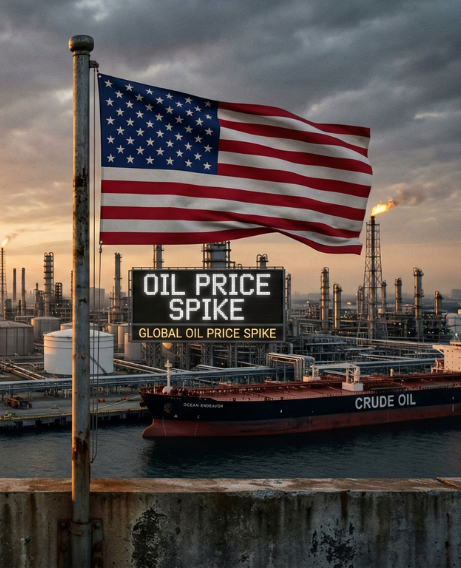
Global oil prices are showing no signs of going down amid the U.S.-Israel and Iran war. The price of Brent crude rose by more than 3% to above $115 (£86.77) a barrel, while U.S.-traded oil climbed to $101.62 after gaining almost 2%. It puts Brent on track for its biggest monthly gain on record.
As per the BBC, Lars Jensen, a shipping expert and former director at Maersk, warned that, even if the Strait of Hormuz “magically were to open tomorrow,” there were still further price rises to come.
“We need to keep in mind that a lot of the oil that was loaded in the Persian gulf prior to this crisis is only now arriving in refineries,” he told the BBC.
READ: Middle East conflict fears send oil prices up, could hit US gas prices (March 20, 2026)
He added: “You’ve got 20 to 30% of the seaborne fertiliser in the world originating from the Gulf.
“This will mean rapidly escalating food prices, especially in poorer countries.”
As The Wall Street analysts predict oil prices touching $200 a barrel, Egyptian President Abdel Fattah El-Sisi noted that these predictions were not exaggerations and only Trump could stop the war.
The recent escalation in the Persian Gulf, particularly involving Iran and strategic infrastructure such as Kharg Island, has raised concerns about potential disruptions to crude shipments. Kharg Island alone handles a significant portion of Iran’s oil exports, so any threat to its operations can have immediate and wide-reaching effects on global supply, driving prices higher.
In addition to geopolitical pressures, global demand for oil remains robust as economies continue to recover and expand post-pandemic. This combination of constrained supply and sustained demand creates a scenario where price volatility is almost inevitable. Traders and investors closely monitor developments in the Middle East, particularly military movements, sanctions, and negotiations, as these factors heavily influence market sentiment.
As per the BBC, Andrew Lipow from consulting firm Lipow Oil Associates said he expected the price of Brent to reach $130 a barrel in the coming weeks as threats against the global energy supply continue.
READ: India faces energy risks as Hormuz closure disrupts global oil flows (
“My greatest fear is that you have a general economic slowdown around the world… because consumers simply run out of money as they’re spending more on energy and, in addition, food,” he said.
When strategic regions like the Persian Gulf experience conflict, the ripple effects extend far beyond local borders, affecting the availability and price of vital commodities such as oil and, indirectly, food. Elevated energy prices place pressure on households, businesses, and governments alike, highlighting how closely economic growth is tied to the stability of supply chains and critical infrastructure.