



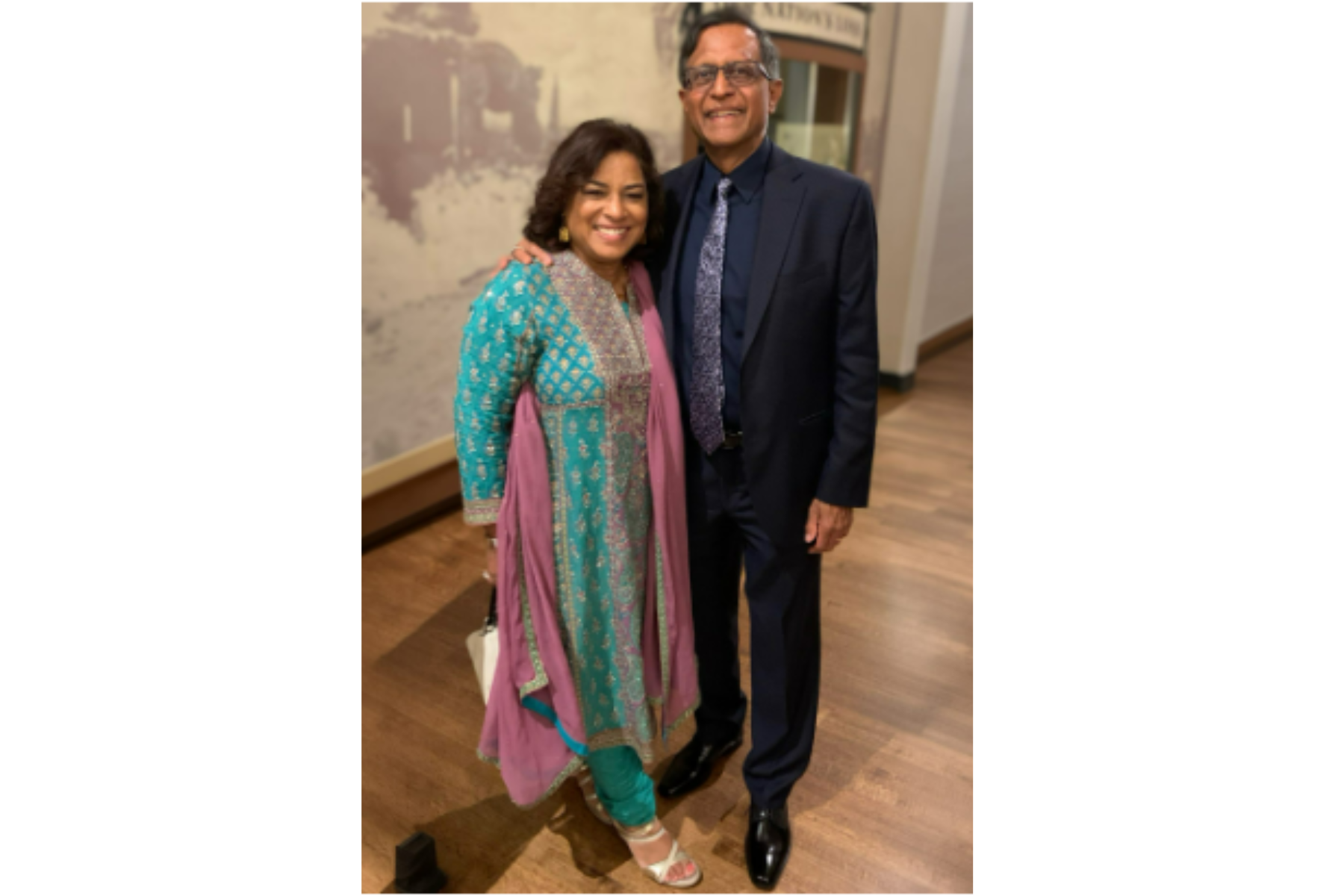
When George Verghese arrived in the United States in 1974, he was a 21-year-old carrying a degree from the Indian Institute of Technology Madras and a vision for his future.
His introduction to American academia was a rocky start, a delayed immigration process forced him to start his master’s program a month late, navigating a Stony Brook University campus on Long Island, New York, that was then a maze of construction and unaccustomed winter snow.
Five decades later, the MIT professor emeritus is ensuring that the spark of inspiration he found in those early, uncertain days continues to reach future generations.
Along with his wife, Ann, Verghese has established the Professor Chi-Tsong Chen Excellence in Education Award within the College of Engineering and Applied Sciences (CEAS).
The endowment is specifically designed to recognize faculty members who excel in the classroom. For Verghese, the gift is a way to pay forward the mentorship of Professor Chi-Tsong Chen, a scholar whose “elegant” teaching style and foundational textbooks on linear system theory convinced Verghese to pursue a life in academia.
Read: Indian American educationist Lakshmi N. Reddi named Nevada university provost
Verghese’s journey is a quintessential story of the Indian American diaspora’s impact on global technology. After completing his foundational studies in India, his time at Stony Brook provided the bridge to a PhD at Stanford and a distinguished 40-year career at MIT.
As the Henry Ellis Warren Professor of Electrical and Biomedical Engineering, he became a leader in power electronics and systems modeling, co-authoring influential textbooks that have shaped the field for decades.
The decision to establish the award now was fueled by a visit back to the Long Island campus in late 2025. Seeing the university’s growth and the vibrancy of the current student body, Verghese felt the timing was right.
The impact of his contribution was further amplified by matching programs from the Simons Foundation and New York State, which tripled the endowment’s value.
The legacy of this gift is also deeply personal for the university leadership. Andrew Singer, the current dean of CEAS, was once a student of Verghese at MIT. Singer noted that the gift represents a “full-circle moment,” as he now oversees the college where his own mentor’s journey began.
The award will be granted annually to up to two faculty members who demonstrate not only excellence in instruction but also innovation in curriculum design.
By naming the honor after the “self-effacing” Professor Chen, Verghese ensures that the often-unheralded work of dedicated teaching remains a priority in engineering education.