


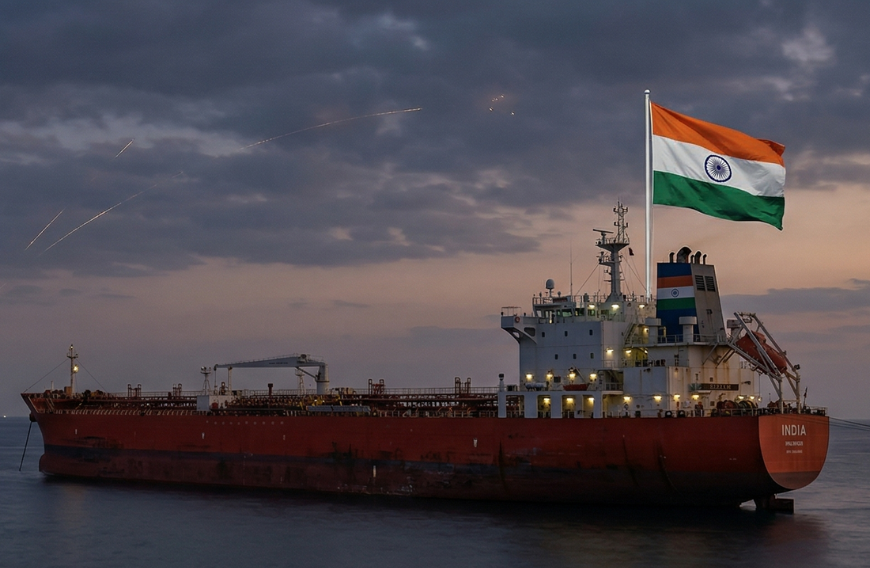
On Feb. 28, just a day before Israel and the United States launched strikes on Iran, the Indian-flagged LPG tanker Pine Gas departed the UAE’s Ruwais port with the expectation of reaching home within a week. Instead, the journey stretched to nearly three weeks, as the vessel waited to safely pass through the Strait of Hormuz after Iran began allowing only selected ships to transit the critical waterway.
Lal said Indian authorities had first asked the crew to be ready to sail around March 11. As the conflict intensified, clearance did not come until March 23, and even then the tanker was not allowed to use the usual shipping lanes through the Strait of Hormuz. Instead, Iran’s Islamic Revolutionary Guard Corps directed the vessel to pass through a narrow channel north of Larak Island along Iran’s coast. Lal added that officials in India and the ship’s owner, Seven Islands Shipping, agreed to proceed only after every crew member gave their consent.
READ: How a distant war is raising India’s cooking gas bills (March 7, 2026)
“They needed a clear yes or no from every crew member,” Lal said, adding that all those on board agreed to proceed. He noted that the route near Larak, rarely used by commercial shipping, was suggested by Iran’s Islamic Revolutionary Guard Corps after the main passage through the Strait of Hormuz was believed to be mined.
Lal said the Indian Navy guided the tanker through the transit, with four Indian warships escorting it for nearly 20 hours from the Gulf of Oman into the Arabian Sea. He added that no transit fee was charged and that Iran’s Islamic Revolutionary Guard Corps never boarded the vessel.
The Indian Navy confirmed it has been escorting Indian-flagged ships after they cross the strait. India’s Ministry of External Affairs said earlier this month that naval deployments in the Gulf of Oman and the Arabian Sea have been in place for years to help secure key sea lanes for Indian and international shipping.
READ: Oil prices climb amid Iran war, Hormuz disruption sparks fears of worst crisis since 1970s (March 23, 2026)
India depends heavily on seaborne imports of liquefied petroleum gas, with hundreds of millions of households relying on it for cooking fuel.
The Pine Gas, carrying 45,000 metric tons of LPG, had initially been scheduled to discharge at the west coast port of Mangalore. Authorities later redirected the cargo, asking the vessel to split deliveries between the eastern ports of Visakhapatnam Port and Haldia Port. Iran has said it is allowing passage through the Strait of Hormuz for what it calls “friendly nations,” including China, Russia, India, Iraq and Pakistan.
So far, six Indian ships have exited the strait, while 18 Indian-flagged vessels carrying about 485 Indian seafarers remain in the Persian Gulf.