


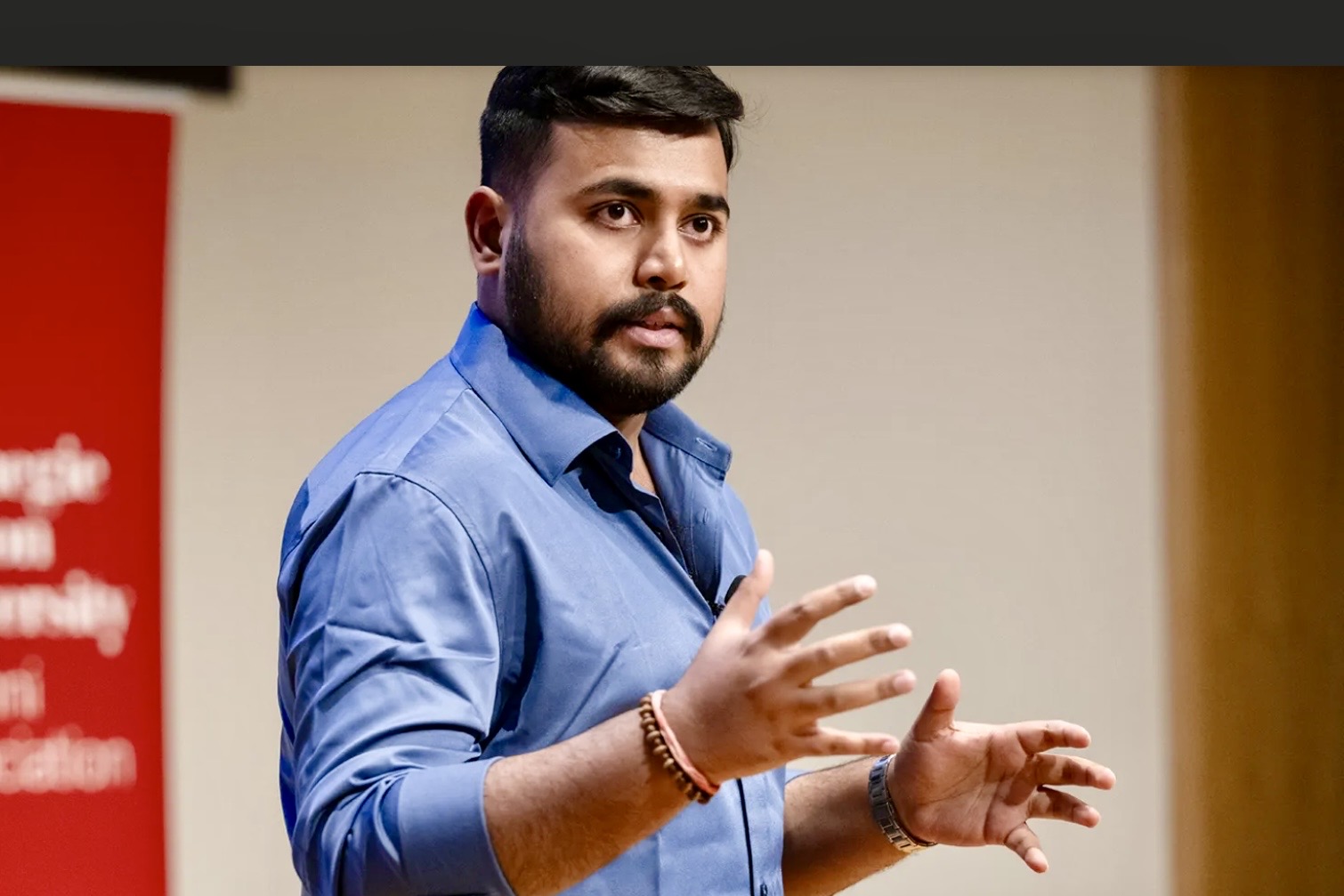
Indian American researcher Anish Pyne has won the People’s Choice Award in the Carnegie Mellon University Libraries’ Three Minute Thesis (3MT) Championship for explaining his microbiology research of bacteria and drinking water systems.
The Indian Institute of Technology Kharagpur alumnus was among ten doctoral students from across campus racing against the clock at the championship finals on March 25 to make their cutting edge work clear and compelling for a general audience — all in just three minutes.
“The Three Minute Thesis competition is all about presenting your research to a general audience, so I’m glad I was able to communicate with the audience in the auditorium and that they voted for me,” said Pyne, a PhD candidate in Biological Sciences.
Read: Indian American students lead in UT Dallas startup awards
Last year, Pyne watched three of his friends and fellow Mellon doctoral students compete in the 2025 championship, and that’s when he knew he wanted to participate. When the preliminary registration was announced he got to work crafting a talk about his microbiology research of bacteria and drinking water systems.
“One of my primary goals, both in pursuing a PhD and also as a long-term career goal, is to make science more accessible,” he explained. “It really inspired me that this platform challenged me to cater my talk to be understood by anyone and everyone. You don’t need to be an expert in my subject to benefit from the knowledge of what I’m doing.”
Pyne’s honors and awards include IIT Kharagpur’ Institute Proficiency Prize for the ‘Best Master’s Project Work’ in 2022 and its Silver Medal for being adjudged the best student in MSc Molecular Medical Microbiology in 2021-2022.
He was awarded the Tata Trust Scholarship for Excellent Academic Performance in all of four semesters in MSc Molecular Medical Microbiology in 2022 and received the SPARK Fellowship at IIT Roorkee in 2021.
The 3MT Championship, which is in its 11th year at Carnegie Mellon, started at the University of Queensland in 2008 and has been adopted by over 900 universities across more than 85 countries.