


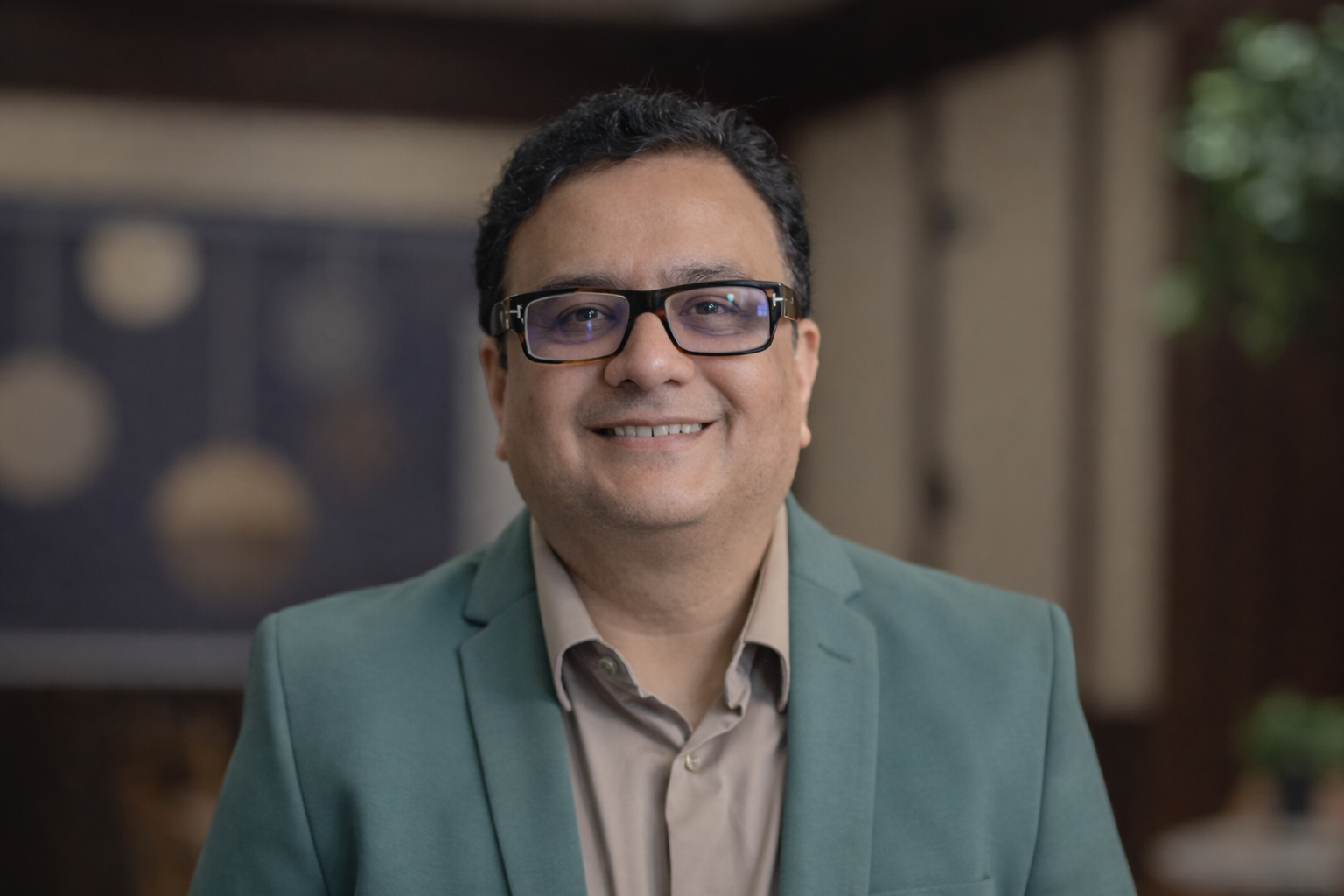
Sandesh Sharda’s story, featured in the second episode of the American Bazaar’s Journey to the C-Suite, traces a familiar arc — small-town beginnings, global ambition — but with a distinctive edge: an unwavering belief that entrepreneurship is not taught, but lived.
Sandesh Sharda typifies “Middle India” — if such a construct exists. Enormously successful, yet quietly grounded, the tech entrepreneur has built a career defined not by flash, but by discipline, instinct, and execution.
Featured in the second episode of the American Bazaar podcast series “Journey to the C-Suite with Krystle Kaul,” Sharda’s story traces a familiar arc — small-town beginnings, global ambition — but with a distinctive edge: an unwavering belief that entrepreneurship is not taught, but lived.
The son of a banker with a PhD in economics, Sharda grew up moving across cities as his father’s career with the State Bank of India took the family from Bhopal to Mumbai and eventually to London. He would go on to earn an MBA in London and later build one of the most successful federal IT contracting firms in the Washington, D.C., area.
Over nearly two decades, Miracle Systems secured more than $2.6 billion in U.S. government contracts, serving agencies ranging from the Department of Homeland Security to the Pentagon.
Listen to the podcast on Spotify
But the foundation of that success, Sharda — who is a judge on the Zee TV show “Ideabaaz,” which premiered last year — says, was laid much earlier.
“I had a very good childhood,” Sharda recalls, reflecting on his early years in Bhopal, in the central Indian state of Madhya Pradesh.
It was a life filled with cricket, friendships, and the rhythms of middle-class India. But beneath that normalcy was something more—a restless curiosity.
“There was always a burning desire in me to do something of my own,” he says.
READ: From DC to Zee TV: Sandesh Sharda mentors India’s next generation of entrepreneurs on Ideabaaz (October 24, 2025)
That instinct manifested early, often in unexpected ways. Long before in-flight Wi-Fi became commonplace, Sharda remembers wondering why internet access wasn’t available on airplanes — a small example of a mindset constantly scanning for gaps and possibilities.
“I would always think—there is a problem here, can there be a solution?” he says.
That ability to identify opportunity—often before others see it—would become a defining trait.
The making of an entrepreneur
For Sharda, entrepreneurship is not a skill one acquires—it is a disposition.
“Either you have it or you don’t,” he says bluntly. “You cannot make someone an entrepreneur if they are comfortable in a 9-to-5 job.”
It is a philosophy rooted in risk, resilience, and a willingness to push beyond comfort.
While his parents never forced him into a particular path, they instilled in him the value of education. That grounding allowed him to navigate both structure and uncertainty—earning a degree from Sydenham College in Mumbai before pursuing his MBA in London.
But even as he moved through formal education, the pull toward building something of his own remained constant.
Sharda’s journey to the United States began with an opportunity at Oracle.
The role took him across cities—Denver, Anchorage, Austin—before landing him in Washington, D.C., working on an ERP implementation for the U.S. Department of Transportation.
That move would prove decisive. “I never left,” he says.
After completing the project, Sharda took the leap that would define his career: he started his own company.
From a one-person operation, Miracle Systems grew steadily, eventually becoming a major federal IT contractor.
The growth was not accidental. It was built on a combination of instinct, execution, and a clear understanding of what it takes to win.
At the heart of Sharda’s success was a simple but powerful principle: get the right people in the right roles. “Once you hire the right people, your job becomes easy,” he says.
But delegation, in his view, does not mean detachment. “You have to be hands-on. You need to know what you’re doing,” he explains. “Otherwise, people can give you any answer.”
This balance—trusting teams while maintaining deep operational understanding—allowed Sharda to scale effectively.
It also shaped his leadership style: rigorous, detail-oriented, and relentlessly focused on outcomes.
Following his successful exit from Miracle Systems in 2023, Sharda expanded into investing across a wide range of sectors—AI, healthcare, media, golf, and hospitality.
At first glance, the diversity might seem eclectic. But for Sharda, the decision-making framework is consistent.
“Financials are the most important aspect of any business,” he says. “If you want to build a sustainable business, you have to make money.”
His approach is grounded in identifying gaps and improving them.
He points to his investment in a golf course as a case study. When he acquired it, the business generated about $3 million in revenue. The facilities were underperforming, the infrastructure outdated.
By investing in upgrades—improving the course, renovating clubhouses, enhancing customer experience—he transformed it into a destination property.
This year, it is expected to approach $10 million in revenue. “The opportunity was there,” he says. “You just had to execute.”
The long-term mindset
If there is one principle that defines Sharda’s investment philosophy, it is patience.
“I invest for the long term,” he says.
Short-term returns, he argues, are not worth the effort. True value is created over time—through sustained improvement, operational discipline, and strong teams. “You’ve got to be there six to eight years,” he says. “That’s where the real returns come.”
Equally important is the human element. “No matter how much money you put in, if the people are not committed, the business will not succeed,” he says.
A personal turning point: loss and purpose
For all his focus on business, one moment profoundly reshaped Sharda’s priorities. In 2019, he received a call from India: his mother had been in a road accident.
By the time he arrived, she had passed away. “When I saw her, I realized—no matter how much money I have, I couldn’t save her,” he says.
That realization, combined with the vulnerabilities exposed during the COVID-19 pandemic, led him to a new mission: improving the lives of senior citizens.
Sharda’s response was ambitious. He acquired a 16-acre property in Indore and developed Golden Yug, a senior living community designed to provide high-quality care and dignity. [Yug means “era” in Hindi.]
The facility offers comprehensive services—medical care, food, recreation, and even technology support—for about $1,300 a month.
The goal, he says, is not just comfort, but respect. “Our seniors are libraries of wisdom,” he says. “They deserve better.”
Unlike traditional models in India, which often emphasize ownership, Golden Yug operates on a rental model—allowing residents to move in without the complexities of property transactions.
“Come with your clothes, live your life, enjoy,” he says.
For Sharda, the shift toward social impact is not a departure from business—it is an extension of it. “Not everything is money,” he says.
Projects like Golden Yu may not generate immediate returns, but they create long-term value—both financially and socially. “You have to balance,” he says. “Some things are for profit. Some things are for legacy.”
Building community: the rise of IAMBIG
Beyond individual ventures, Sharda has also focused on building collective platforms.
As co-founder of the Indian American Business Impact Group (IABIG), he has brought together over 150 CEOs and founders in the Washington, D.C., region.
Together, the group represents billions in net worth and thousands of jobs.
The idea is simple: create a unified platform for collaboration, mentorship, and influence. “There are many regional associations,” he says. “But there was nothing that brought everyone together.”
Through regular events, discussions, and youth mentorship programs, the group has become a hub for learning and networking.
Sharda sees the Indian American business community as a critical bridge between the United States and India. “We are not here to take jobs,” he says. “We are here to create jobs.”
He points to the broader impact of Indian-origin leaders—from CEOs of global tech companies to entrepreneurs building new industries—as evidence of that contribution.
At the same time, he calls for stronger collaboration between the two countries, including reduced trade barriers and more open dialogue. “The partnership is natural,” he says. “It will only get stronger.”
Advice for the next generation
For young entrepreneurs, Sharda’s advice is both practical and uncompromising. “Charity begins at home,” he says.
In other words: focus on building your business first.
“Be laser-focused,” he adds. “Grow your business. Become the best in your field.”
Only after achieving scale, he argues, can entrepreneurs meaningfully give back. “Money talks,” he says. “Use it to create impact.”
At the core of Sharda’s philosophy is a belief in focus.
During the early years of Miracle Systems, he concentrated entirely on winning government contracts—attending conferences, building partnerships, refining proposals. “I rolled up my sleeves,” he says.
The lesson is clear: success requires concentration. “Until you are different, you are the same as everyone else,” he says.
A life beyond business
Despite his demanding schedule—splitting time between multiple ventures and geographies—Sharda remains grounded in simple pleasures.
He follows cricket passionately, spends time with family, and hosts barbecues for friends.
His days begin early, often reviewing emails across time zones, and can stretch late into the night. “I like to stay busy,” he says.
If there is one idea that defines Sharda’s journey, it is this: success is driven by individual will. “Business is built on the strength of an individual,” he says.
From Bill Gates to Jeff Bezos, he notes, every great company reflects the determination of its founder. “Your willingness to succeed—that defines everything,” he says.