


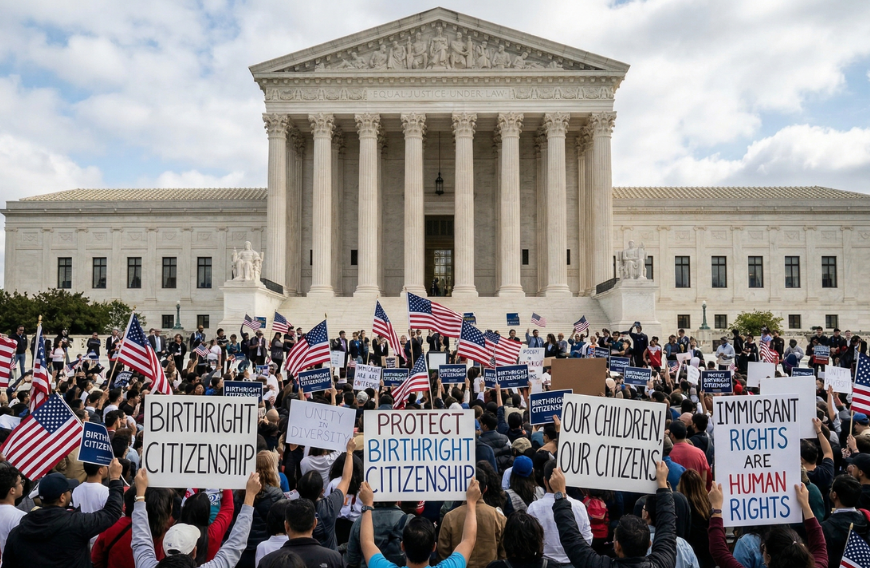
The South Asian American Justice Collaborative (SAAJCO) joined hundreds of community members and advocates outside the Supreme Court as justices heard arguments as part of a case on birthright citizenship. SAAJCO representatives called the moment “fundamental,” and that the case could have far-reaching consequences for immigrant communities.
“The energy today was powerful… this is about recognizing that when one community is impacted, we all are,” said Chirag Shah. program manager at SAAJCO.
The case revolves around an executive order by President Donald Trump, issued on the first day of Trump’s second term, which seeks to strip citizenship from U.S.-born children of parents “in the United States illegally or temporarily.” Lower courts have unanimously blocked the policy, invoking the century-old precedent Wong Kim Ark, which held that virtually all U.S.-born children are citizens.
READ: Trump attends Supreme Court arguments on birthright citizenship (April 1, 2026)
The 14th Amendment guarantees that “All persons born or naturalized in the United States, and subject to the jurisdiction thereof, are citizens.” Historically, this was intended to secure citizenship for former slaves, but the text has been read broadly. Trump’s order challenges that interpretation. His administration argues that the clause excludes children of noncitizens and that unfettered jus soli is an outlier globally.
In the hearing, Justice Department lawyers called unrestricted birthright citizenship a “powerful pull factor for illegal immigration” and said it “demeans the priceless and profound gift of American citizenship.”
SAAJCO, which also submitted an amicus brief in the case, highlighted historical parallels and warned against narrowing constitutional guarantees.
READ: Trump’s birthright citizenship order on hold, but rollout plan moves forward (
“Two things stood out. Justice Sotomayor rightly raised the denaturalization of South Asians after Thind ruling and whether changes to birthright citizenship could be applied retroactively. Reading new conditions into the 14th Amendment is already deeply concerning. While the government offered assurances about limiting its scope, those limits may not hold over time. This administration has not thought through how far-reaching the implications are,” said Kalpana V. Peddibhotla, Executive Director of SAAJCO.
“Second, the government relied on the idea of ‘temporary visitors’ to argue that birthright citizenship should turn on domicile. That directly implicates families who have lived here for years or decades on H-1B visas, in asylum, and in other statuses due to green card backlogs.”
Legal experts and advocacy groups have argued that the case goes beyond legal technicalities, and pointed to the administrative and humanitarian fallout of the order being implemented. “For South Asians… that means many babies would be denied citizenship at birth,” said SAAJCO legal director Anisa Rahim. She added that several South Asian countries do not automatically grant citizenship to children born abroad, potentially creating a situation of statelessness.