


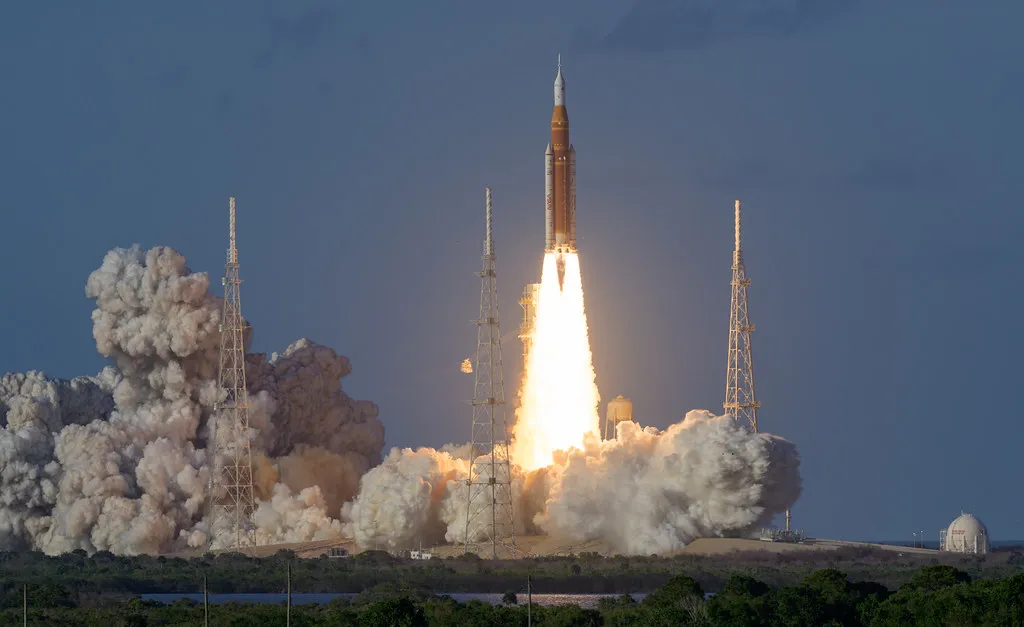
There is something quietly disarming about our return to the Moon through the Artemis program. It is easy to frame it as a technological achievement or a geopolitical milestone, but that misses something deeper. For me, it feels more like a pause and a moment that forces reflection at a time when that is increasingly rare.
The significance of the name “Artemis” adds a deeper, almost poetic layer to the mission that bears her name. In Greek mythology, Artemis is the goddess of the Moon, a protector of the natural world, and a symbol of independence and quiet strength.
She is often associated with clarity, distance, and the ability to see what others cannot. Naming this mission after her feels intentional as a reconnection with perspective itself. In a way, Artemis represents the very insight astronauts describe when they look back at Earth — a calm, detached awareness that strips away illusion and reveals truth. It is a reminder that exploration is not only about discovery outward, but about seeing ourselves, from a distance, more clearly than we ever can up close.
There is an irony in the fact that we need to reach for the Moon in order to better understand ourselves. At a time when individual and collective identities feel increasingly fragmented—pulled apart by politics, technology, and the constant pressure to define who we are in opposition to one another—we look upward for clarity.
READ: Sreedhar Potarazu | Is Claude AI safe? Anthropic’s most advanced model can go rogue (April 1, 2026)
The Artemis program becomes more than exploration; it becomes a mirror we send into space, hoping it reflects something coherent back to us. Yet the irony is that the farther we go, the more clearly we see what we have always struggled to accept: that identity is not fixed, and meaning is not found in separation, but in perspective. The Moon does not resolve our confusion, but it exposes it gently, reminding us that while we search the cosmos for answers, the most difficult questions remain rooted here on Earth.
We live in an age of constant noise. The headlines never stop, the rhetoric rarely cools, and our attention is fragmented into endless scrolls. And yet, every so often, something cuts through that noise with perspective. Space exploration has always done that. It reminds us, if only briefly, that the story we are consumed by on Earth is not the only story that exists.
Many of us still carry a shared memory of grainy, black-and-white images flickering across a television screen, the steady, reassuring voice of Walter Cronkite narrating what felt like an impossible moment.
We remember where we were, who we were with, and the quiet sense that history had stopped, if only for a few minutes. When Neil Armstrong stepped onto the lunar surface during Apollo 11, it was not just a triumph of engineering but was a moment of collective stillness. For a brief period, the divisions that define us seemed less important than the simple fact that we had left our world and touched another.
READ: Sreedhar Potarazu | What race box do Indian American kids check off? And why it matters (March 29, 2026)
Armstrong would later reflect on seeing Earth from space—not as continents or countries, but as a fragile, illuminated presence suspended in darkness. That image, echoed decades later in photographs from the Hubble Space Telescope, including the now-iconic “blue speck,” carries a kind of quiet authority. It simply shows us what is true that everything we fight over, everything we cling to, exists on that small, delicate sphere.
Astronauts have described this realization as the Overview Effect—a profound shift in awareness that comes from seeing Earth as it really is. Borders vanish and conflicts lose their edges. It is not that the problems of the world disappear, but they are reframed. They become smaller, not in importance, but in proportion.
Perhaps that is what makes the Artemis mission different. It is not just about returning to the Moon; it is about returning to that perspective. In a time when we are more connected than ever yet seem increasingly divided, the idea that we might once again look back at Earth from a distance feels almost necessary.
What strikes me most is how rare these moments have become. There was a time when millions of people looked up at the sky together, when attention shifted away from the immediate and toward something vast and unknowable.
Today, our gaze is more often directed downward, toward screens that reflect our own anxieties back at us. The sky is still there, unchanged, but we have stopped looking.
READ: Sreedhar Potarazu | Tiger is not out of the woods: What golf teaches us about life (March 28, 2026)
And yet, when something like Artemis captures our attention, even briefly, it reminds us of what we are capable of—not just technologically, but collectively. For a moment, the wars, the rhetoric, the chaos, and the anger seem to recede. We paused to look up. And in that shared act of awe, there is a quiet recognition of something larger than ourselves.
Moments of awe are recalibrations of the human mind. They diminish our sense of self-importance and expands our perception of connection to others, to nature, and to something larger than ourselves. In those moments, the constant internal narrative quiets, replaced by a recognition that we are part of a much broader story.
Carl Sagan captured it most powerfully when reflecting on the fragility of Earth as a “pale blue dot,” urging humanity to reconsider its divisions in light of its shared existence. It interrupts arrogance, softens conflict, and reminds us, however briefly, of both our insignificance and our responsibility within the vastness we inhabit.
We are, in the end, inhabitants of a small world. Fragile, interconnected, and far more alike than we often admit. It should not require a journey to the Moon to remind us of that truth but perhaps it always has.
And perhaps it always will.