


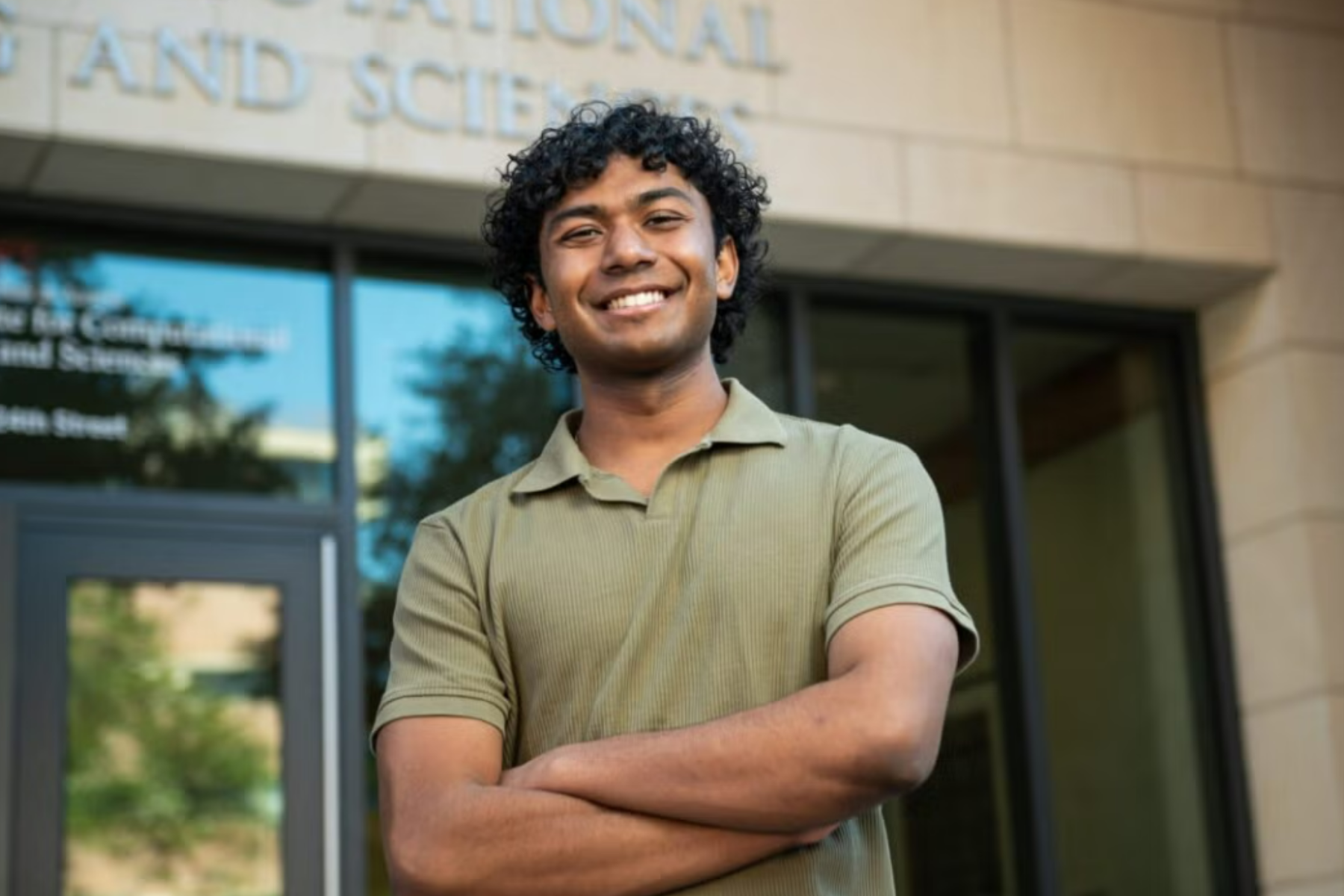
Krithik Vishwanath, a senior at the University of Texas at Dallas, has won the prestigious Churchill Scholarship, marking a historic achievement for both the student and his institution, for medical AI research.
A triple major in computational engineering, chemistry, and mathematics, Vishwanath is the first student from his program in 36 years to receive the elite honor. The scholarship, which selects only 16 to 18 students nationwide annually, provides full funding for a year of master’s study at Churchill College in the University of Cambridge.
For Vishwanath, an Indian American scholar, the achievement is a testament to a journey rooted in a family culture that prizes education and interdisciplinary curiosity. His work at the intersection of mathematics and medicine reflects a growing wave of second-generation Indian Americans leading innovation in high-tech healthcare.
At Cambridge, Vishwanath intends to leverage advanced electronic health record systems to refine predictive models. His research is specifically geared toward improving hospital efficiency by estimating patient stay lengths and discharge readiness.
Read: Indian American researcher Tejal Desai elected AAAS fellow (April 6, 2026)
“I wanted to see if I could use what I enjoy in a more impactful way,” Vishwanath said, reflecting on his transition from high school mathematics to clinical applications. “My first instinct was how we can broaden the impact.”
His academic trajectory has been defined by high-level collaborations. At the UT Center for Computational Oncology, he worked under director Thomas Yankeelov to develop mathematical models for breast and pancreatic cancer.
He also spent time at NYU Grossman School of Medicine, where he helped develop “MedMobile,” a compact AI model designed to run locally on smartphones to assist in clinical decision-making while protecting patient privacy.
Yankeelov, who has mentored Vishwanath throughout his undergraduate years, noted that the senior’s technical skills are “extraordinary.” The scholarship recognizes not only this technical proficiency but also what the Churchill Foundation calls a “distinguishing spirit” a combination of academic excellence and leadership potential.
The win is a rare feat for UT Dallas, highlighting the university’s growing footprint in competitive STEM research. For Vishwanath, the year in the United Kingdom is a stepping stone toward a career as a physician-scientist.
He plans to return to the United States to pursue an MD-PhD, focusing on making healthcare more accessible and personalized through the very AI tools he is currently pioneering.
As he prepares to graduate this spring with three degrees, Vishwanath remains a prominent figure in the North Texas academic community, embodying the success of the Indian diaspora in American science and technology.