


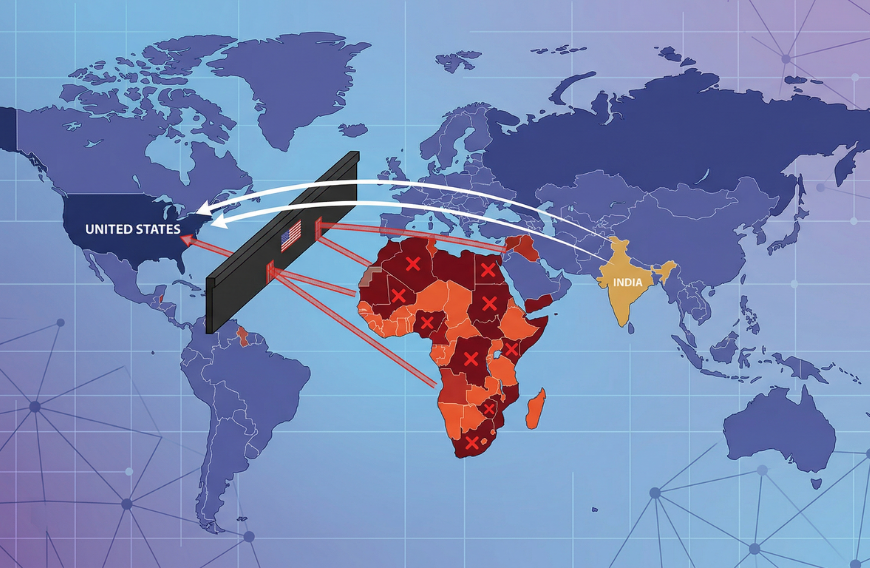
While backlogs and lottery odds have long frustrated Indian applicants, nationals from several African countries face near-impossible pathways
With green card waits stretching decades and H-1B odds at entry level below 15%, Indians have often faced steep immigration hurdles in the U.S. Yet for some nationalities, the chances are even slimmer—bordering on impossible.
Recently, Orlando-based multi-practice law firm Bogin, Munns & Munns conducted a study on U.S. immigration patterns across several countries, following the tightening of travel restrictions affecting 75 nations. The findings are stark: applicants from parts of Africa face significantly steeper barriers, and for some, the odds of obtaining a U.S. visa verge on the Sisyphean.
The April 2026 report on U.S. immigration barriers found that nationals of Senegal face the toughest path to entering the United States. With roughly three out of four visa applications rejected and limited pathways to permanent residency, Senegal ranks among the most restrictive.
READ: ‘Side hustles’ on H-1B? Hidden risks and where immigration law draws the line (April 9, 2026)
For applicants from Nigeria, the challenge is similarly daunting. Each month, more than 100,000 Nigerians search for ways to immigrate to the U.S., yet only about 1,000 immigrant visas are approved.
Spencer R. Munns, owner and managing leader of Bogin, Munns & Munns, said, “Travel restrictions keep getting tighter in our country. The U.S. just introduced a $15,000 bond requirement for tourist visas in March 2026. This means our consular officers in some countries can now demand this bond from any applicant they consider a flight risk. If you don’t return home after your visit, you lose $15K. For many applicants, it’s a barrier to entry entirely, because that amount can equal years of income in many places.”
Notably, all of the top 10 hardest countries to immigrate from are in Africa, where travel bans and green card freezes continue to block millions from reaching the United States.
The research examined legal restrictions across more than 100 countries to determine where immigration to the U.S. is most difficult. It tracked travel ban status to assess entry restrictions, and green card eligibility to determine whether permanent residency is possible. The report also analyzed B-visa refusal rates, measuring how often tourist and business visa applications are denied.
READ: ‘Golconda Express’: Dallas food truck video sparks debate over H-1B visa rules (April 1, 2026)
Each country was then assigned an Immigration Difficulty Index score ranging from 0 to 100, with higher scores indicating tougher entry barriers and lower approval rates.
In the case of Senegal, green card eligibility remains blocked, while B-visa refusal rates stand at a steep 74%. With just 170 immigrant visas approved each month, Senegal scored 97.9 on the Immigration Difficulty Index. Its passport power ranking was placed at 68. The study identifies Senegal as the most difficult country from which to immigrate to the United States at present. The country faces both a partial travel ban and a near-total freeze on green card processing, effectively shutting down most pathways to permanent residency. Even short-term entry is challenging, leaving many Senegalese unable to visit the U.S. as tourists.
Burundi ranks second, facing similar restrictions that make entry into the United States nearly impossible. The Central African nation is also subject to a partial travel ban, with 69% of visa applications denied. To put this into perspective, the U.S. issues just 10 immigrant visas each month to Burundian citizens, despite a population of nearly 15 million. Green card approvals are frozen as well, leaving virtually no pathway to permanent residency.
Nigeria ranks third, despite being Africa’s largest economy. Out of a population of 242 million, more than 100,000 people search each month for ways to immigrate to the U.S., yet they face a partial ban that restricts most entry. The U.S. approves around 1,000 immigrant visas for Nigerians monthly—equivalent to just five visas per 100,000 residents. The B-visa rejection rate is also high, at 57%, while pathways to permanent residency remain effectively frozen under public charge rules.
READ: Did getting marriage-based Green Card just got tougher? What you need to know (April 8, 2026)
The Gambia takes fourth place, with some of the highest rejection rates in the world. U.S. officials deny three out of every four Gambian visa applications—the highest refusal rate among all countries studied. Like other West African nations, The Gambia faces both a partial travel ban and frozen green card processing. The country receives about 166 immigrant visas each month—a higher number than Nigeria—but still a tiny fraction of overall demand.
Angola rounds out the top five, with just 29 people receiving immigrant visas monthly out of a population of 40 million. That translates to fewer than one approval per 100,000 residents annually—among the lowest rates globally. While Angola’s 54% tourist visa rejection rate is lower than that of Senegal or The Gambia, the barriers remain significant. The country recorded only 570 green card approvals last year, and those pathways are now frozen under partial ban rules.
The remaining countries in the top 10 are Benin, Tanzania, Malawi, Zambia and Gabon.