


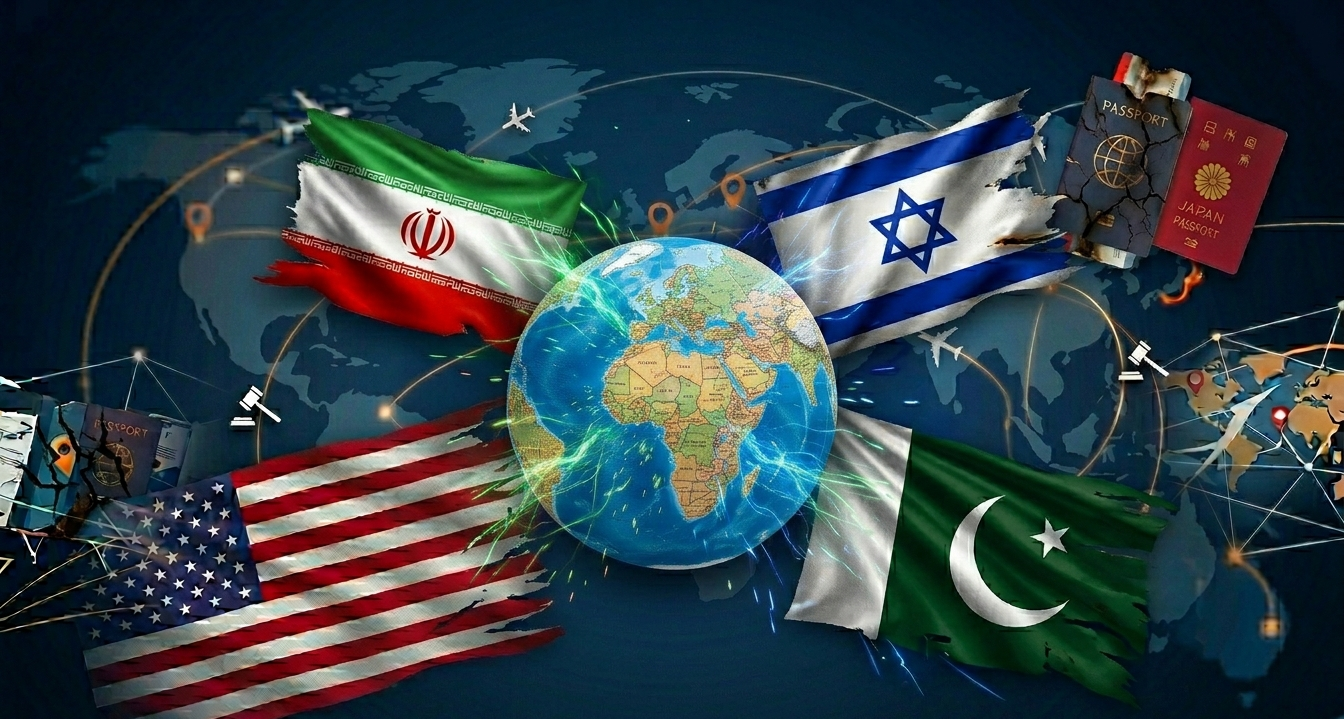
In the spring of 2026, the world witnessed a diplomatic inversion that would have seemed improbable just months earlier.
In Islamabad, officials from Washington and Tehran sat across from one another, testing whether a fragile ceasefire could harden into something more durable. The setting mattered as much as the stakes. The intermediary was not a great power, nor a Gulf monarchy with a long record of mediation. It was Pakistan.
For decades, Pakistan has been described in the language of fragility: an economy under strain, politics unsettled, a military that shadows civilian authority. Yet in April, it performed a function that larger, richer states often struggle to execute—it became a bridge between adversaries who could not afford to speak directly.
Even as U.S. Vice President J.D. Vance arrived in Pakistan for follow-on negotiations, underscoring Washington’s willingness to work through Islamabad, the symbolism was unmistakable: a state long treated as peripheral had moved, however briefly, to the center.
This was not an accident.
Geography helped—Pakistan shares a long, sensitive border with Iran—but geography alone does not produce diplomacy. What mattered was alignment: lines open to Tehran, credibility in Riyadh, a reactivated channel to Washington, and quiet backing from Beijing. Pakistan’s civilian and military leadership spoke with unusual coherence. Messages were carried, proposals tested, and, crucially, expectations managed. In an era when many states confuse visibility with influence, Pakistan chose discretion.
READ: Satish Jha | The Thali was full. The nation was not hungry enough (April 3, 2026)
Necessity sharpened the effort.
A widening Iran conflict would not have remained distant: it threatened to inflame insurgencies along Pakistan’s western frontier, spike energy prices in an import-dependent economy, and imperil millions of Pakistani workers in the Gulf. Islamabad did not act out of altruism. It acted because the cost of inaction was immediate and severe. In diplomacy, clarity of interest often produces clarity of execution.
India’s absence from this moment is what gives it meaning.
For more than a decade, New Delhi has cultivated the image of a rising power whose global relationships would translate into strategic leverage. The performance has been compelling, especially at home: summits, optics, the language of civilizational confidence. But influence is not a function of visibility. It is a function of utility—of whether others turn to you when outcomes are uncertain and costs are high.
In April, they did not.
Part of the explanation lies in timing and alignment. India’s increasingly explicit tilt toward Israel—culminating in a high-profile visit to Tel Aviv just days before the latest escalation—placed it out of step with much of the Global South, where anger over Gaza and Lebanon has been acute. In that context, India’s relative silence at the outset of the crisis read not as prudence but as positioning. Diplomacy requires not only relationships but also credibility across divides. That credibility, once narrowed, is difficult to re-expand in real time.
Part lies in style.
Indian diplomacy in recent years has often been rhetorically assertive—eager to instruct Western audiences on hypocrisy, to signal autonomy, to perform independence. Some of this has been effective. But in a crisis that required quiet coordination across adversaries, performance was a liability. Bridges are rarely built in public.
And part lies in the limits of multi-alignment in a transactional age. India’s effort to maintain simultaneous proximity to Washington, Moscow, and others has delivered flexibility. It has also, at moments of stress, produced ambiguity. When policy becomes a series of calibrated gestures rather than a hierarchy of priorities, partners are left to infer where you stand. In crises, inference is a poor substitute for clarity.
Pakistan, by contrast, played a weaker hand with greater discipline. It did not claim centrality; it accepted a role. It did not advertise influence; it exercised it. Even the optics that followed—the arrival of senior American officials, the acknowledgment from multiple capitals—were byproducts, not objectives.
None of this transforms Pakistan into a stable power. Its economy remains fragile, its internal fissures real, and the ceasefire it helped midwife is precarious. Mediation can elevate a country’s profile; it does not resolve its fundamentals. But diplomacy is not a reward for strength alone. It is often the art of making one’s constraints legible and useful to others.
This is the lesson India now confronts. Power that is narrated too loudly risks becoming performative; power that is quietly useful accumulates. For years, India has invested in the former. April 2026 suggests the costs of neglecting the latter.
READ: Satish Jha | The Full Plate: What does it mean? (March 30, 2026)
The contrast should not be overstated. India’s structural advantages—economic scale, technological depth, a vast diaspora, enduring ties across the Gulf—remain intact. Pakistan’s gains may prove temporary. But moments matter in international politics. They recalibrate expectations. They signal who can be trusted to act when stakes rise.
For a brief interval, Pakistan became that actor. Not because it was stronger, but because it was available, aligned, and disciplined enough to be used.
The mirror this holds up to India is not flattering. But it is clarifying.
In the end, diplomacy is not a contest of narratives. It is a test of relevance. When the world needed a channel, it turned to the country that could carry a message without amplifying itself. That is a quieter kind of power. It is also the kind that endures.