



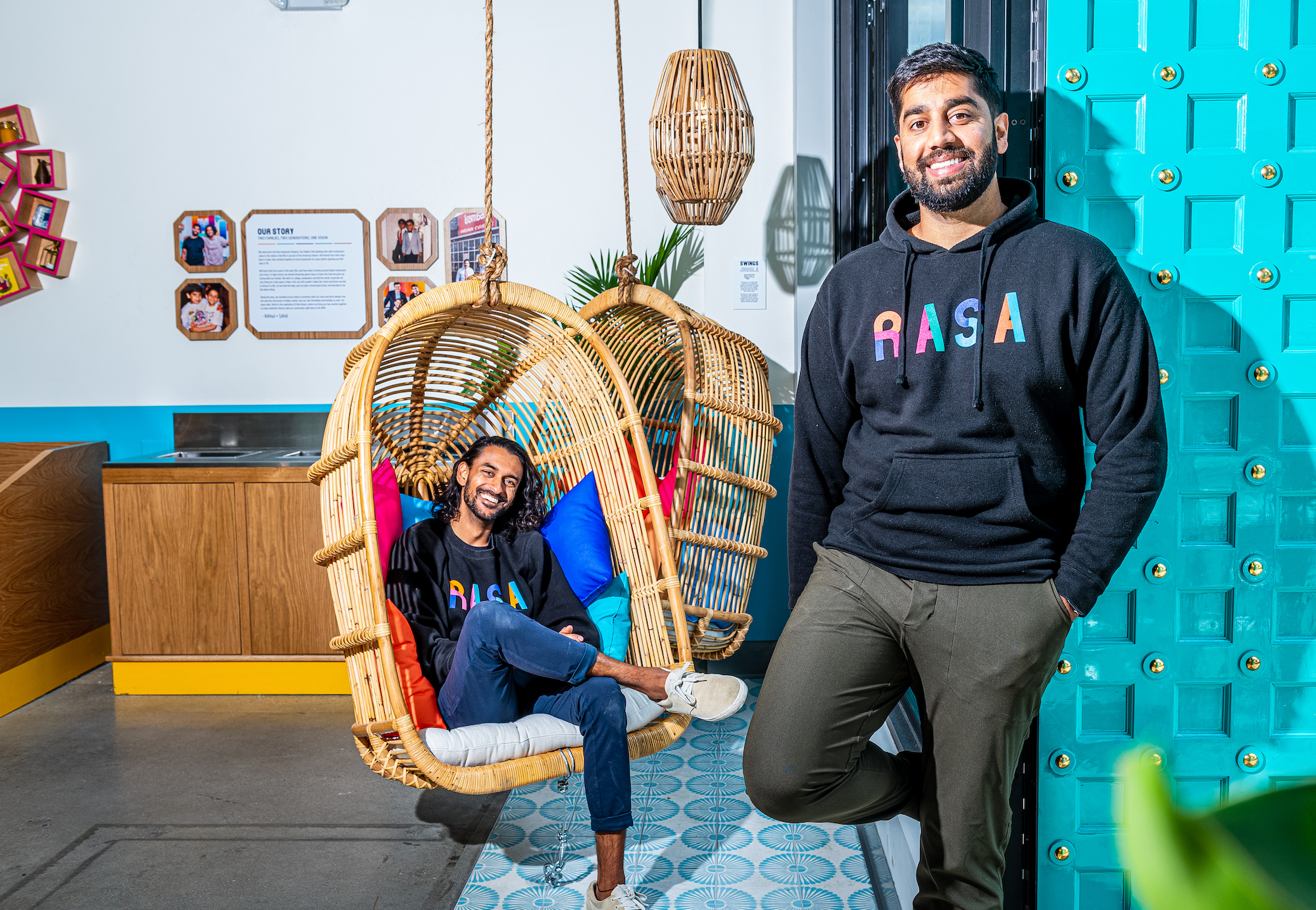
Rasa cofounders Sahil Rahman and Rahul Vinod are on a mission to make Indian cuisine a household favorite across the U.S., combining rich heritage with modern dining.
By Mara K. Bell
The spunky, vibrant fast-casual Indian restaurant, Rasa, emerges in the D.C. metropolitan area, aiming to widen America’s cultural horizons through more accessible Indian cuisine.
Lifelong friends Sahil Rahman and Rahul Vinod grew up immersed in the culture of small business, bonded by their fathers who co-owned a local Indian restaurant in Rockville.
After graduating from college and spending a few years in their corporate jobs, they decided to honor their roots and pursue a business plan from 10 years prior.
The two quit their jobs and began their Indian restaurant with a modern twist, blending their heritage with an assembly-line style restaurant of healthy vibrant bowls accessible in the bustling city.
Founded in 2017, Rasa is not only a combination of the co-founders’ first names—(Ra)hul and (sa)hil, but the realization of an idea inspired by their restaurant journey.
“Rasa”, in Sanskrit and many Indian languages, refers to taste or flavor. In Ayurveda and Indian cooking, there are six primary Rasas (tastes): Sweet, sour, salty, pungent, bitter, and astringent.
With many traditional sit-down Indian restaurants in the U.S. averaging $15 to $20 in meal prices, along with complex, overwhelming menus that included heavy meals, Rahman and Vinod felt that Indian food was largely inaccessible.
READ: Chefs of world leaders savor Indian fast casual food at Rasa Grill in Washington (November 23, 2023)
“It’s hard to get out of there for less than 50 bucks,” Vinod said.
Instead, Rasa’s flavorful meals with locally sourced ingredients are priced between $11 to $15.
“We wanted to combat all those issues to get more people to try [Indian] cuisine, to enjoy our culture,” Vinod said.
CEO and cofounder Rahman said Rasa wants to be “a part of the movement to make Indian cuisine as popular as other cuisines like Mexican, Chinese, and Italian.”
“I think we’re sort of surfing the wave of adoption if you will,” he added.
In 2022, the restaurant chain successfully raised its Series A funding, led by female-founded growth equity firm, Rellevant Partners’ Janice Meyer and Jessica Kates. The investment marked a significant milestone for the restaurant business as it planned for growth in the DMV region as well as evaluated market opportunities along the East Coast.
READ: Two Indian American former bankers open Indian restaurant Rasa Grill in Washington (December 8, 2017)
The same year, former Starbucks Chief Operating Officer Troy Alstead was brought onto the board of Rasa as part of the growth strategy, said Rahman. “We are looking to grow in this region and beyond as we continue our march toward becoming the leading household name for Indian food in America,” he said. “We look forward to bringing our culture and flavors to more places around the US.”
The main vision for Rasa was “to use food as a vehicle to bring people from different backgrounds, different ethnicities, together,” Vinod described.
Since the COVID-19 pandemic, their business has stayed afloat amid the consumer slowdown, opening a total of five locations.
“We’ve been able to kind of weather that storm for sure,” Vinod said. “Now, we have about 70 by 80 employees across the company, so we’ve been able to get more opportunities for people to create their livelihood.”
Decorated to fit the vibrancy and culture of India, all five of Rasa’s locations—DC’s Navy Yard and Mount Vernon Triangle, Maryland’s Rockville, and Virginia’s Arlington and Fairfax—beam with colors of teal, pink, and orange, and warm lighting to welcome customers.
READ: Indian American chef K.N. Vinod is marking International Sous-Vide Day with Kerala Shepherd’s Pie (January 25, 2019)
“We want people to feel invited and warm when they step into our restaurants. Similarly, when people would come to our own homes,” he said.
In addition to the pandemic, Rasa’s founders faced challenges in hiring people that fit their vision. Vinod explained that their early hiring approach proved faulty and quickly pivoted to improve their team.
“We thought, ‘okay, you’ve worked at Chipotle, you must be a good employee,’ and so we hired those people in the beginning,” Vinod said. “That was like an early failure. We didn’t hire correctly, and we [didn’t] have the systems yet [or] tools to help our team succeed.”
Now, he said, Rasa is focusing on a better hiring strategy and equipping their team with the right tools to succeed in their roles.
Luke Allen, 24, is a frequent Rasa customer at the K Street location and shared that he enjoyed the structure of Rasa’s customizable bowls for Indian cuisine.
“[Rasa]’s super cool. I love how you can customize your bowl,” Allen said. “I love Indian food and I only live like two blocks down, so I go here a lot.”
The menu is curated with dishes from both northern and southern India, offering chef-curated bowls with catchy names, like Tikka Chance On Me (chicken tikka, tomato-garlic sauce, sauteed spinach, rice, mint-cilantro chutney), and the option to build your bowl with a variety of ingredients including greens (spinach, arugula, lettuce), grains (basmati rice, lemon turmeric rice), and a choice of a main (lamb kebab, tandoori shrimp, turmeric ginger shrimp).
Since opening, Rasa has received critical acclaim from local and national media outlets including receiving the 2018Eater Young Guns Award, 2022 StarChefs Best Concept Mid-Atlantic, and was named “Best New Restaurant” and “Best Fast Casual” by Washington City Paper. The restaurant has also been featured on the cover of QSR Magazine’s annual 40/40 list, the Washington Post’s “Fall Dining Guide,” and Washingtonian’s “Top 100 Cheap Eats.”
1 Comment
Rasa is revolutionizing Indian cuisine in the U.S. with its vibrant, fast-casual concept, making Indian food more accessible and affordable. By blending traditional flavors with a modern, assembly-line style, Rasa is bridging cultural gaps and creating an inviting atmosphere. It’s exciting to see Indian restaurants like Rasa gaining popularity and introducing Indian food to a wider audience!