


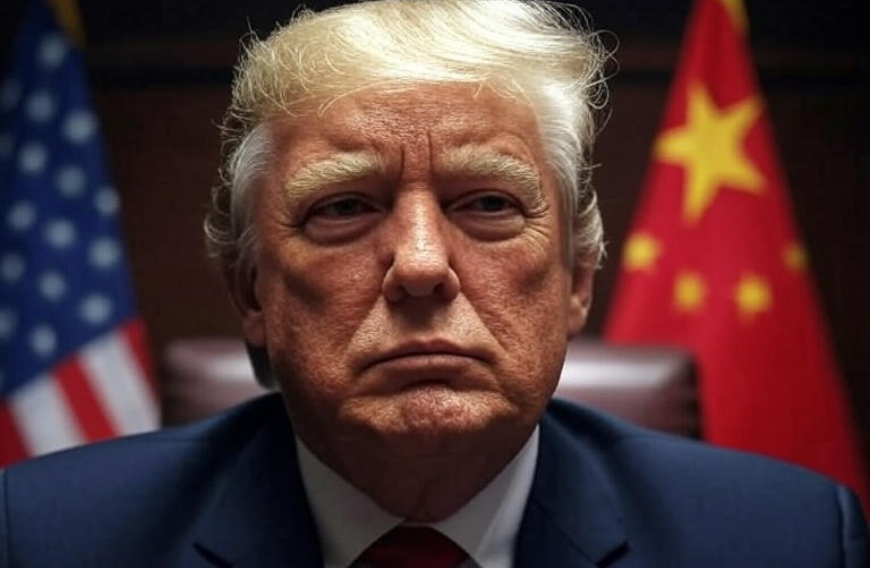
President Donald Trump has signaled a policy shift by welcoming around 600,000 Chinese students to American universities, even while his administration maintains tighter controls on other international students. Emphasizing the “very important relationship” between Washington, D.C., and Beijing, the move marks a departure from his earlier “America First” stance.
The announcement comes at a time when the U.S. and China are in the middle of trade negotiations, working to clear out differences over tariffs and the supply of rare earth minerals vital for U.S. industries. Another key issue on the table is China’s access to American-made AI chips, something the Biden administration has been cautious about.
Earlier this year, the administration slapped a 145% tariff on Chinese imports, leading Beijing to hit back with a 125% duty on American goods. While negotiators in Geneva reached a pause on any new tariffs in May, Trump has kept the pressure on, warning of more penalties ahead. Just last week, he even proposed a 200% tariff on Chinese-made magnets, pointing to what he called Beijing’s “monopoly” in the global market.
Speaking at the White House Monday, President Trump as quoted by Fox News, “I hear so many stories that we’re not going to allow their students” to the reporters. Trump added, “we’re going to allow their students to come in. It’s very important, 600,000 students. It’s very important. But we’re going to get along with China.”
Trump also asserted that, “as you know, we’re, we’re taking a lot of money in from China because of the tariffs and the different things. It’s a very important relationship.”
READ: America first or left behind? US, under Trump, embraces economic isolation (
“It’s a much better relationship economically than it was before with Biden. But he allowed that. They just took him to the cleaners,” he mentioned.
Now the move has triggered backlash from Trump’s own base, with many loyalists viewing it as a departure from the “America First” agenda. Conservative commentator Laura Loomer voiced her anger on X, branding Chinese students as “CCP spies” and accusing the policy of weakening Trump’s hardline stance on immigration. “I didn’t vote for more Muslims and Chinese people to be imported to my country… Please don’t Make America China. MAGA doesn’t want more immigrants,” Loomer wrote.
In a separate post, she tagged White House Deputy Chief of Staff Stephen Miller, insisting, “Nobody, I repeat nobody, wants 600,000 more Chinese ‘students’ aka Communist spies in the United States. China murdered 1.2 million Americans. Now they get to replace us? This cannot happen.”
Congresswoman Marjorie Taylor Greene spoke in similar stance on X, saying, “we should not let in 600,000 CHINESE students to attend American colleges and universities that may be loyal to the CCP.”
Secretary of State Marco Rubio had earlier declared that the U.S. would “aggressively revoke” visas issued to Chinese citizens, especially those linked to the Communist Party or working in sensitive research areas. But by June, Trump struck a different note, telling reporters he has “always been in favor” of allowing Chinese students to study in America.
READ: US tariffs threaten India’s diamond industry; RBI to strike back with new policies (
On the other hand, Commerce Secretary Howard Lutnick backed the President’s decision, telling Fox News that without Chinese students, “the bottom 15 per cent of universities would go out of business in America.” He added that President Trump was simply taking “a rational economic view.”
He further added that “I am involved in changing H-1B program. We are going to change that program because that’s terrible. We are going to change the Green Card. The average American makes 75,000 dollars a year and the average green card recipient, 66,000 dollars.”
“Why we are doing that? That’s why Donald Trump is going to change it. That’s the goal card that’s coming. And that’s gonna start picking up the best people to come into this country. Time for that to change,” Lutnick said.
This signals at the earlier pushed change. This is shift away from the lottery system toward a merit-based framework. This aligns with what Trump and his advisers have floated in the past: prioritizing applicants with higher salaries, advanced degrees, or specialized skills, rather than random selection.
It shows how Trump is trying to strike a balance. On one hand, he is welcoming Chinese students while on the other, he is looking forward to stricter visa and green card rules. While this could benefit U.S. universities and industries that rely on global talent, it also risks upsetting his own base, where some “America First” supporters see any concession to China as a betrayal.