



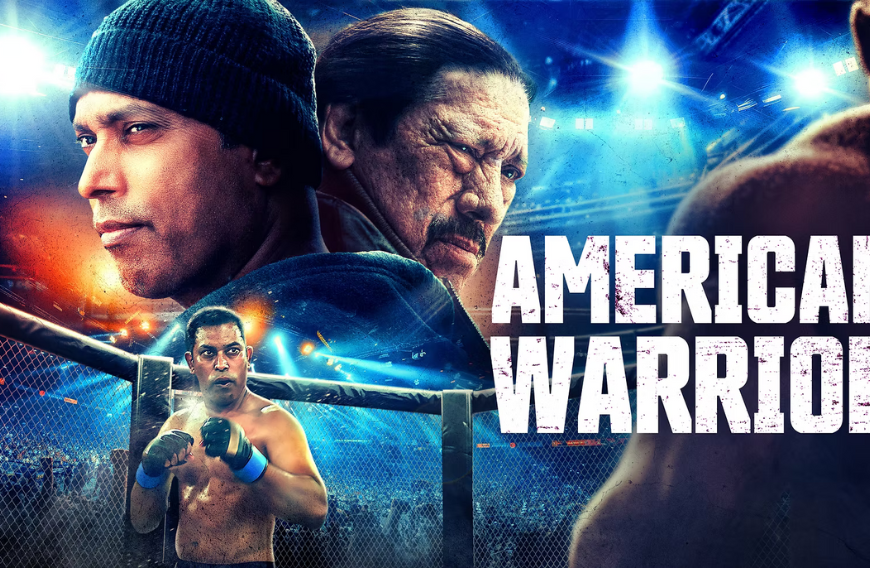
Few actors walking a red carpet can also explain the mechanics of a real estate crash. But Vishy Ayyar, the Indian American star of the newly released thriller “American Warrior,” has lived both sides of that reality. Once a self-made millionaire who built a $55 million property venture, Ayyar saw his empire collapse during the financial crisis—forcing him to rebuild from scratch. Now, as his debut feature hits theaters, he brings lessons from Wall Street boardrooms to indie film sets, weaving together a story of loss, reinvention, and stardom.
“American Warrior,” an award-winning film that opened in theaters last week after premiering at the 55th International Film Festival of India (IFFI) in November 2024, also stars Danny Trejo, Veronica Falcón, Taylor Treadwell, and Omi Vaidya. Lauded at festivals including the Heartland International Film Festival, the Buenos Aires International Film Festival, and the San Antonio Film Festival, the film tells the story of an Indian American ex-con who steps into an MMA cage to fight for redemption.
What makes Ayyar’s story riveting is that, two decades ago, he seemed to embody the immigrant dream. After moving from India, he co-founded a luxury real estate venture in Los Angeles that grew to a $55 million valuation. By his early thirties, he had established himself as a self-made mogul in one of the most cutthroat markets in the world. Then came the 2008 financial crisis, triggering a freefall that wiped out his fortune and nearly broke him.
Instead of disappearing, Ayyar chose reinvention—first as a speaker and author exploring resilience and spirituality, and now as an actor. His unusual trajectory shows that lessons learned in high-stakes business—about risk, branding, and recovery—can be just as vital in Hollywood as they are in finance.
Ayyar speaks to The American Bazaar in an exclusive interview, candidly sharing his journey.
READ: Reviving a dying art: How P-TAL is putting India’s coppersmiths back on the global map (
The American Bazaar: You co-wrote your debut feature “American Warrior.” As an immigrant in America building dreams from scratch while overcoming adversity, how much of your own journey shaped your portrayal of this character?
Vishy Ayyar: The movie is very loosely based on my own personal story. I lost millions of dollars in real estate during the 2008 financial crash in America; I had to file for bankruptcy and was down and out. At that time, I felt I was in a ring, just getting punched and I deserved it. And all I wanted was redemption — another chance. So, that was the seed for this movie. In 2013, I thought of this story, honestly through my own dream. I really feel my DNA is in the movie.
In 2004, you co-founded a real estate venture that eventually reached a $55 million valuation. Coming to the U.S. as an Indian immigrant, what inspired you to dive into real estate and what were some of the key strategies or decisions that propelled such rapid success?
Okay, so I always wanted to be a Hollywood actor. I knew that in Hollywood we do not get South Asian representation as a protagonist and I wanted to bring that change. I also wanted to contribute as a content guy because I write stories. Now, I also have a masters in computer science and I was clear about one more thing – I did not want to be a struggling actor. I knew looking for that one dream role involves waiting tables and what not. So, I thought of becoming an investor as I thought of getting passive income and that was the propeller.
Back in 2004, the market was favorable, everything was going up. So, I spent a year studying real estate and its patterns. Since, I come from a scientific background, I studied market forces – which seemed in favor and I decided to take the plunge.
The financial crisis wiped out your business. How did you process that loss personally and professionally, and what lessons did you take away about risk and resilience?
Well, on how did I process the loss, I would say my wife was a phenomenal support. I dealt with it personally by turning to a lot of meditation. Professionally, I calculated that 80 percent of what I did in my business was right, it was only 20 percent that was not so good and it was that 20 percent that killed my 80 percent. So, I learnt my lesson about correcting that 80 percent to 100 percent.
READ: ‘Brain drain’ risk for US as Indian families rethink education plans (
So, the first lesson was identifying the mistakes. I also knew what I did right, so I persevered on that. What I did different was, became a student again and that was my most important lesson – to always be a student and another important lesson was to always have a mentor, who can look at your business and critique it. The third lesson was – just work hard and as cliché as it may sound – take calculated risks. I followed these lessons looked up to great mentors and experienced investors and I went to them and asked them as a student. I built it back slowly and did not shy away from asking for advice where ever I needed.
Across real estate, entrepreneurship, and Hollywood, what do you consider the most important traits for success in high-stakes, competitive environments? Especially making it big as a person of color?
The first thing, I would say is to drop all this thought – that you are a person of color, that it is competitive and it is high stakes. It is important to do this because these are all labels that we put on ourselves and this leads to an undue pressure that we put on ourselves. The first thing to look at is – do you love something? And let that love guide you because if you truly love it, you will live and breathe it. I really loved real estate and I loved creating stories and I loved movies. I can do all of this for hours – without any pay. So, I live and breath real estate during the day, so it’s this passion that fuels competitiveness and it doesn’t matter what color, which ethnicity you are. It’s about bringing excellence in something you love so hard.
Looking back, what would you tell aspiring immigrant entrepreneurs about navigating high-pressure industries in the U.S.?
So my take on this would be that there is nothing that can be called high pressure. Pressure is what you take on yourself. There is nothing called competitive as long as your goal is to reach your vision because then nothing around you matters. However, I would say that America as a country does offer that great support system – there is so much mentorship, there is so much financial support if you know where to look for. For instance, I wanted to become a real estate investor so I started hanging around real estate investors, I started visiting real estate clubs and guess what I started meeting people who live and breathe real estate. Now if you want to be in films, start doing it the same thing; if you want to be in software industry start doing the same thing. So, the idea is to immerse yourself in what you want to achieve, it is this immersion that will give you success and that is the way to navigate high-pressure industries.