



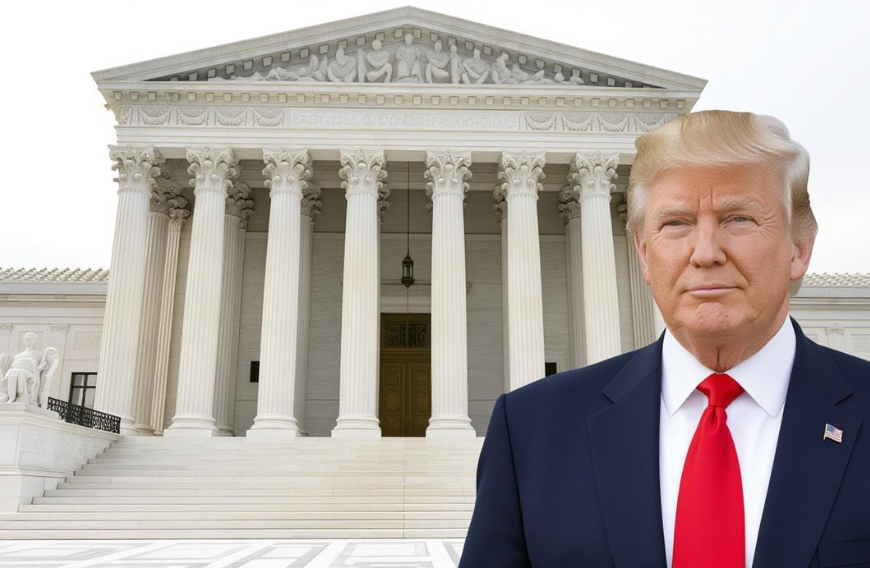
The United States Supreme Court seems to be very eager to hear President Donald Trump’s tariffs case. The Supreme Court on Tuesday granted the Trump administration’s request to hear its appeal of lower court rulings that many of President Trump’s wide-ranging tariffs are illegal and it also agreed with the administration’s request to consider the appeal on a faster-than-normal timeline.
The court, in an order, said it would hear oral arguments in the first week of November.
“We are confident that the Supreme Court, like the CIT and the Federal Circuit, will recognize that the President does not have unilateral tariff power under IEEPA,” said Jeffrey Schwab, senior counsel and director of litigation at the Liberty Justice Center, which represented a group of five small businesses who were plaintiffs in V.O.S. v. Trump.
“Congress, not the President alone, has the constitutional power to impose tariffs,” Schwab said.
READ: Supreme Court blocking Trump tariffs could ‘end’ US economy: Peter Navarro (
In May, the U.S. Court of International Trade ruled that the IEEPA did not grant the president the authority to impose such extensive tariffs, asserting that tariff-setting is a legislative function reserved for Congress. The court’s decision was based on constitutional principles and the major questions doctrine, which holds that significant policy decisions require clear congressional authorization.
The Trump administration appealed this decision to the Federal Circuit Court of Appeals, which, in August, upheld the lower court’s ruling, reinforcing the separation of powers and limiting executive authority in trade matters.
The Trump administration argues that the tariffs are a legitimate exercise of presidential power under the IEEPA, which grants the president authority to regulate commerce and impose sanctions during national emergencies. They justify the tariffs on grounds of national security and economic protection, citing concerns such as trade deficits, drug trafficking, and foreign influence.
However, several lower courts have challenged this interpretation, ruling that the tariffs overstep the president’s authority. Critics contend that imposing tariffs is fundamentally a legislative power, reserved for Congress, under the U.S. Constitution’s separation of powers. They argue that the IEEPA was intended to address more narrowly defined emergencies and does not grant the president unlimited tariff powers.
READ: Billions in Tariffs at Risk as Supreme Court Reviews Trump Policy (
The decision, expected by early 2026, will be pivotal in shaping U.S. trade policy and executive authority for years to come.
If the Supreme Court rules against the tariffs, the consequences could be substantial. The U.S. government might be forced to refund hundreds of billions, potentially up to $1 trillion, in collected duties. The case also raises broader implications about the balance of power between the executive and legislative branches, setting a precedent for future trade and foreign policy actions.
The Supreme Court’s expedited decision to hear President Trump’s tariffs case highlights the significant constitutional and economic stakes involved. A ruling against the tariffs may force the U.S. government to refund potentially up to $1 trillion in collected duties, impacting both government finances and businesses affected by these tariffs. Conversely, a ruling in favor of the administration could expand presidential authority in economic and national security matters.