



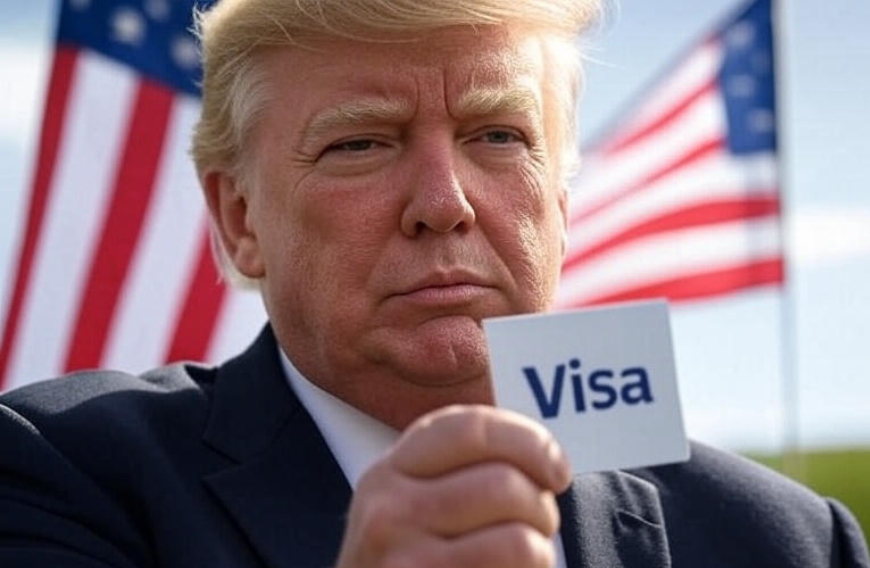
Foreign correspondents in the United States are navigating an increasingly tense environment as the Trump administration signals tighter controls. After President Trump sharply rebuked an Australian reporter over a probing question, media outlets say the message was clear: scrutiny may come at a cost. With plans to limit correspondent visas and subtle warnings circulating, many international journalists now face growing uncertainty about reporting freely on U.S. soil.
Earlier this week, an Australian Broadcasting Corporation reporter questioned President Trump about his ongoing business interests while in office, prompting a visibly frustrated reaction from the president.
“In my opinion, you are hurting Australia very much right now, and they want to get along with me,” Trump told the reporter John Lyons, as quoted by France 24.
“Your leader is coming over to see me very soon. I’m gonna tell him about you. You set a very bad tone.”
Speaking to AFP on condition of anonymity, one foreign correspondent noted that President Trump’s antagonism toward the press is not limited to international journalists. “When Trump insults a journalist, it doesn’t matter to him whether it’s a foreigner or not,” the correspondent said.
READ: Trump may strike deal with Israeli spyware firm accused of targeting journalists, activists (
The reporter expressed greater concern over the administration’s proposal to cut journalist visas drastically, reducing the standard five-year term to a renewable 240 days, and limiting Chinese media workers to just 90 days. “How am I supposed to rent a flat? To get a driver’s license? To put my kids in school with a 240-day visa?” the correspondent asked, stressing that establishing a network of sources in the U.S. requires time.
“It’s going to be a nightmare,” they added.
Another journalist, reporting for a European media outlet, observed that “the precariousness of foreign journalists doesn’t make them prime targets for this administration,” but added that it “is part of a very worrying overall picture.”
The correspondent also noted that the White House favors journalists, wherever they come from, “who are committed to its stories or self-censor enough to normalize what’s happening.”
“The shortened timeframe for I-visa renewals creates a framework for possible editorial censorship in which the Trump administration can trade access for compliance in reporting,” Katherine Jacobsen with the Committee to Protect Journalism (CPJ) stated in a statement.
Mike Balsamo, president of the Washington-based National Press Club, shared a similar concern, warning that these measures could trigger retaliatory actions against American journalists stationed overseas. “A free press doesn’t stop at America’s borders. It depends on correspondents who can work here without fear their time will run out,” he wrote on X.
READ: ‘Will I ever step into my house again?’ The human toll of Trump’s $100K H-1B fee (
Although the correspondents interviewed for this story did not report direct hostility from the White House, they noted that political figures within President Trump’s “Make America Great Again” (MAGA) movement have openly targeted foreign journalists.
Richard Grenell, former U.S. ambassador to Germany and a close ally of President Trump, recently suggested revoking the visa of a journalist working for Germany’s ZDF network. “This radical Lefty German keeps calling for violence against people he politically disagrees with,” Grenell said on X, criticizing the journalist’s interview with influential White House adviser Stephen Miller. “He poses as a journalist in Washington, D.C. His visa should be revoked. There is no place in America this type of inciter.”
Not all foreign media have faced setbacks under Trump’s administration. Outlets that echo views aligned with the president in their home countries have found a warmer reception.
For instance, British broadcaster GB News, featuring far-right figure Nigel Farage among its personalities, was recently granted access to the Oval Office. During Trump’s visit to the UK this week, one of its journalists even secured a highly sought-after seat on the presidential plane.