



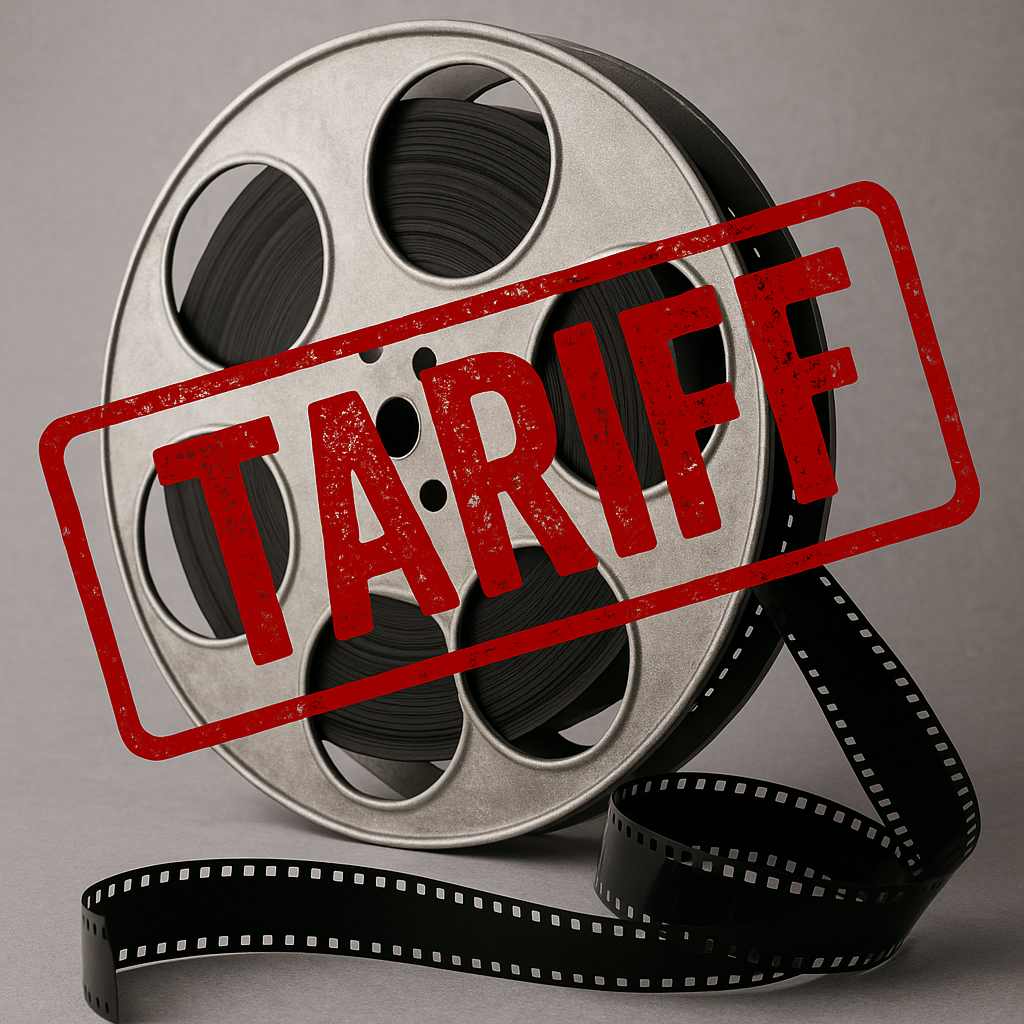
As the U.S. considers a 100 percent tariff on foreign films, Indian cinema faces a new wave of uncertainty. Beyond box-office losses, the move threatens to redefine how culture, commerce, and diplomacy intersect on the global stage.
In late September 2025, President Donald Trump reignited a debate over trade and culture by announcing plans to impose a 100 percent tariff on all films produced outside the United States. The declaration, made in a post on Truth Social, asserted that foreign productions have unfairly “stolen” America’s movie business.
While sweeping in scope, the proposal’s legal and practical implications—particularly for the Indian film industry—remain unclear. The coming months are likely to shape a new chapter in the intersection of entertainment, diaspora markets, and global trade policy.
For Indian cinema, the U.S. has long been a critical overseas market. Hindi films, Telugu productions, and other regional Indian industries often depend on North American box-office returns, diaspora audiences, and ancillary revenues such as digital streaming and satellite rights.
READ: Namaste Vietnam Festival to celebrate 75 years of Indian Independence (July 19, 2022)
“India, being the world’s largest film-producing country, has the United States accounting for nearly 50 percent or more of the overseas earnings of Indian films,” well-known Indian filmmaker and actor Rahul Mittra told The American Bazaar.
Estimates suggest that anywhere from 40 percent to 60 percent of all overseas earnings for many Indian films come from the United States. Indian movies collectively generate between $100 million and $150 million (roughly ₹886 crore and ₹1,330 crore) annually in North America, the Producers Guild of India estimates. The earnings come not only from theatrical releases but also through digital platforms, satellite broadcasting, and other distribution deals across the U.S.
Some of the biggest Indian blockbusters have made a strong mark at the U.S. box office. Baahubali 2 led the pack with earnings of about $22 million (nearly ₹195 crore). Other recent hits such as Kalki 2898 AD, Pathaan, RRR, Pushpa 2, Jawan, and Animal each pulled in between $15 million and $19 million (roughly ₹133 to 169 crore).
The threat of doubling distribution costs could drastically alter that dynamic. Distributors warn that to absorb the tariff, ticket prices might surge from $10-15 to $20-30, a move likely to reduce footfalls and push back release strategies.
The Delhi-based Mittra, producer of the critically acclaimed Saheb, Biwi Aur Gangster series, said a 100% tariff on films made outside the United States is expected to affect revenues of Indian films in the American market, leading to a substantial percentage drop in US earnings for Indian films.”

If imposed, the tariff “will further increase ticket prices in the U.S., which could severely impact box office collections,” said the producer-actor, who stars in the recently released Hindi film Haq, currently playing in U.S. theaters.
In the Telugu film industry alone, analysts warn of potential losses of $25 million (₹2,200 crore) if U.S. tariffs take effect, a figure that underscores the precariousness of the margin for overseas dependence.
Mid-budget and regional films may be especially vulnerable, as they typically have tighter budgets and rely more heavily on diaspora ticket sales.
Some industry voices are already hinting at adjustments. Advertising budgets for U.S. releases might shrink, favoring targeted digital campaigns over costly billboard promotions.
Larger studios, meanwhile, may prioritize tentpole films with strong overseas pull, while smaller films skip U.S. theatrical releases altogether and head straight to streaming or OTT platforms.
“Producers might think of skipping theatrical releases in the US altogether, opting instead for direct-to-OTT releases,” said Mittra, whose film Torbaaz, starring Sanjay Dutt, was released on Netflix during the pandemic. “Hence this move may eventually reshape the business landscape for Indian cinema abroad.”
Bollywood filmmaker Anurag Basu struck a contrarian tone, suggesting that the tariff could shift attention back to Indian films if foreign blockbusters become prohibitively expensive. He dubbed the situation “box-office karma.”
Still, many insiders fear that the uncertainty itself may delay international release plans until clarity emerges.
A 100 percent import tariff on films would be an unprecedented step. Movies are not traditional goods — they straddle the boundary between intellectual property, trade in services, and cultural content. Legal experts question whether such a tariff is consistent with U.S. trade commitments or international obligations.
Enforcement mechanisms are unclear. Would the tariff apply to digital streaming, satellite distribution, or only theatrical prints? Would it include films partially produced in the U.S. or with joint production packages?
If implemented, the move could trigger retaliatory measures. Other countries might impose quotas or taxes on American films, opening a new front in cultural diplomacy and trade warfare.
Reflecting on whether tariffs on films risk turning culture into just another trade commodity, Dr. Shweta Sinha, a New York-based media and communication strategist who examines trauma, culture, and the politics of storytelling across global media while teaching storytelling in New Media at New York University, stated:
“The history of global cinema has always been entangled with unequal flows of power. When dominant economies tax the cultural expressions of others, it revives colonial hierarchies under the language of ‘trade protection.’ Because art has always been a country’s emotional and cultural export, reducing it to a taxable commodity almost feels like imposing borders or customs duties on empathy. Not that economies shouldn’t protect their industries, but in the process, we shouldn’t end up shrinking the shared space that art was meant to expand.”
At the diplomatic level, this tariff proposal compounds existing strain in U.S.-India relations. Earlier in 2025, the U.S. imposed steep “reciprocal” tariffs on Indian goods (eventually totaling 50 percent) in response to energy procurement and trade imbalances.
India has denounced the earlier tariffs as unfair and threatened countermeasures.
As of now, there is no formal executive order or policy instrument detailing how the film tariff will be implemented — making the industry’s next steps a guessing game.
What Lies Ahead: Strategies and Scenarios
- Clarification and carve-outs: There is hope that final rules may exempt foreign-language films, joint productions, or digital-only releases. Indian industry groups are pressing for such carve-outs.
- Pricing discipline and limited rollout: If tariffs stick, big-budget films may absorb costs or limit U.S. distribution. Smaller projects may bypass theatrical release.
- Strengthened streaming channels: The push toward direct-to-OTT platforms may accelerate as a hedge against tariff-driven theatrical risk.
- Diplomatic pressure and trade negotiation: India is likely to raise the issue in bilateral dialogues, possibly linking it to broader trade talks and cultural exchange agreements.
- Industry realignment: Some studios may shift their focus to other markets — Canada, the UK, and the Middle East — where Indian films have strong presence but are not subject to U.S. tariffs.
What makes this proposed tariff particularly controversial is not just the dollar cost, it’s the symbolic collision of commerce and culture. The idea of taxing a film, a work of art and storytelling frames it as a commodity that can be banned or taxed like any other import. That shift raises both economic and philosophical questions about how culture moves across borders, especially in a connected, digital era.
For Indian cinema, the U.S. has been more than a commercial frontier; it’s a cultural showcase, a way to connect diaspora audiences with homeland narratives, and to strengthen soft power abroad. If the tariff proposal survives legal scrutiny and administrative decisions, this may alter how Indian filmmakers think about globalization, distribution, and audience outreach for years to come.
Sinha also reflects on Indian cinema’s unique global role:
“Indian cinema has been one of our most democratic diplomats! Long before trade deals or tech startups, it was Hindi films and regional cinema that introduced global audiences to the glorious multiculturality of India! The soft power of Bollywood song-and-dance sequences, diaspora stories, and independent films resides in their ability to convey painful sociocultural truths with an honesty that often eludes political or popular media narratives. Not only does Indian cinema do the heavy lifting of carrying India’s pluralism into global consciousness, it is a testament to the fact that post-colonial nations can export complexity and nuance, not just exoticism.”
“The continuity of this exchange is vital. It keeps Indian cinema from becoming insular and Western audiences from staying ignorant. Culture thrives on circulation; when we restrict it, everyone’s world gets smaller,” Sinha added.
But as of now, the plot remains open-ended. The industry watches, the lawyers wait, and millions of movie lovers in the India-U.S. corridor and beyond may find the next few months among the most consequential in recent memory.
(Zofeen Maqsood contributed to this story.)