



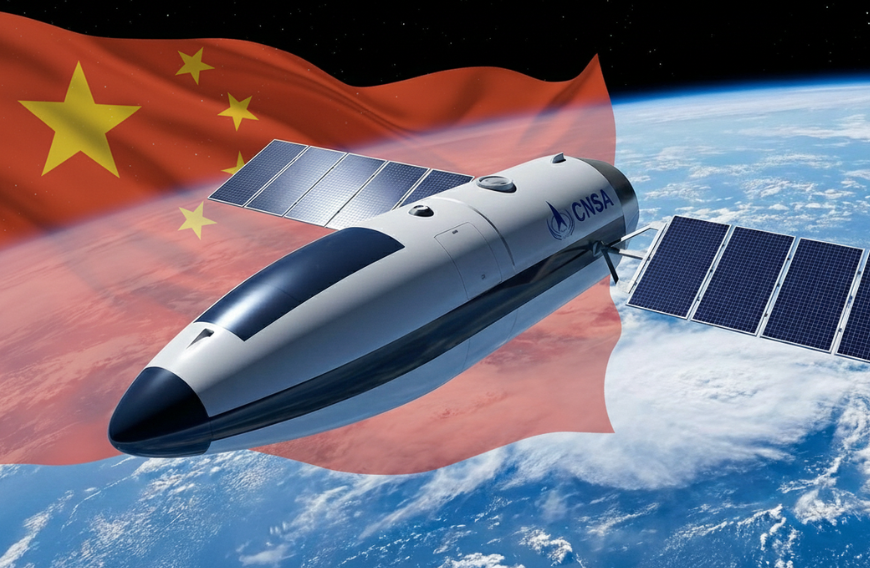
China is looking to give Elon Musk a run for his money. China’s rocket startup LandSpace has made no secret about drawing inspiration from Musk’s SpaceX.
China is increasingly positioning itself as a serious competitor in the commercial space race, and one of the clearest signs of this ambition is the rise of private rocket startups such as LandSpace. Often compared to Musk’s SpaceX, LandSpace has openly acknowledged drawing inspiration from SpaceX’s approach: rapid iteration, vertical integration, and a focus on reusable, cost-efficient launch technology.
“(SpaceX) can push products to the edge and even into failure, quickly identifying limits and iterating,” Zhuque-3 chief designer Dai Zheng told state broadcaster CCTV after the rocket’s inaugural flight.
Earlier this month, the Beijing-based firm became the first Chinese entity to conduct a reusable rocket test, which seemingly put SpaceX on alert and LandSpace is now preparing to go public to fund its future projects, just as its bigger and far more successful U.S. rival considers an initial public offering of its own.
READ: SpaceX rival United Launch Alliance CEO resigns (
Founded in 2015, LandSpace gained international attention in 2023 when it successfully launched Zhuque-2, the world’s first operational rocket powered by liquid methane and liquid oxygen. This was a milestone because methane-fueled engines are widely seen as the future of rocketry. SpaceX has championed methane for years with its Raptor engines on Starship, citing benefits such as cleaner combustion, reusability, and suitability for long-term space missions.
Unlike traditional state-run programs, companies like LandSpace operate with startup-style speed while still benefiting from China’s strong industrial base and government support.
The rivalry is not just about rockets—it reflects broader competition in technology, innovation, and space access.
As launch costs fall and reliability improves, private companies gain influence over satellite deployment, communications, and even national security infrastructure. For China, nurturing companies like LandSpace may help reduce dependence on state launch systems and strengthen its presence in the global space economy.
“Falcon 9 is a successful configuration that has been tested by engineering,” Zhuque-3’s deputy chief designer Dong Kai said in a podcast interview last week. “After studying it, we recognize its rationality; this is learning, not imitation.”
READ: SpaceX to pursue ‘one of the largest’ IPOs in 2026 (
“Calling (Zhuque-3) a ‘Chinese Falcon 9,’ I think, is a very high compliment.”
Dai said SpaceX’s generous financial backing was a key factor in allowing the U.S. firm to incur huge losses while testing Starship, its reusable launch vehicle.
“For us, we’re not yet able to do that,” Dai told CCTV.
“I believe our country has recognized this, allowing capital markets to support companies (in areas) like commercial space flight.”
In short, while Elon Musk and SpaceX remain the benchmark, LandSpace’s progress shows that China is serious about building its own commercial launch champions. The result is a more competitive, faster-moving global space industry—one where SpaceX may no longer be running alone at the front.
“They have added aspects of Starship, such as use of stainless steel and methalox, to a Falcon 9 architecture, which would enable it to beat Falcon 9,” Musk said in October, in his first public comments about LandSpace.
“But Starship in another league.”