



There’s a running joke in tech circles: Blink, and an AI tool has already learned how to do part of your job. With advancements arriving faster than users can recalibrate, the industry has slipped into a prompt-or-perish ecosystem, where models compete, cannibalize, and continuously retrain on one another in pursuit of marginal gains. As everyone from tech giants to developers push their own in-house AI tools, it can be quite eye-opening to see which AI models are able to cut through the fierce competition and emerge as winners in this new age.
Interestingly findings from a just released survey not only gives a glimpse on the most-used AI model in corporate workspace but also reveals an ironic fact — while big tech companies are trying to push their own in-house AI tools, professionals across the U.S. appear to be voting with their keyboards, and their loyalty is not always landing where companies expect.
Conducted by Blind, the anonymous professional community platform, the survey shows that Anthropic’s Claude has emerged as the most-used AI model in the workplace. Claude has emerged as a clear favorite outperforming better-known rivals including ChatGPT and Google’s Gemini. According to the poll, 31.7% of professionals reported using Claude as their primary AI tool at work, regardless of their employer.
The survey, collected samples responses from verified U.S.-based professionals, in the month of December. Most of those who responded identified as software engineers. On the areas that these respondents required AI assistance ranged from debugging and system design to documentation and content generation.
A fragmented AI toolkit, not a one-model world
Despite Claude’s lead, the data also reveals another nuanced reality — professionals are not committing to a single AI model. Instead, many are assembling personalized toolkits based on task-specific strengths.
San Ramon, California-based Vasudha Badri Paul, founder of Avatara AI, a platform that helps businesses’ design, deploy, and grow responsible AI and GenAI solutions, told The American Bazaar, that her team says her daily workflow spans multiple platforms. She said, “I use Perplexity and Notebook LLM most frequently. For research and learning, I go to Claude and Gemini and ChatGPT is my go-to for content.”
“I also use Notion AI to organize my digital workspace, Sora for short video generation, Canva Magic Studio for graphics, and Gamma for slide decks,” she adds.
Her sought-after approach, tailored to her needs reflects a growing trend among professionals. An increasing number of users are pragmatic about switching between them rather than vowing loyalty to only one ecosystem.
Coding is where Claude pulls ahead
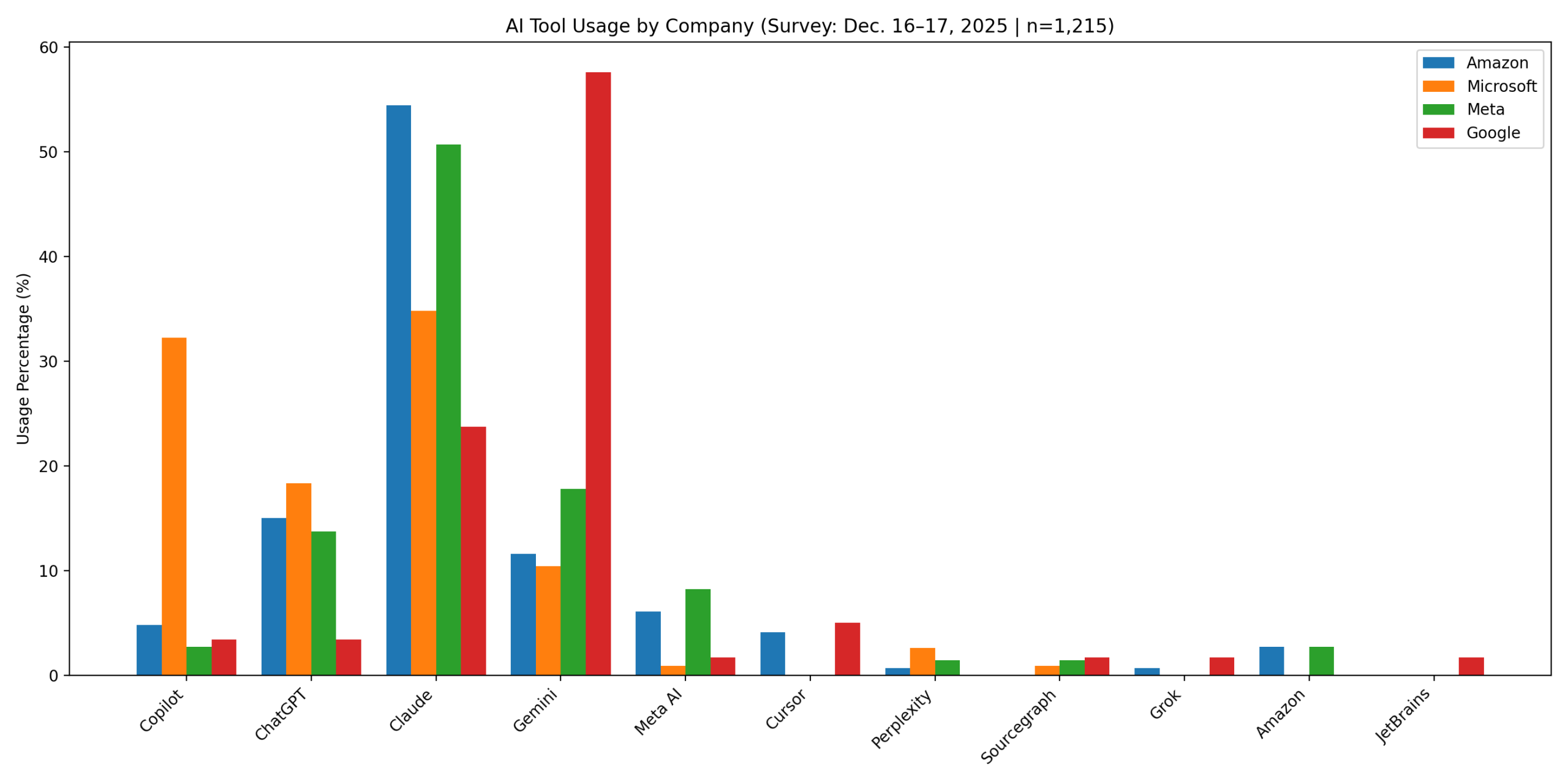
But the question that arises is where is it that Claude is able to surge ahead of others. The survey shows that among developers, Claude’s advantage appears clearest in software development. Many respondents cited its strength in writing and understanding complex code—a space where company-backed tools are facing resistance. The survey showed that a 19.6% of professionals use ChatGPT; while a 15% use Gemini. GitHub Copilot is closer with 14.2% respondents relying on it. Another 11.5% said they used Cursor.
The survey also attempted a peep into the preference trend inside companies with their own AI products. At Meta, 50.7% of surveyed employees said Claude was their go-to AI model, while only 8.2% reported using Meta AI. Microsoft employees showed a similar pattern: 34.8% favored Claude, narrowly ahead of Copilot at 32.2%, with ChatGPT trailing at 18.3%.
One key takeaway, companies can get from this survey is that corporate backing may not necessarily win over employees’ trust. Especially in a time when productivity is expanding given the AI tools.
READ: Grok faces backlash across UK, EU and India over sexualized content (January 7, 2026)
Developers are making hard choices
For some professionals, the shift away from legacy tools is a natural growth chart. Nitin Kumar, an app developer, and solutions manager says he has fundamentally changed his AI stack over the past year. He told The American Bazaar, “Claude is definitely the most superior for software development.” He added, “I use Gemini now and recently cancelled my ChatGPT Plus subscription because I no longer find it useful for anything.”
Still, Kumar sees that the AI wars are far from decided. He added, “Gemini 3 Pro changed the game completely for non-coding uses,” he added. Infact, the coding also is almost at par with Claude Opus 4.5.”
His views confirm that users are dabbling and comparing version upgrades and increasingly relying on the tools, where they best serve them.
Google loyalists, Amazon skeptics
Google employees showed the strongest internal alignment with 57.6% of those surveyed using Gemini as their primary AI model. However, that preference did not really travel beyond Google office. Only 11.6% of Amazon employees said that Gemini was their top choice.
Amazon’s own AI tools fared the worst. Amazon CodeWhisperer was selected by just 0.7% of respondents. This is an eye-opener and points towards limited traction despite corporate backing.
What the survey really shows
Beyond individual rankings, the poll highlights a deeper shift in how professionals engage with AI. Rather than adopting tools because they are mandated or branded, workers are choosing what demonstrably improves speed, accuracy, and output. It must be predictable that Claude’s current lead may not be permanent but for now, it seems to have won the metric of trust by many.