



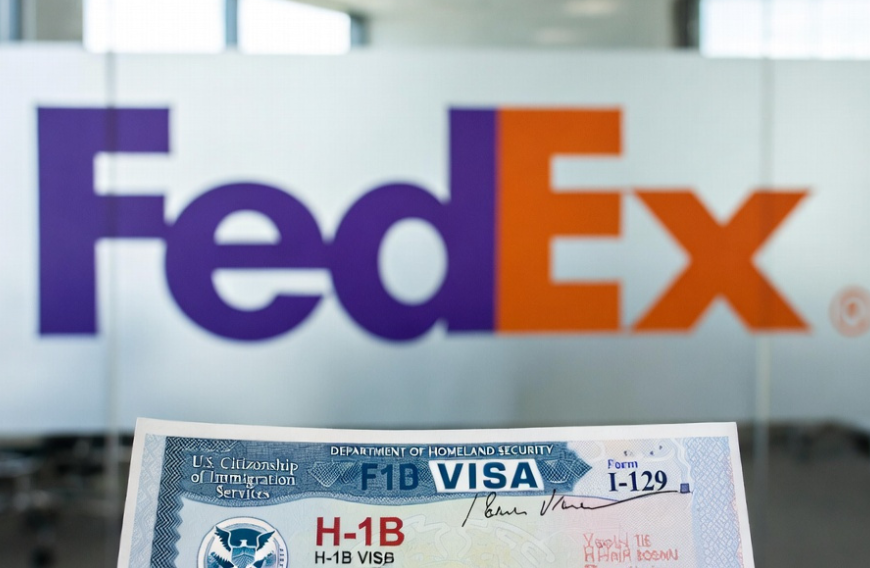
For the first time since allegations emerged in December 2025 that FedEx favored Indian candidates at the expense of American workers, CEO Raj Subramaniam has publicly addressed the controversy.
Speaking out after weeks of silence, Subramaniam said the company’s hiring decisions are rooted in merit, not nationality, and insisted that FedEx remains committed to equal opportunity for all employees.
The scrutiny intensified after a report by The Dallas Express pointed out that FedEx secured a $2.2 billion federal contract in 2022 and later brought in hundreds of foreign workers through the H-1B visa program. The report directly tied the hiring trend to Indian American Subramaniam, noting that the company’s use of H-1B visas rose sharply after he took over as president and CEO in the same year.
As per the records, H-1B approvals for FedEx climbed from 37 in 2021 to 102 in 2025, a period that also saw the company carry out multiple rounds of layoffs. Addressing the issue in an interview with The New York Times, Subramaniam said he supports legal immigration and described it as an important part of the U.S. workforce.
READ: Companies under fire over hiring Indians amid H1-B backlash (
Reflecting on the immigration stance, Subramaniam said, “I’m just grateful for the opportunities given to me. It’s very much an American story because I think it’s going to be rare for these kinds of stories to happen in other countries. That’s one of the true, great strengths of America,” he said.
“I’m very much a believer in legal immigration, and that’s important.” He added, “From a FedEx point of view, we are a meritocracy. We provide opportunities for everybody. I’m one of those examples, but I’m not the only one.”
The data adds further context to the debate. According to the U.S. Citizenship and Immigration Services H-1B Employer Data Hub, Federal Express Corporation filed 436 H-1B petitions in fiscal year 2025 tied to its Memphis, Tennessee, operations, with 434 of those petitions approved.
“Team members on H-1B visas make up less than .05% of our US workforce. In 2025, we sought fewer than 100 H-1B visas for new hires. These trends are consistent with our regular employment patterns,” FedEx clarified that its layoffs have nothing to do with its H-1B hiring.
READ: Amazon, Meta lead H-1B visa petitions; Indian companies drop sharply in FY 2025 (
Now 59, Subramaniam is only the second CEO in FedEx’s history and has spent his entire professional career at the company. He joined FedEx in the early 1990s as a marketing analyst and steadily rose through the ranks. Reflecting on his move from India to the United States, Subramaniam has described his path as a familiar one for top engineering students of that era.
“At that point in the late ’80s, it was a well-worn path because I went to the Indian Institute of Technology, which was the premier institution in India for undergrad. I was fortunate enough to get a scholarship to come to America. I still have the $2 bill that I came here with.”
He has also spoken about his upbringing, framing education as the central focus of his family’s life. “It was very much a middle class upbringing, in a town called Trivandrum, in the south of India. My dad was a policeman. My mom was a doctor, so education was the ticket, basically,” he said.