



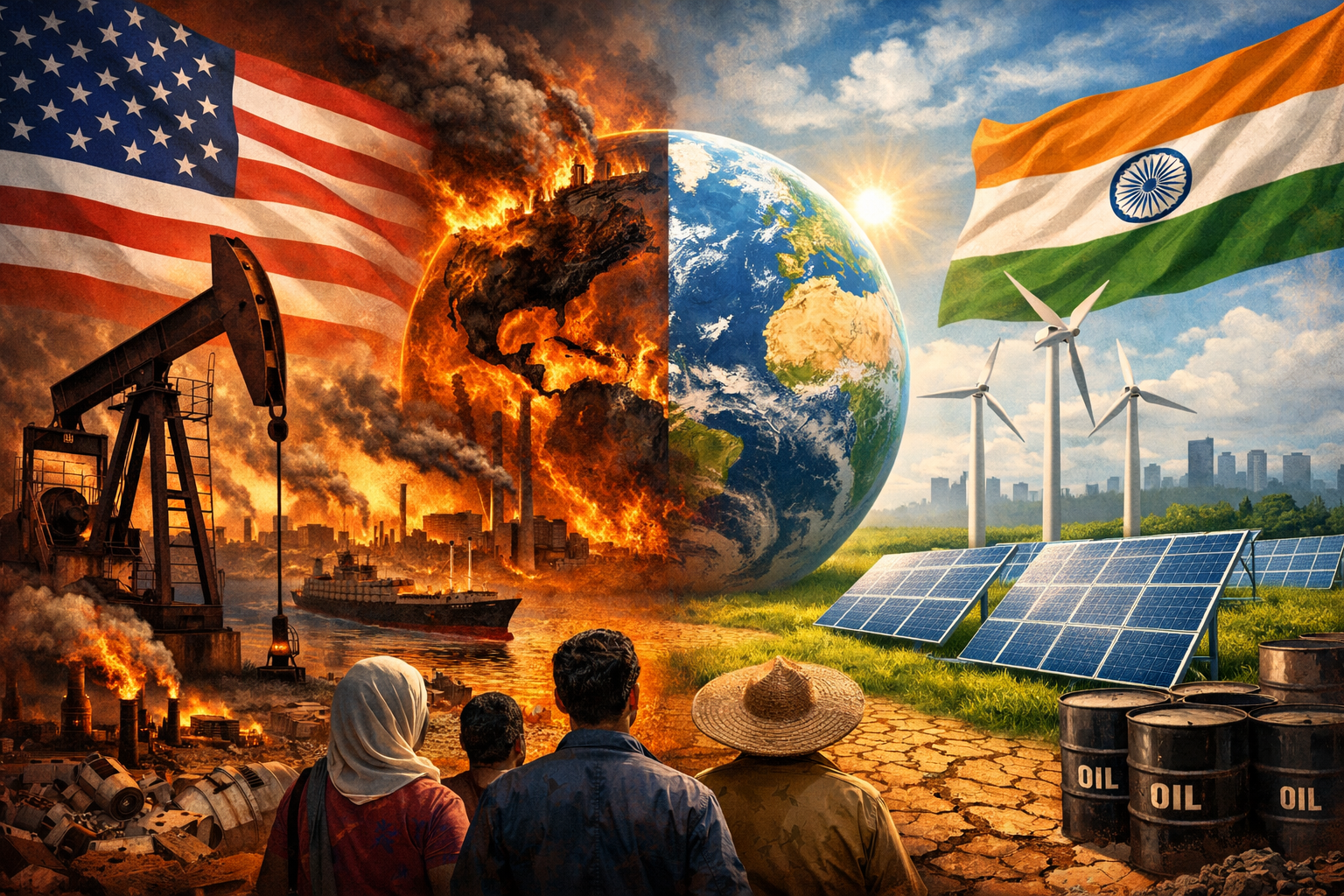
Positioning himself as a global “super cop,” President Donald Trump, early in his second term in January, intervened militarily in Venezuela, a sovereign South American nation with a long Caribbean coastline. The intervention, which Venezuela has described as a violation of its sovereignty, culminated in the arrest of President Nicolás Maduro and his wife on charges of “narco-terrorism,” according to U.S. authorities.
The couple were taken into custody, handcuffed, and transported to New York City, where they were presented in federal district court and charged with drug trafficking, U.S. officials said.
READ: How U.S. tariffs threaten Indian exports from textiles to jewelry (August 24, 2025)
Venezuela, which holds some of the world’s largest crude oil reserves, has seen its oil production sharply curtailed by U.S.-led sanctions. In 2025–26, the country is producing roughly 2–3% of global crude oil supply, averaging about 826,000 barrels per day.
The repercussions of the action were felt far beyond the Americas, including in India. Although Venezuela accounts for only about 0.3% to 0.6% of India’s total crude oil imports due to sanctions, the development has contributed to broader geopolitical and economic turbulence in global energy markets. That turbulence has direct implications for India’s energy transition, already a complex effort to balance rapid economic growth, energy security, and climate commitments under the Paris Agreement.
India, the world’s third-largest energy consumer and oil importer, has pledged to reach net-zero emissions by 2070 and is pushing aggressively toward renewable energy sources such as solar and wind to reduce its heavy reliance on fossil fuels.
However, the crisis has intensified existing challenges by increasing supply uncertainty, influencing oil prices, and potentially locking in higher-emission energy pathways—factors that could undermine climate mitigation efforts. These pressures are compounded by a weakening rupee, with the dollar-rupee exchange rate crossing 91, further straining India’s energy import bill.
The impact of this action could include the following:
Heightened energy insecurity and supply disruptions: India historically sourced heavy crude oil from Venezuela, which was well suited to its refining infrastructure, but U.S. sanctions imposed in 2019 had already reduced those imports to near zero. Recent U.S. military strikes and political upheaval have further destabilized Venezuela’s oil sector, which was already struggling due to years of mismanagement and underinvestment. The country is now producing only a fraction of its estimated potential of 3–4 million barrels per day.
In the short term, the disruption has contributed to volatility in global oil markets. Prices initially dipped amid uncertainty but could spike if efforts to revive production falter.
From a climate perspective, the instability complicates India’s energy transition by forcing a renewed search for alternative fossil fuel supplies—primarily from the Middle East or Russia—rather than accelerating investment in domestic renewable energy. India’s energy demand is projected to double by 2040, and supply constraints could push policymakers to prioritize short-term fossil fuel imports over long-term green infrastructure, potentially delaying the expansion of solar power and electric vehicle ecosystems.
Such a shift would prolong high carbon emissions. Oil accounts for roughly 30% of India’s energy mix and is a significant contributor to its greenhouse gas emissions. The episode also underscores how great-power rivalries, increasingly intertwined with energy control, can disrupt diversified supply chains. That dynamic could place additional strain on India’s multi-alignment foreign policy—balancing ties with the U.S., Russia, and BRICS partners—and complicate cooperation on climate action. Analysts warn that if U.S. dominance results in preferential energy arrangements for allies, India could face higher costs or limited access, indirectly slowing its transition to low-carbon alternatives.
Potential flood of high-emission oil and price distortions: The United States is seeking to revive Venezuelan oil production by encouraging American firms to invest billions of dollars, leveraging the country’s vast reserves—the world’s largest, estimated at more than 300 billion barrels. A production rebound could eventually add 1 to 2 million barrels per day to global supply, potentially lowering prices and making oil more accessible for major importers such as India.
However, Venezuelan crude is among the most carbon-intensive in the world. Its lifecycle emissions per barrel are estimated to be more than double the global average, driven by high methane leakage, energy-intensive extraction from heavy oil and tar sands, and aging infrastructure.
READ: Why the US-Venezuela crisis matters to India’s energy and global strategy? (January 6, 2026)
A resumption of flows to India—where refiners such as Reliance Industries and ONGC have historical ties to Venezuelan supply—could increase the greenhouse gas intensity of the country’s energy mix, undercutting efforts to curb emissions through cleaner fuels and efficiency standards.
Lower oil prices also carry climate risks. Analysts warn that cheaper fossil fuels can create a “lock-in” effect, reinforcing oil dependence at the expense of renewable energy, which requires significant upfront investment and sustained policy support. India’s solar capacity has expanded rapidly to more than 80 gigawatts, but prolonged oil price volatility could dampen investor confidence in green projects, echoing patterns seen during past OPEC-driven market disruptions.
These pressures are compounded by signs of weakening global climate cooperation. The U.S. withdrawal from the UNFCCC and the IPCC has raised concerns about reduced climate finance and technology transfer—both critical for developing countries such as India to scale renewable energy affordably.
The cumulative effect could be slower decarbonization, with India’s per-capita emissions—currently about 2 metric tons of CO₂ equivalent—at risk of rising if fossil fuel imports increase, potentially jeopardizing its nationally determined contributions and amplifying climate-related risks such as heatwaves and flooding.
Geopolitical ripple effects on climate diplomacy: The crisis has revived the use of U.S. hard power in Latin America in the name of energy security, reshaping global oil geopolitics with indirect effects for Asia. For India, the shift presents strategic challenges. Venezuelan oil had been part of New Delhi’s effort to diversify supplies away from Middle Eastern volatility, and greater U.S. control over production could tie future access to geopolitical alignment, potentially complicating India’s relationships within BRICS, where Venezuela has held observer status.
Upstream investments by Indian firms in Venezuelan oil fields now face uncertainty, raising the prospect of write-downs or renegotiations under U.S. oversight. Analysts say this uncertainty could further constrain India’s ability to manage energy security while maintaining strategic autonomy.
READ: Trump moves to tap 30-50 million barrels of Venezuelan oil, following Maduro’s removal (January 7, 2026)
From a climate perspective, the fragmentation risks weakening the multilateral cooperation critical to India’s energy transition. India depends on international climate forums for loss-and-damage funding, technology transfer, and climate finance, but reduced U.S. engagement could erode these mechanisms, forcing India to shoulder a greater share of the transition costs domestically.
There are also broader indirect risks. An escalation of regional instability—such as refugee flows or proxy conflicts—could divert global attention and resources away from climate priorities, complicating India’s efforts to pursue a just transition in coal-dependent regions such as Jharkhand, Odisha, and Chhattisgarh. Some analysts note that prolonged uncertainty and sustained high oil prices could accelerate renewable adoption, but current trends point to greater downside risks for emissions reduction.
Overall, the U.S.-Venezuela crisis adds volatility that may reinforce fossil fuel dependence at the expense of green innovation, increase exposure to high-emission oil, and weaken global climate frameworks. While India could respond by accelerating domestic renewable deployment and expanding strategic petroleum reserves, the episode underscores how external geopolitical shocks can hinder equitable climate progress across the Global South.