



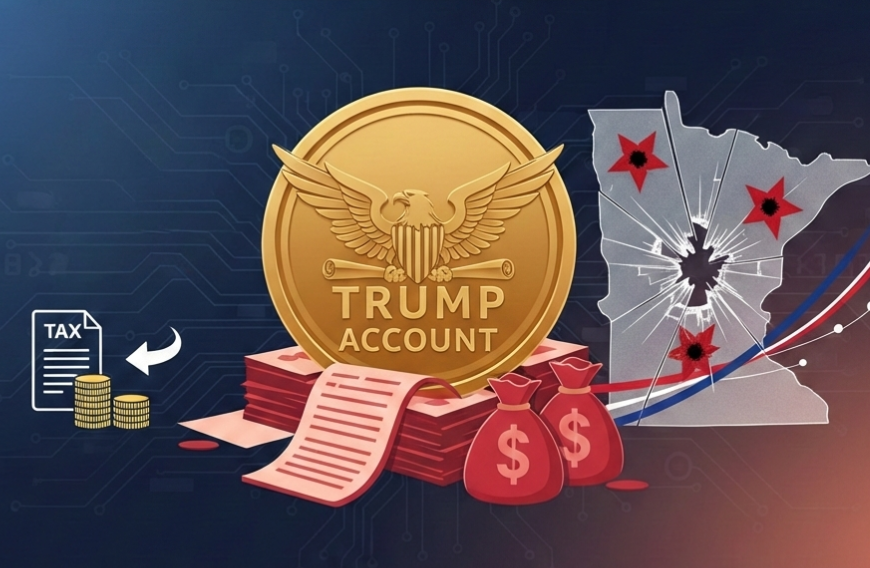
This tax season, US President Donald Trump seems to be urging citizens to open Trump accounts. Trump will join Treasury Secretary Scott Bessent, CEOs and investors at an all-day summit on Wednesday in Washington, D.C., calling on parents to open their accounts.
What is a Trump account?
A Trump account is a government-backed savings and investment account for U.S. children, created under the One Big Beautiful Bill Act of 2025. The account is designed to help kids start long-term investing from an early age.
At birth, children born between January 1, 2025, and December 31, 2028, receive a seed deposit of about $1,000 from the federal government. Parents or guardians manage the account until the child turns 18 and can contribute up to $5,000 per year.
Funds are typically invested in low-cost U.S. stock index funds or ETFs, though exact investment options may vary depending on the account provider. The money is generally locked until adulthood, though withdrawals may be used for education, housing, or business ventures, depending on regulations and account rules.
READ: Ray Dalio backs ‘Trump account for kids’ along with Michael Dell (
Taxes apply on withdrawals similar to traditional investment accounts. Trump accounts differ from college 529 plans or standard IRAs, providing a long-term wealth-building tool intended to foster financial security and early investing habits for the next generation, though the long-term impact is not yet known.
A number of major U.S. companies have already pledged to match the federal government’s initial $1,000 contribution for eligible employees’ children, including Charles Schwab, Robinhood, SoFi, Uber, Charter Communication and BNY.
The introduction of Trump accounts reflects a broader shift toward encouraging early financial literacy and long-term wealth accumulation among younger generations. By combining government support with voluntary family contributions, the program seeks to normalize investing habits from childhood, potentially shaping how Americans approach personal finance throughout their lives. It also highlights the increasing role of public-private partnerships in financial initiatives, as corporate contributions can amplify government efforts and incentivize broader participation.
The Trump administration estimates that, based on historical stock market averages, a Trump account opened in 2026 with the $1,000 federal government contribution would grow to $5,800 by age 18, for a family that contributes the maximum $5,000 annually, the account is projected to grow to $303,800 by age 18.
Beyond individual wealth-building, such programs may influence societal attitudes toward saving, risk management, and intergenerational financial planning. At the same time, the Trump account initiative raises questions about equity and accessibility, as families with greater resources are better positioned to maximize benefits, potentially widening financial disparities.
READ: Trump pushes contested plan to privatize Social Security (
Policymakers and financial institutions will need to carefully monitor participation rates and outcomes to ensure the program supports inclusive economic growth. Overall, Trump accounts represent a modern approach to combining government incentives, private-sector involvement, and financial education to foster long-term economic stability and investment-minded behavior among young Americans, though the long-term effects remain uncertain.
Digital platforms and automated investment tools make it easier for families to manage contributions and track growth, creating opportunities for early financial engagement. At the same time, reliance on market-based growth may introduce uncertainty in returns and exposure to economic fluctuations, highlighting the importance of financial education alongside the accounts themselves.
The initiative may also set a precedent for future child-focused savings programs, demonstrating how policy, private sector participation, and technology can combine to encourage long-term planning.
Ultimately, the success of such programs will depend on adoption rates, accessibility, and whether families can effectively leverage these accounts to build sustainable financial habits over time.