



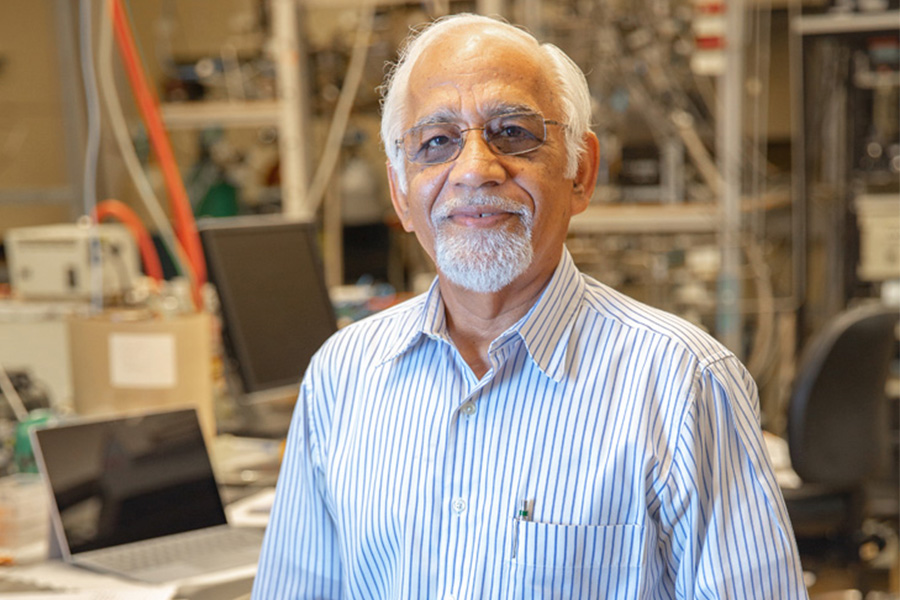
Dr. Raj Singh, an Indian American Materials and Science Engineering professor at Oklahoma State University College of Engineering, Architecture and Technology (CEAT) has been named a Big 12 Faculty of the Year Award honoree.
The award honors one outstanding faculty member from each member institution from Arizona to West Virginia who exemplifies the highest standards of teaching, research and academic leadership while advancing student success.
Singh, a Regents Professor in the School of Materials, Mechatronics and Manufacturing Engineering, and a member of the National Academy of Engineering, was selected as OSU’s honoree in recognition of his groundbreaking contributions to materials science and engineering research and his longstanding dedication to educating and mentoring future engineers.
“Dr. Singh’s work reflects the core of CEAT’s mission, advancing cutting-edge research while preparing students to solve real-world challenges,” said Hanchen Huang, dean of CEAT. “His selection as Big 12 Faculty of the Year highlights the caliber of faculty at Oklahoma State University and the impact they have locally, nationally and globally.”
Singh’s research in materials science and engineering supports innovation across multiple industries, while his commitment to student learning and mentorship has helped shape the next generation of engineers and researchers. His recognition underscores CEAT’s leadership in engineering education and applied research within the Big 12 Conference.
“We are constantly looking for ways to highlight how Big 12 faculty continue to educate and inspire the next generation of leaders,” Big 12 Chief Impact Officer Jenn Hunter said. “From the arts and filmmaking to business and engineering, this year’s cohort showcases the vast opportunities available to students pursuing an education on Big 12 campuses.”
Read: Two Indian Americans among Cincinnati University’s top alumni award winners
The award also reflects the breadth of research excellence across the conference, spanning disciplines from astronomy and psychology to engineering and the arts. Singh joins a distinguished group of faculty members recognized this year, further elevating the reputation of OSU and CEAT for academic excellence and innovation.
“I am surprised, delighted, humbled, and grateful to the selection committee and those responsible for their support for this most prestigious recognition and award,” Singh said.
Singh was the founding school head of the School of Materials Science and Engineering at OSU–Tulsa. He earned his Doctor of Science degree in ceramics from the Massachusetts Institute of Technology. He previously held positions at Argonne National Laboratory, the GE Global Research Center and the University of Cincinnati before joining OSU.
His research career spans numerous fields, including nanostructured materials, nanotubes and nanorods, fuel cell materials, smart ferroelectric materials, and ceramic matrix composites.
Read: Indiana University names Courtemanche & Associates CEO Sandeep Goel as Adjunct Professor
Singh has authored more than 350 research articles and holds 29 granted patents, establishing him as a world-renowned expert in CMCs. He is widely recognized for inventing new materials and developing novel processing methods, making transformative scientific and technological contributions to the field.
Singh pioneered the patented melt-infiltration process for producing fully dense, net-shape, damage-tolerant silicon carbide fiber-reinforced CMCs. This innovative and inherently simple process led to widespread commercialization by GE Aviation beginning in 2016.
The technology has accumulated more than 40 million flight hours in LEAP engines used by Airbus, Boeing 737 and 777, and COMAC aircraft, marking the world’s first commercial jet engines to incorporate CMCs as structural turbine components.
These advancements have reduced engine weight, improved efficiency, lowered CO₂ and NOx emissions, and enabled new multibillion-dollar industries, delivering significant societal and economic benefits as a direct result of Singh’s pioneering work.
Read: Indian American researcher Meha Jain wins inaugural ASU-Science Prize
In 2024, Singh was elected to the NAE, one of the highest professional honors for engineers, in recognition of his lifetime contributions to materials science and engineering.
Beyond his research achievements, Singh remains deeply committed to educating and mentoring students. He views mentorship as a cornerstone of his role, helping students cultivate curiosity, creativity and a lifelong passion for learning, ensuring his impact extends well beyond the laboratory and into the future of the engineering profession.
“The best part of my job is to help educate the best possible engineers and impart knowledge of the discipline of materials science and engineering,” Singh said. “I want to encourage students in the engineering field to be curious, persevering, creative, inventive and passionate about their field.
“Never forget to be curious and inventive. It should be a lifelong pursuit.”