



By Gulshan Singh
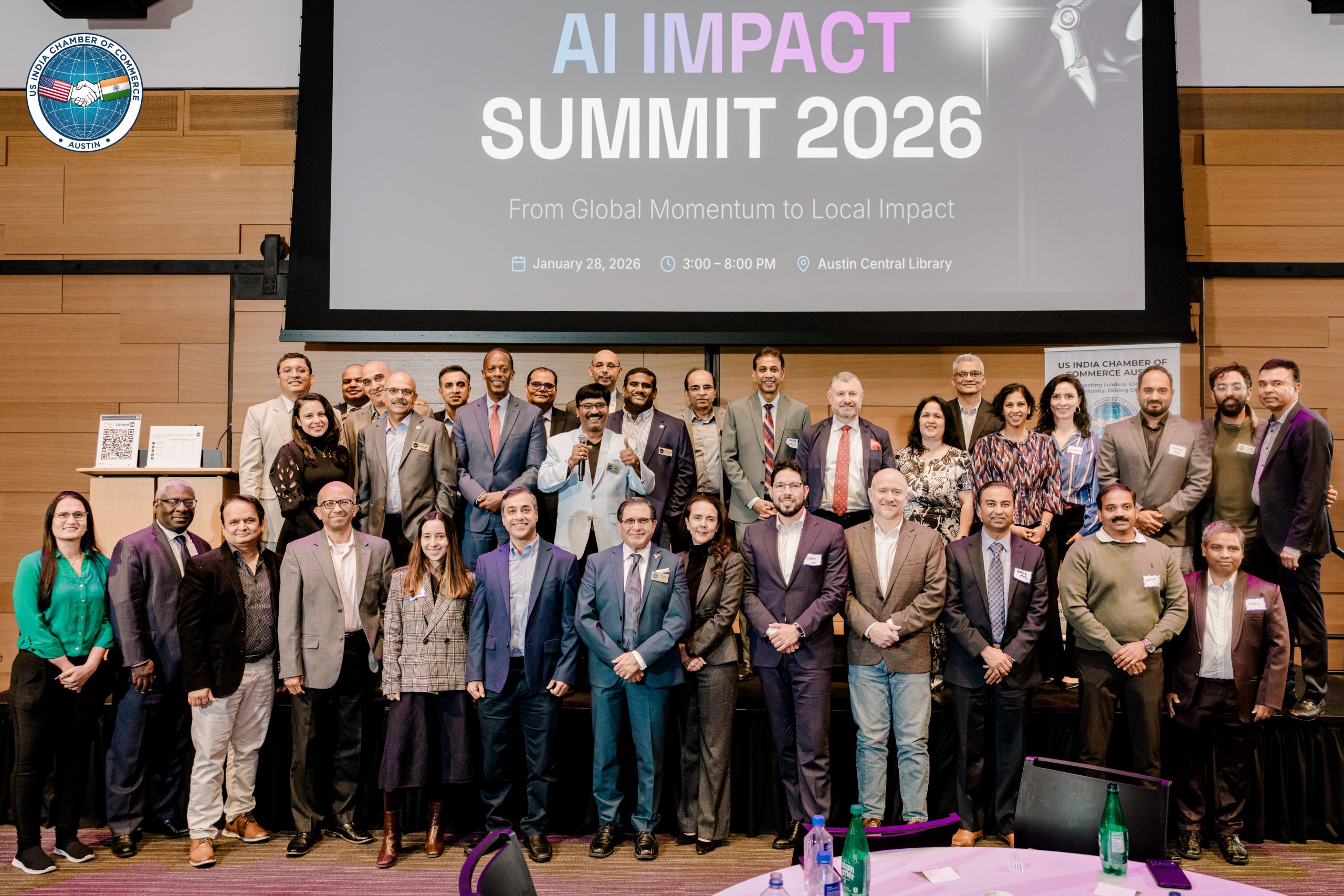
Austin, Texas — The conversation surrounding artificial intelligence has officially exited its “magic” phase. At the third annual AI Impact Summit 2026, hosted by the U.S.-India Chamber of Commerce Austin at the Austin Central Library on Feb. 14, the rhetoric of wonder was replaced by the cold, hard metrics of industrial deployment. The central theme was the rise of “Agentic AI”—a shift from systems that merely generate text to “compound systems” that can reason, plan, and execute workflows autonomously.
For the modern professional, this represents a fundamental change in “job enablement.” Agentic AI is less like a smarter search engine and more like a digital workforce that requires management, governance, and a clear set of “wheels” to make the “engine” of the model actually move the business forward.
The day opened with a powerful reflection on history and transformation. Anupam Govil, Chairman of the U.S.-India Chamber of Commerce and Managing Partner of Avasant, described today as the third major technological inflection point of the modern era. “We’ve experienced the internet age and the mobile revolution,” he noted, “but the AI era will have an even greater multiplying effect.”
READ: India’s first sovereign ‘AI box’ unveiled at AI Summit 2026 (February 16, 2026)
The Strategic Imperative: Monitoring the “Rocket Ship”
The summit’s opening keynote, delivered by Vivek Mohindra, SVP at Dell Technologies, framed the current state of AI not as a static tool, but as a high-velocity vehicle. “It is a rocket ship,” Mohindra told the audience. “The pace of change is so dramatic that a year ago, the best model that existed—there are over 30 models today which are better than the best model a year ago”.
For tech-using readers, this means the “technical debt” of using outdated tools accumulates in weeks, not years. Mohindra noted that at Dell, the leadership now monitors a “daily AI radar” to track these shifts every morning. This isn’t just about keeping up with news; it’s about a “massive value shift” where AI is expected to add $15 trillion to the global GDP by 2030.
He emphasized that the most successful companies aren’t treating AI as a “standalone strategy”. Instead, they are finding four or five “sharply defined use cases” where the technology supports the core business goal. This transition from “Gen-AI” (generating content) to “Agentic” (executing tasks) is what will define the winners of the next decade.
Texas: The “Secret Sauce” of the Innovation Corridor
While the intellectual birth of these models often happens in the research labs of Silicon Valley, the summit established that the physical reality of AI is being built in the South. Sunil Pal, Head of AI GPU Allocation at AMD, highlighted the significance of the “Innovation Corridor” stretching from Austin to San Antonio,. “We look at the Bay Area as a lab for the AI, but Texas is going to be the factory floor for the AI because of their expertise in manufacturing and deployment at scale.”
This industrial shift is supported by what Aaron Demerson, President of the Texas Economic Development Corporation, calls the state’s “secret sauce”. “In Texas, we say our secret sauce, a little bit, is when you bring together the worlds of workforce, economic development, and education… and then you couple that with elected leadership that gets it, then we’re well on our way to success.”
Demerson emphasized that Texas’s dominance—including 13 consecutive Governor’s Cups—is rooted in a commitment to listening to challenges and turning them into opportunities. “We have to make sure we’re listening… utilized the expertise that’s in this room and in this state to make sure that we move ourselves to that level that gets us to being number one,” he said. Evidence of this leadership is the $3.5 billion “Stargate” program in Abilene, a massive federal investment that positions Texas as the engine room for national AI infrastructure.
READ: India’s AI carnival: A warning and a bet on the future (February 17, 2026)
Navigating the Era of Intelligent Business: Deep Guardrails
As AI moves out of the lab and into “intelligent business” operations, the security stakes have shifted from protecting data to governing reasoning. Mark Lueck, CISO in residence at Zscaler, argued that organizations must embed ethical and operational standards directly into their DNA.
“I’m really proud that our guardrails, early on, how we train, what data we’re going to train on, where data is going to live, when customer’s data will never be used to train another customer—these are the guardrails we set up years ago and we’re still holding true,” Lueck stated. He warned that creators of AI must set these guardrails early to satisfy four fundamental requirements: “You should not be harming the business. You should not be harming your employees. You should not be harming your consumers, and you should not be harming society in general.”
This is critical because, as Neeraj Jetly, Head of Engineering at Amazon, noted, AI now has the ability to reason like a human, meaning the “attack surface areas multiply overnight.” Enterprises must now build deterministic methods to validate what is essentially non-deterministic, probabilistic software.
Redefining the Startup: Domain Moats vs. Cheap Software
The summit’s third panel addressed the disruption of the startup ecosystem, where basic models are rapidly becoming a commodity. Sandeep Goel, CEO of Maverick, noted that the value of a startup no longer lies in the technology alone. “We’re definitely seeing some commoditization happening with models themselves… your domain expertise [is key],” Goel explained. “So I’m looking for the combination of both, not just we’re using AI and going faster, cheaper”.
Paula Retes of LiveOak Venture Partners expanded on this need for “defensibility”. She looks for companies where a “data moat” accrues over time by solving problems that were previously too complex for rigid software. “Building on that point on defensibility… you’re able to codify knowledge that was previously only available to humans because the decision logic is just so complex,” Retes noted. She emphasized that the most exciting investment areas are those that solve “things that weren’t possible before,” such as automating tasks that require reasoning rather than just simple repetition.
The $1.4 billion Exit Strategy: Vertical Execution
The summit concluded with a fireside chat featuring Jeff Cotten, CEO of PROS, whose company commanded a 41% premium in a $1.4 billion acquisition by Thoma Bravo. Cotten’s success serves as the ultimate proof of the “Vertical AI” strategy—solving deep, industry-specific problems with specialized algorithms that general-purpose models cannot replicate.
Cotten shared a startling metric for operational efficiency: as of late 2025, 40% of all product code pushed by PROS was generated by automated bots. He advised leaders to stop playing with “grassroots” AI experiments that don’t hit the bottom line and instead target high-ROI areas like customer support and code generation.
The Engine and the Wheels
As the summit closed, the recurring sentiment was one of practical engineering. Vice President at Dell Technologies, Ajay Kwatra, reminded the audience that, “Just like any tool whether fire or you know knife can cut both ways it will do the same thing so just learn to use it the best you can… At the end of the day, don’t count the humans out. Human ingenuity and human spirit is still alive and common sense will never get pulled.”
In this new industrial landscape, the wheels for the modern enterprise are the sharply defined use cases, the rigid security guardrails, and the specialized talent that “breathes” this technology into every workflow. Whether it is the $3.5 billion infrastructure rising in Abilene or the vertical domain expertise that drove PROS to a $1.4 billion exit, the message is that the machine is only as good as its contact with reality.
For those willing to manage this high-velocity rocket ship, the focus must now shift from the roar of the engine to the precision of the steering. The opportunities for ROI are no longer a matter of speculative hype—they are a matter of rigorous, grounded execution.