



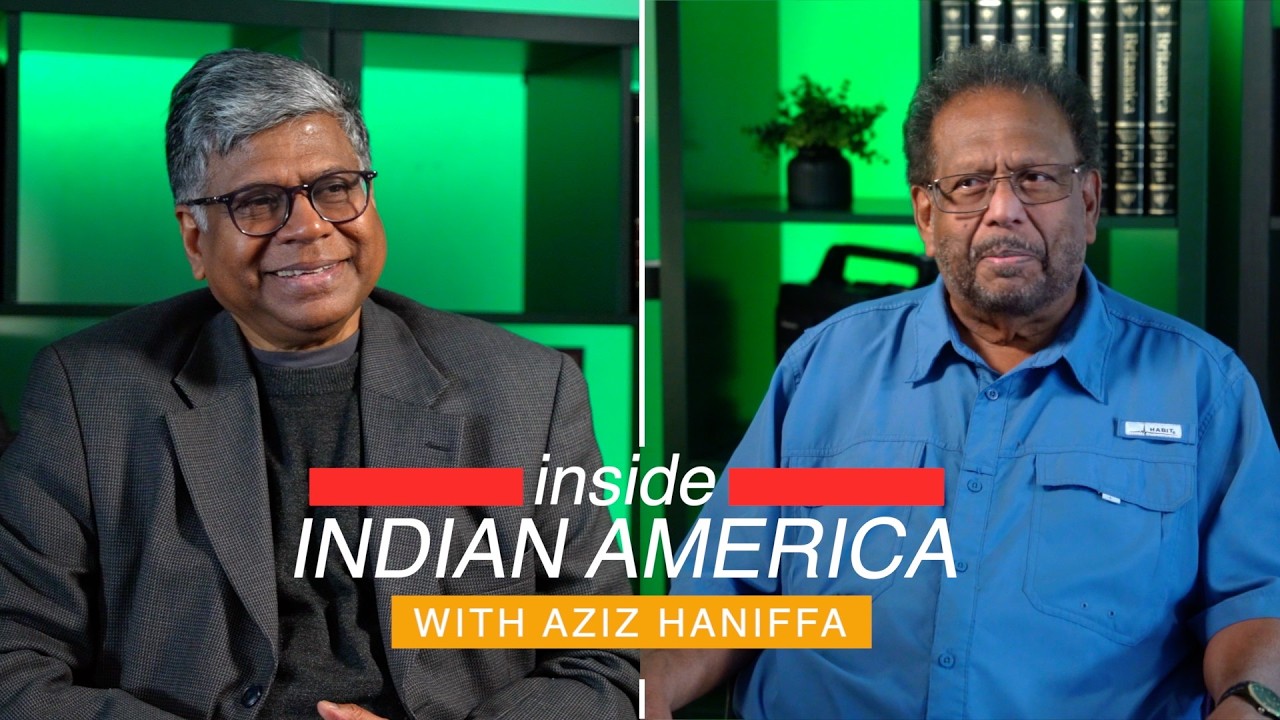
Chidanand Rajghatta came to Washington thinking that he would return to India after three years. “I didn’t have any … American dream… things kept happening that extended my stay.”
If you’ve covered Washington long enough, you recognize that pattern immediately: history keeps grabbing you by the collar. You arrive thinking you’ll do your tour, file your stories, and go home. Then the city does what it always does—it manufactures one crisis after another, and your departure date becomes a joke you tell at parties.
Rajghatta — foreign editor of The Times of India and one of the most seasoned Indian journalists in Washington — has been living that joke for over three decades.
In the latest episode of “Inside Indian America,” I sat down with Chidu, as friends and colleagues call him, to trace his accidental American life: the “three-year stay” that became a front-row seat to Monica Lewinsky, India’s 1998 nuclear tests, Kargil, the 2000 election meltdown, 9/11, Afghanistan and Iraq, the long arc of U.S.-India ties, and the parallel rise of Indian America—from a small professional diaspora to a community now shaping media, technology, politics, and the American ethos itself.
What emerged from our conversation was not just a reporter’s chronology. It was something closer to a living map of how Washington changed—and how Indian America changed with it.
Rajghatta arrived in the mid-1990s as a correspondent for The Indian Express. The Cold War had ended. India had liberalized. A new energy was moving through New Delhi — and, for the first time in decades, Washington was beginning to look at India through the lens of trade and possibility, not simply aid and geopolitics.
“When I … came here [in 1994], there were two very distinct trends,” he recalled. “One, India had liberalized… Narasimha Rao had become prime minister… Manmohan Singh was the finance minister… Bill Clinton was the president… and there’s a very dynamic commerce secretary named Ron Brown.”
The relationship was imperfect, but it was warming. And Rajghatta, like many foreign correspondents, soon discovered that Washington has its own gravitational force: the story always continues.
Inside Indian America with Aziz Haniffa | Vinai Thummalapally: From Obama’s roommate to the first Indian American U.S. ambassador (February 14, 2026)
He tried to leave repeatedly. Each time, history intervened.
“Every time I wanted to go back there would be something that would happen,” he said, such as the Monica Lewinsky controversy, India’s nuclear test in 1998, Clinton’s visit to India in 2000, and then one of the most controversial presidential elections in U.S. history.
The nuclear tests sort of slammed the brakes on the improving U.S.-India relationship
“That was the election that didn’t end,” he said. “Hanging chads… it went to Supreme Court… all the plans went out of the window. I couldn’t go back.”
Rajghatta had another plan that year, too. He was working on a book — “The Horse That Flew” — and imagined wrapping up his manuscript and flying back to India.
Then came September 11.
He was in Delhi for the book release. He had just returned to his hotel room, “champagne jetlag combination,” remote control in hand, when the world turned.
“I saw the second plane hit World Trade Center,” he said. “For a moment I thought I’m watching some HBO movie or something… And… before I know it, you know, I’m back here because now it’s another story and the next three years went by in a flash because you know we had 9/11, Afghanistan, Iraq.”
Three years became ten. Ten became twenty. And the temporary stay became a life, with all the domestic anchors that quietly turn a foreign posting into home: “a dog, a cat,” a mortgage, and a newsroom that now assumes you’ll be there for the next storm.
The Indian American story
What makes Rajghatta’s Washington story especially resonant is how closely it parallels a technology revolution that transformed India and the world — and, in many ways, transformed the Indian diaspora’s role in America.
READ: 7 in 10 Indian Americans disapprove of Trump: Carnegie survey(
Rajghatta’s own biography gave him a unique vantage point. He is originally from Bangalore, and he had seen India’s tech transformation begin long before Silicon Valley turned India into shorthand for coding talent.
“The first three U.S. technology companies which came to [Bangalore] in the ’80s… Texas Instruments… Hewlett Packard and… Nautilus… These three companies are the first modern IT companies… this is what kicked off India’s IT revolution.”
Then came the H-1B era.
READ: US India trade deal: Key takeaways from joint statement (
“The second thing was in 1990 was when the H-1B visa… kicked off,” he said. “So, you started to see more and more Indians come… and towards the end of the ’90s a lot of them came because of the whole Y2K problems.”
Rajghatta witnessed, more than immigration, a structural shift in America’s workforce: an infusion of engineers and technologists that helped power an innovation economy just as the internet was taking off.
It also changed the self-understanding of Indian Americans. The community began expanding rapidly, then settling, then integrating, and soon after, shaping.
“Literally, I saw the growth of the whole Indian population, which is now an Indian American population because most of them have… integrated into this,” he said.
Rajghatta was one of the very few Indian reporters in Washington to document this shift systematically.
He remembered hearing about Sabeer Bhatia and Hotmail — one of those early internet stories that carried an unmistakable Indian imprint.
“I heard the story that he had started something called Hotmail,” he said, recalling an anecdote Bhatia shared. A marketer misunderstood “hotmail” as something pornographic, until Bhatia clarified: “No, no, no, it’s M.A.I.L., not …”
Those stories mattered because they marked a break from the older stereotype of the Indian immigrant as only a doctor or engineer. These were founders, risk-takers, venture-backed entrepreneurs — the early contours of a community that would later become a pipeline for CEOs, investors, and political donors.
Rajghatta began connecting dots: Vinod Khosla at Sun Microsystems, Kanwal Rekhi, Jagjit Tandon, and others who had “founded companies… taken companies public.”
“In the ’60s, ’70s, 80s… those guys also didn’t do any self-promotion,” he said. “The techy guys… were low profile… but the guys who had got involved in politics… those were the sexy stories.”
So he went looking. “I spent time in California,” he said. “I went there quite often… I wrote a series… and that’s how the first book came.”
In a way, his career captures the pivot of U.S.-India relations itself: from a politics-first frame to a technology-first, economy-first understanding of the partnership.
1998: The nuclear rupture
No conversation about U.S.-India ties in the late 1990s can avoid 1998.
The nuclear tests did more than trigger sanctions. They froze momentum, embarrassed Washington, and ignited fury across party lines.
“Even the CIA didn’t know about [the tests],” I recalled during our conversation. “We heard it through CNN.”
Rajghatta explained why the Clinton administration felt blindsided: U.S. officials believed India would not test, and envoys had been told so.
“They had actually sent envoys… an energy secretary named Bill Richardson… met with… George Fernandes,” he said. “George apparently told him, ‘No, we have no… plans to test.’”
Then came the explosion.
“Two weeks later, you go kaboom,” Rajghatta said. “There was a lot of anger… not just Jesse Helms… even the Democrats… Madeleine Albright… everyone blew a gasket.”
Yet what fascinates Rajghatta — and me — looking back is that the rupture did not last as long as it could have. In geopolitical terms, the healing began quickly, aided by the Kargil war between India and Pakistan, by strategic dialogue, and by leadership on both sides that grasped the larger stakes.
“India was very lucky that they had Naresh Chandra as ambassador here,” he said, praising the late envoy’s steadiness, credibility, and direct line to Delhi.
And then came Clinton’s 2000 trip, which was transformational, not only for its optics but for its political psychology.
“The highlight… was Clinton’s speech to the Indian Parliament,” Rajghatta said. “Masterpiece.”
The reception, he said, was electric. “Like a rock concert… MPs literally gaga.”
History is full of “what if” moments. The nuclear tests could have derailed U.S.-India ties for a generation. Instead, the relationship recalibrated, then moved forward.
READ: Brahma Chellaney flags asymmetry in India-US trade deal, calls it ‘imbalance’ (
It would later produce the civilian nuclear deal — another improbable bipartisan achievement, pushed through Congress by an unlikely combination of strategic logic, lobbying, and political will.
“To look back and think that… George Bush pulled it off,” Rajghatta said. And he noted, pointedly: “A great guy in the US Senate who guided it through was Joe Biden.”
The rise of Indian America
As the conversation moved through the decades, it turned from diplomacy to demography — to how Indian America became not just larger, but more visible, more complex, and more embedded in the American mainstream.
Rajghatta pointed to the early growth of Indian American staffers on Capitol Hill — an ecosystem that barely existed when I started reporting for India Abroad in 1983.
“By this time… you began to see the presence of Indian Americans in government… public policy… staffers,” he said. “And then… what happened with congressional staffers… is now happening in the media.”
That may be the most important cultural shift of all: the diaspora no longer appears only as subject. It appears as storyteller: Writing the bylines, shaping the narrative, setting the terms of debate.
“Bylines… Wall Street Journal, New York Times, Washington Post,” he said. “Then comics… comedians… stand-up.”
In other words, Indian America stopped being a niche community and became part of the American story, across politics, journalism, law, entertainment, and corporate leadership.
Toward the end of our conversation, Rajghatta also discussed the current atmosphere: public diplomacy by megaphone, algorithmic outrage, and a harshness that spills from politics into social life.
He described today as “a very bleak time,” driven not only by policy but by culture — the emboldening of racism online, the public nature of pressure campaigns, and a sense of instability that discourages people-to-people ties.
“Social media… your platforms… it’s a sewage pit,” he said. “Populated by bots… driven by algorithms.”
He returned to what he considers the core contradiction: the desire to restore manufacturing and control borders colliding with a workforce reality that depends on global talent, especially in STEM.
“You don’t have the engineers… you don’t have the STEM graduates,” he said. “Keep them all out… and let’s see whether you guys can do it.”
And like any good correspondent, Rajghatta’s real gift is that he doesn’t tell this story as nostalgia. He tells it as a reminder: history is never finished—and Washington, for better or worse, always has another chapter ready to drop.