



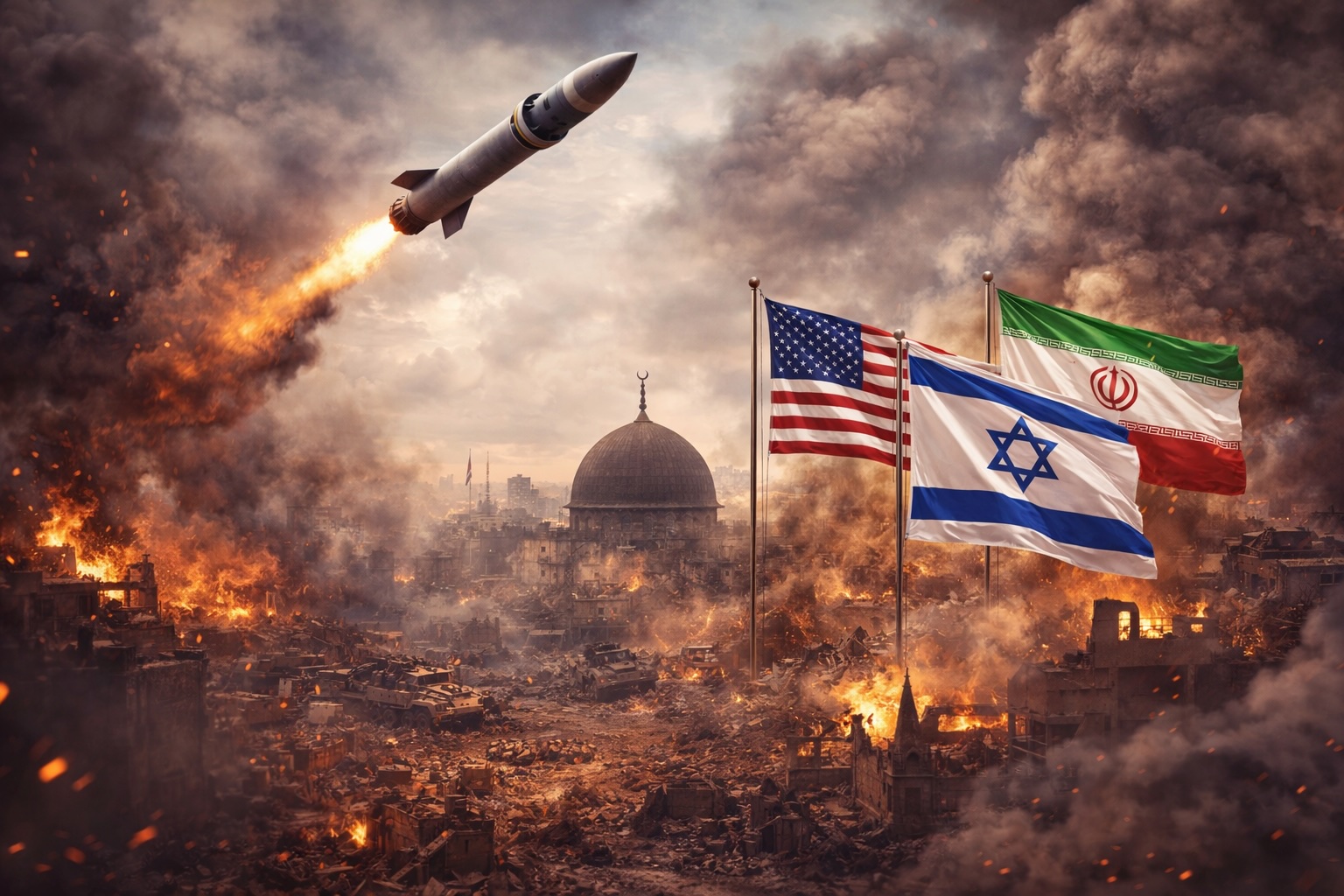
From the Strait of Hormuz to grocery bills worldwide, the consequences of war travel faster than the missiles that begin it.
Wars begin in necessity and end in regret. The confrontation with Iran risks proving both truths again.
The strikes that have drawn the United States and Israel into direct conflict with Tehran are already being litigated politically, legally, and morally. In Washington, lawmakers spar over the War Powers Resolution. At the United Nations, scholars debate whether the threshold for self-defense has been met. International humanitarian law hovers like a stern but distant parent, reminding all sides that even war has rules.
But legality is not abstract. It is the price of gasoline. It is the draft notice. It is the trembling hand holding a phone in Tehran, Tel Aviv or Dubai, waiting for a text that says: I’m safe.
Proponents of escalation argue that Iran’s missile programs and proxy networks demanded a response. The Wall Street Journal’s editorial page insists that credibility, once lost, invites greater danger. If threats are empty, conflict becomes more likely, not less.
Skeptics counter that deterrence without defined objectives is drift disguised as strategy. Decapitation strikes topple leaders but rarely steady nations. Military actions without a clear end state risk becoming a revolving door through which countries enter easily and exit painfully.
READ: Satish Jha | Escalation was a choice — and Washington held the deciding hand (February 28, 2026)
The American founders placed the power to declare war in Congress precisely to restrain executive passions. Sustained hostilities without explicit authorization erode not only law but the architecture meant to prevent unilateral war-making.
Jeffrey Sachs reminds us that diplomacy once produced the Joint Comprehensive Plan of Action, constraining Iran’s nuclear program through inspections and sanctions relief. Abandoning diplomacy for force risks validating hardliners and weakening norms against proliferation.
On the populist right, Tucker Carlson frames the conflict as elite consensus overriding public interest. Whether one agrees or not, the anxiety is real: decisions of immense consequence often feel insulated from everyday scrutiny.
This convergence—progressive internationalists and populist conservatives alike questioning escalation—signals fatigue. After two decades of Iraq and Afghanistan, Americans are wary of open-ended commitments. Israelis and Iranians alike are weary of permanent emergency. The perception that wars serve elite imperatives rather than popular will is combustible.
Meanwhile, the global economy listens not to speeches but to tankers. One-fifth of the world’s oil passes through the Strait of Hormuz. Even the hint of disruption sends futures markets upward. A sustained spike above $130 a barrel would ripple through grocery bills in Mumbai, bus fares in Nairobi, heating costs in Berlin. Inflation is not ideological. It is arithmetic.
The United Nations, envisioned as a brake on spirals of war, appears diminished. Security Council vetoes paralyze collective action. Investigations proceed, enforcement falters. International law without consequences is aspiration without anchor. Reform is possible: automatic triggers for emergency sessions, independent war-powers panels, tighter linkage between arms sales and humanitarian compliance.
READ: Satish Jha | When tablets vanish, future falters (February 27, 2026)
None would eliminate conflict. But they might slow the rush. Because speed is the hidden accelerant. Social media amplifies outrage before facts settle. Leaders respond not only to adversaries but to hashtags. Misinformation spreads faster than missiles.
In that environment, the most radical act is restraint. States do not operate in innocence, but neither do they operate without consequence. If this war remains limited, history may record it as contained. If it widens—if proxies ignite, if shipping lanes close, if defenses falter—it could become enduring and damaging.
Oil shocks tip economies into recession. Recession tips politics into extremism. The chain reaction is as old as geopolitics itself. What unsettles most is not the exchange of fire but the erosion of guardrails.
When citizens doubt constitutional process, when international law feels optional, when institutions seem incapable of arbitration, the space for “might makes right” expands.
Read more columns by Satish Jha
Democracy was designed to resist that expansion. Its premise: the costs of war must be borne by the many only after consent is secured from the many. Its promise: leaders are stewards, not proprietors, of national power.
The tragedy of elite-driven escalation is that it widens the distance between those who decide and those who endure. A missile launched in the name of security may land in a neighborhood that has never heard of the doctrine that justified it.
Wars redraw maps, budgets, memories. But they do not erase the question that preceded them: Was this the only path? That question lingers—in courtrooms, in parliaments, in oil markets, in refugee camps. It lingers in the quiet spaces between
(Satish Jha is a former Editor of the Indian Express Group and The Times of India Group and studied international relations at the Fletcher School of Law & Diplomacy and was a Ford Fellow in Foreign Policy at the University of Maryland)