



President Trump’s critics have not been wrong about the optics. Within days of Operation Epic Fury, the February 28, 2026 strikes on Iran, the Trump administration had cycled through at least four different explanations for why America went to war.

Special envoy Steve Witkoff said Iran was probably a week away from nuclear bomb-making material. Then the State of the Union framing invoked an Iranian intercontinental ballistic missile capable of striking the American homeland. Then Secretary of State Rubio suggested the U.S. acted pre-emptively because Israel was about to strike and inaction would have meant higher American casualties. Then Trump himself, contradicting Rubio, said Iran was going to strike first, on its own initiative. By multiple news organizations’ count, the administration was on its fourth contradictory rationale in under ten days.
Administration critics and government officials briefed on the operation expressed deep skepticism publicly: no coherent rationale, no endgame, no plan for the aftermath. Analysts offered careful Clausewitzian readings tracing the pattern of “mission creep,” how wars that begin with narrow goals (“degrade,” “disrupt”) drift toward open-ended abstractions (“restore deterrence,” “force compliance”) that airpower alone cannot deliver. Serious scholars raised the constitutional dimensions. Serious analysts from across the ideological spectrum are asking, with genuine alarm: What, exactly, is this war for?
It is a fair question, badly posed. Because the administration’s messaging is chaotic, it does not mean there is no strategy. It may simply mean the strategy is one the administration cannot fully articulate because doing so would require naming the actual adversary. And the actual adversary is not Iran, Venezuela, Greenland or Panama.
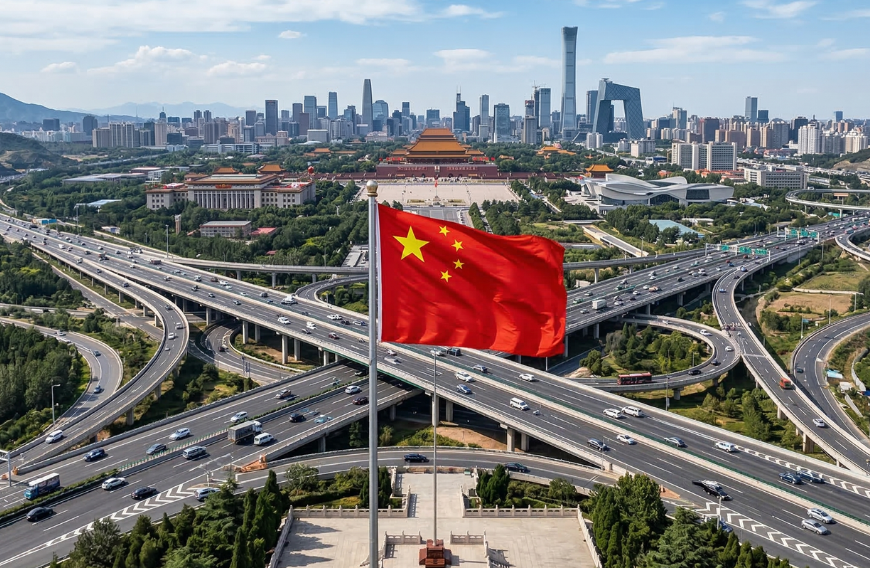
All signs, if you follow them far enough, lead to Beijing.
Objection one: “This is about nuclear weapons”
The nuclear rationale has been the most publicly prominent, and the most readily dismantled. The Defense Intelligence Agency’s May 2025 assessment projected that Iran could develop a militarily viable intercontinental ballistic missile by 2035, but only if Tehran made a determined push to pursue that capability. Multiple intelligence sources confirmed there was no evidence Iran had even initiated such a program. You do not go to war in February 2026 over a threat that is both conditional and a decade away.
READ: The Review by Ajay Raju |The coming Civil War inside law firms (February 23, 2026)
The Pentagon itself estimated that the June 2025 strikes on Iran’s nuclear facilities, conducted under the code name Operation Midnight Hammer, had set back Iran’s nuclear program by approximately two years. That assessment, offered by the Pentagon’s chief spokesman in July 2025, represented the administration’s own stated benchmark for success. You do not go to war again in February 2026 over a program you said you had already neutralized eight months earlier.
But the nuclear framing does point, however imprecisely, toward something real, not what Iran might do to America, but what a nuclear-armed, China-aligned Iran would mean for the balance of power in the Persian Gulf. A regime in Tehran that could operate behind a nuclear umbrella, free from the credible threat of overwhelming military response, would be a regime far more capable of doing what Beijing most needs it to do: hold at risk the twenty-one nautical miles of water between Oman and Iran that carry one-fifth of global petroleum consumption every single day.
The Strait of Hormuz, in other words, is the nuclear question’s subtext. Strip the nuclear framing away, and the geography underneath it is the same.
Objection two: “This is about helping the Iranian people”
Trump has floated what he calls the “Venezuela scenario,” the idea that after Maduro’s removal in January, Washington helped install workable leadership. The humanitarian and democratic liberation language is real, even if its sincerity is debated.
But consider the Venezuela parallel more carefully, and the China thesis snaps into focus. According to the U.S.-China Economic and Security Review Commission, Venezuelan oil made up approximately four to four-and-a-half percent of China’s seaborne oil imports. In January 2026, before the first bomb fell on Tehran, that supply line was severed. Reuters reported in January 2026 that Iranian oil, most of it traveling in tankers that relabel their cargo as Malaysian or Indonesian to evade sanctions, accounted for 13.4 percent of China’s total seaborne oil imports.
Venezuela and Iran together: roughly seventeen to eighteen percent of what China’s industrial economy runs on, eliminated in the span of six weeks. The “helping the Iranian people” framing is not false, but it is not the load-bearing argument. The load-bearing argument is that Washington wants to choose, or at minimum shape, what comes next in Tehran, and that what comes next must not be a regime that functions as a Chinese energy proxy and a potential Hormuz chokepoint operator.
Objection three: “This is Israel wagging the American dog”
This has been perhaps the most politically charged line of critique, that Trump is not the top dog in this equation, that Israel’s interests have driven America into a war that serves Tel Aviv more than Washington. The administration’s scrambled messaging on whether Israel forced America’s hand deepened the suspicion.
But this framing, too, misses the larger geometry. Israel’s security interests are real and legitimate. Iran has spent decades funding, arming, and directing proxy forces from Hezbollah to Hamas to the Houthis. The June 2025 Twelve-Day War, during which U.S. and Israeli aircraft struck Iranian nuclear sites under Operation Midnight Hammer, accelerated a dynamic that was already in motion. These are genuine Israeli concerns. They are also, not coincidentally, aligned with a broader American strategic interest in preventing a Chinese-armed Iran from becoming the master of the Gulf’s critical chokepoints.
The CM-302 supersonic anti-ship cruise missile negotiations, reported by Reuters based on six people with knowledge of the talks in late February 2026, make this alignment concrete. Iran was close to finalizing a deal with China for missiles that travel at supersonic speeds, fly low to evade shipborne radar, carry warheads capable of damaging or sinking naval vessels, and have a range of approximately 290 kilometers.
China had already supplied Iran with more than one thousand tons of sodium perchlorate, a solid rocket fuel ingredient, beginning in February 2025, with further large shipments confirmed throughout the year. The missile deal, had it been completed before the February 28 strikes, would have placed in Iranian hands a weapon specifically designed to threaten the U.S. Navy’s carrier strike groups, the very vessels that project American deterrence across the region.
Israel’s security interest and America’s strategic interest intersected, yes. But the gravitational center of both is not Tel Aviv. It is the South China Sea’s resource calculus made visible in the Persian Gulf.
Objection four: “The rationale keeps shifting — This is strategic incoherence”
This is the most serious critique, advanced rigorously by analysts at leading think tanks and in the documented record of the operation’s stated war aims. A formal letter Trump sent to Congress on March 2 cited four distinct rationales: protection of U.S. forces in the region; protection of the American homeland; ensuring the free flow of maritime commerce through the Strait of Hormuz; and collective self-defense of regional allies including Israel.
The letter said nothing of regime change, even as Trump spoke openly of it. Secretary of Defense Hegseth promised no “nation building quagmire” and no timeline in the same breath. One analyst invoked Clausewitz: war must remain subordinate to a defined political purpose, and when the political purpose is a moving target, the military is left without a benchmark for when to stop.
The incoherence at the message level is real. But the strategy is present at a level of abstraction that the public rationales have not yet reached, or have been designed to obscure. Let us state it plainly.
China is the world’s largest crude oil importer, drawing approximately 11.6 million barrels per day as of 2025. As of the first quarter of 2025, China alone accounted for 37.7 percent of all crude and condensate flows through the Strait of Hormuz, more than any other nation by a substantial margin, according to U.S. Energy Information Administration data. Forty-five to fifty percent of China’s total crude oil imports transit that strait. Eighty-four percent of everything that moves through the Strait of Hormuz is bound for Asian markets; China, India, Japan, and South Korea together account for sixty-nine percent of all Hormuz crude flows. The United States, for context, receives 2.5 percent.
A disruption of the Strait of Hormuz does not meaningfully threaten the American economy. It is potentially catastrophic for China’s. When Iran’s IRGC effectively closed the strait following the February 28 strikes, daily vessel transits collapsed dramatically. It was China that had dozens of vessels stranded in the Persian Gulf. It was China’s energy economy that reached for its strategic reserves. It was Chinese LNG imports from Qatar that went dark when Ras Laffan, one of the world’s largest gas production and export terminals, halted operations.
The apparent strategic incoherence dissolves the moment you ask: incoherent toward what goal? If the goal is nuclear nonproliferation, the messaging is a mess. If the goal is the humanitarian liberation of Iran, it is contradictory. If the goal is controlling the energy geography relevant to the great-power competition with China, that goal is being pursued with remarkable consistency, and the various public rationales are, at best, explanations for the instrument and not the purpose.
Rare earths, AI, and the 100-year race with China
To fully understand why Iran is a China story, you must zoom out from the Persian Gulf to the periodic table.
In April 2025, following Trump’s “Liberation Day” tariffs, China introduced export controls on seven heavy rare earth elements. By October, it had expanded those controls to twelve of the seventeen rare earth elements and crucially extended them extraterritorially, meaning that any foreign company, anywhere in the world, using Chinese-origin rare earth materials or Chinese processing technologies would require Beijing’s permission before exporting the resulting products.
A German manufacturer using Chinese-refined neodymium to produce magnets for American defense contractors would need Beijing’s blessing before shipping to Washington. In November 2025, under a diplomatic agreement reached at the Xi-Trump summit, China suspended the October expansion for one year, but the foundational April controls on seven elements remain in place, and Beijing retains the option to reactivate the full framework at will.
This is not a trade dispute. It is a demonstration by China of supply-chain sovereignty. The International Energy Agency’s 2025 Global Critical Minerals Outlook documented that China is the leading refiner for nineteen of the twenty most important strategic minerals, with an average global market share of seventy percent. Chinese state-backed monopolies control roughly eighty-nine percent of global rare-earth refining. For comparison, Western nations hold an estimated thirty-five to forty percent of global reserves but only ten to fifteen percent of refining capacity. Experts estimated that breaking China’s stranglehold would require a minimum a decade of sustained investment.
When China imposed its April 2025 controls, European rare earth prices in some categories reached six times Chinese domestic levels. American defense contractors scrambled. Factory utilization rates fell.
The Middle East has oil. China has rare earths. And rare earths, like oil, feed the competition that is the true engine of this era: the artificial intelligence arms race. Training large language models, running inference at scale, building the data center infrastructure of the digital future, all of this requires electrical power in quantities that dwarf anything the industrial economy demanded. The nation that secures reliable, affordable, abundant energy for its AI infrastructure wins the technological civilization race. The nation that cannot is permanently downstream.
China has invested in domestic energy with a clarity of purpose that is both admirable and alarming. In 2024 alone, China invested more than $625 billion in clean energy, thirty-one percent of the global total. Across the full year 2025, China added more than 430 gigawatts of new wind and solar capacity, roughly seven times American utility-scale additions for the entire year. In April 2025, China’s State Council approved ten new nuclear reactors in a single announcement. Clean energy and related technologies contributed more than ten percent of China’s GDP for the first time.
Notwithstanding these measures, China still imports the majority of its oil. For all its extraordinary energy ambition, the bridge between China’s present fossil fuel dependence and its renewable future is made of tankers passing through the Strait of Hormuz every day.
The Review by Ajay Raju: Bikini: What we don’t cover (
That bridge is the strategic pressure point. Limiting China’s access to reliable hydrocarbon supply does not merely inconvenience Beijing; it constrains the energy available for the AI infrastructure buildout that will determine which civilization sets the terms for the next century.
The coherent map: Hormuz, Panama, Venezuela, Greenland
Once you accept that the competition with China is the organizing principle, the apparently scattered foreign policy moves of the past year resolve into a coherent geography.
Trump’s insistence on removing Chinese-affiliated operators from the Panama Canal, through which significant Chinese commerce flows between the Pacific and Atlantic, reflects the same logic as the Iran operation. The U.S. action in Venezuela, which severed Chinese access to sanctioned Venezuelan crude, reflects the same logic.
The persistent American interest in Greenland, where melting Arctic ice is opening new shipping lanes that could alter trans-oceanic commerce, reflects the same logic. These are not disconnected impulses of an impulsive administration. They are moves on the same board, toward the same objective: constraining the energy geography available to the adversary in the ultimate contest.
It is the same reason Trump wants influence over who comes next in Tehran. A regime workable for Washington is not just a geopolitical abstraction. It is a regime that would, in a serious U.S.-China confrontation over Taiwan, consider using its position on the northern shore of the Strait of Hormuz to choke, rather than protect, the flows of crude that sustain China’s economic momentum.
The critics demanding strategic clarity deserve an answer. Here it is: the public rationales for Operation Epic Fury have been inconsistent, legally contested, and morally complicated. The administration’s messaging has been, on those terms, genuinely incoherent. Those criticisms land.
But incoherence in rhetoric does not require incoherence in purpose. The purpose is larger than nuclear weapons, larger than Iranian regime change, and larger than any Israeli security calculus, however legitimate. It is a long-game competition over who controls the energy that powers the AI that defines the civilization that sets the rules.
The Strait of Hormuz is twenty-one nautical miles wide. The contest being fought across it spans the entire horizon of the century ahead. Critics looking for the strategy have been searching inside the justifications. The strategy is in the geography. And the geography, followed to its conclusion, leads, as it has all along, to Beijing.