



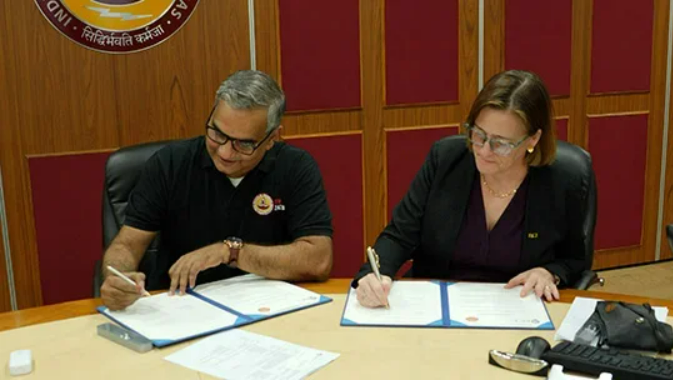
Rice University and the Indian Institute of Technology Madras have named the first recipients of their Strategic Partnership Collaboration Awards, signaling a significant step forward in a burgeoning academic alliance between the United States and India.
The awards, announced Friday, fund three faculty-led initiatives that span a diverse range of fields, from the decarbonization of industrial waste to the socioeconomic dynamics of women-led business ventures.
The partnership stems from a formal agreement signed in late 2024, designed to bridge the expertise of two world-class institutions located nearly 9,000 miles apart.
“The goal is to foster projects that address complex global challenges,” said Amy Dittmar, Rice University’s Howard R. Hughes Provost. “By investing in these teams, we are creating new pathways for discovery and long-term institutional collaboration.”
One project, headed by Rice’s Kai Gong and IIT Madras’ Piyush Chaunsali, aims to use artificial intelligence to solve a major environmental hurdle: the carbon footprint of the construction industry.
Their team is researching ways to upcycle industrial byproducts like red mud into sustainable cement binders, potentially reducing greenhouse gas emissions on a massive scale.
Read: OpenAI partners with IIT Madras, pledges $500,000 to learning accelerator
In the realm of social science, researchers Diana Jue-Rajasingh of Rice and Rupashree Baral of IIT Madras are investigating how corporate social responsibility (CSR) programs affect the perception of female entrepreneurs in India.
Their work seeks to understand whether these programs provide legitimate support or inadvertently create stigmas, with the ultimate goal of improving resource access for women-led startups.
The third award focuses on the frontiers of subatomic science. Rice physicist Wei Li and IIT Madras’ Prabhat Pujahari are collaborating on detector innovation for the Large Hadron Collider and the upcoming Electron-Ion Collider.
This initiative includes the establishment of a permanent silicon sensor testing laboratory at IIT Madras, ensuring the partnership leaves behind physical infrastructure for future generations of scientists.
The awards are a cornerstone of the “Rice Global India” initiative, a strategy launched by the Houston-based university to expand its footprint in South Asia. By focusing on student mobility and joint research, the program aims to turn academic curiosity into tangible, global impact.
The collaboration comes at a time of increased synergy between American and Indian higher education systems. As researchers from both campuses prepare for joint workshops and field experiments, the program serves as a model for how international cooperation can translate high-level theory into practical, human-centered solutions.