



Editor’s note: This article is based on insights from a podcast series. The views expressed in the podcast reflect the speakers’ perspectives and do not necessarily represent those of this publication. Readers are encouraged to explore the full podcast for additional context.
“None of the employees who work with us are employees. They are all my family members.”
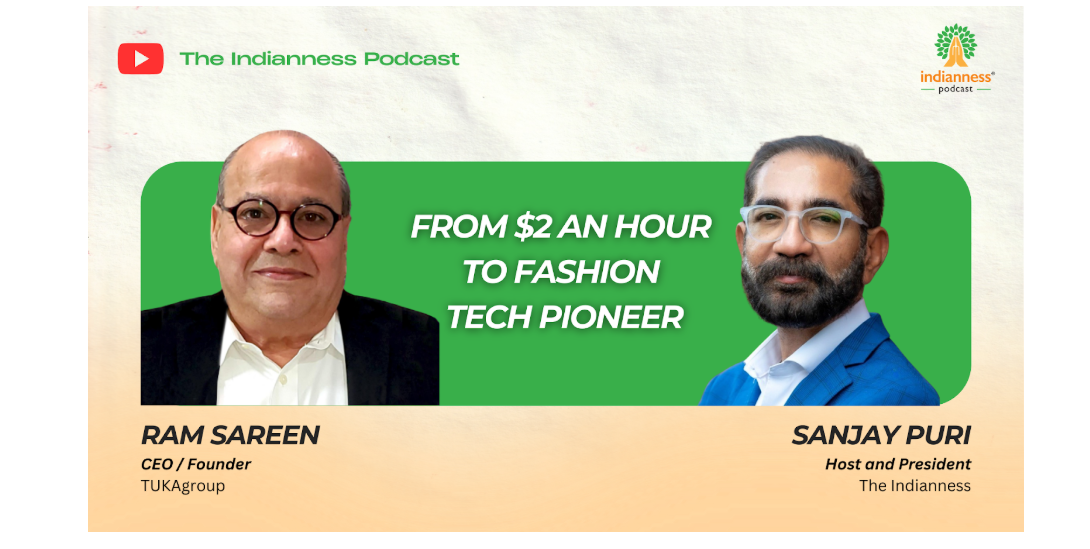
That line, shared by Ram Sareen, founder and CEO of Tukatech (TUKA Group), sets the tone for a deeply moving and insightful conversation with Sanjay Puri, host of the “Indianness Podcast.” In this episode, Sareen reflects on a life shaped by struggle, resilience, and values and how those experiences helped him build one of the most enduring technology companies in the global apparel industry.
Sareen’s journey began with just $24 in his pocket when he immigrated to Canada. What followed were years of uncertainty: recession, unemployment, delivering pizzas at night, drafting architectural drawings for cash during the day, and trying to keep his young family afloat. Those months left a permanent mark. Sareen made a vow during that time—never again to let someone else control his future.
Instead of chasing status, Sareen chased learning. He studied relentlessly, not to show off credentials, but to understand systems, people, and processes. That mindset propelled him from hardship to becoming a senior vice president at a $600 million company within five years.
READ: How Abhishek Singh is building India’s vision for responsible AI at scale (March 26, 2026)
Success came quickly and so did burnout. Sareen built consulting businesses, factories, and retail operations while working 14 to 18-hour days and traveling constantly. One honest moment changed everything, “My wife got upset one day, she said, ‘you know what, you’re not doing it for your children, you’re doing it for your own ego’.”
That truth hit hard. Sareen shut down his businesses and retired early, only to discover that a life without purpose didn’t suit him. After returning briefly to corporate life, he suffered a cardiac arrest, a moment that forced him to confront mortality and meaning.
At 45, Sareen made a decision that defied logic and cultural expectations. Using his retirement savings, he started TUKA Group without investors, without Wall Street pressure, and without shortcuts. As he explains on the podcast, the goal was simple: focus on customer success and people, not just profits.
Three decades later, that decision has paid off. While competitors were acquired or collapsed, TUKA survived. Today, it is the only American CAD/CAM company working across global fashion, space programs, and defense proof that values can be a competitive advantage.
One of the most powerful themes in the conversation is respect. At TUKA, everyone eats together from janitor to president. Kitchens were built in every office to remove hierarchy and build trust. Many team members have been with the company for 15, 20, even 28 years.
READ: ‘Leaving no one behind’: UNDP’s Robert Opp on using technology for inclusive development (March 25, 2026)
Disrespect, however, is a deal-breaker. Sareen has let people go not for lack of skill, but for lack of humility, “I have fired people for not being respectful to the other people… They are all equally important. They all add value for us to be in the business.” As he tells Puri, respect inside the company teaches respect for customers. Life, he believes, mirrors what you give.
Sareen hires fresh graduates instead of experienced professionals, preferring a clean slate and deep internal training. Through internships and partnerships with hundreds of fashion schools including NIFT, education remains central to TUKA’s mission.
His definition of innovation is equally grounded. Disruption, Sareen says, is not hype, it’s simplifying broken processes so artisans and technologists alike can succeed.
When asked what “Indianness” means to him, Sareen’s answer goes beyond nationality. It’s tolerance, humility, respect, and gratitude, according to him. Sareen credits blessings not ego for his survival and success, and lives by a simple philosophy: learn, earn, and give back.
After more than 30 years, Sareen’s story is not just about building technology, it’s about building people, relationships, and a legacy rooted in respect.