



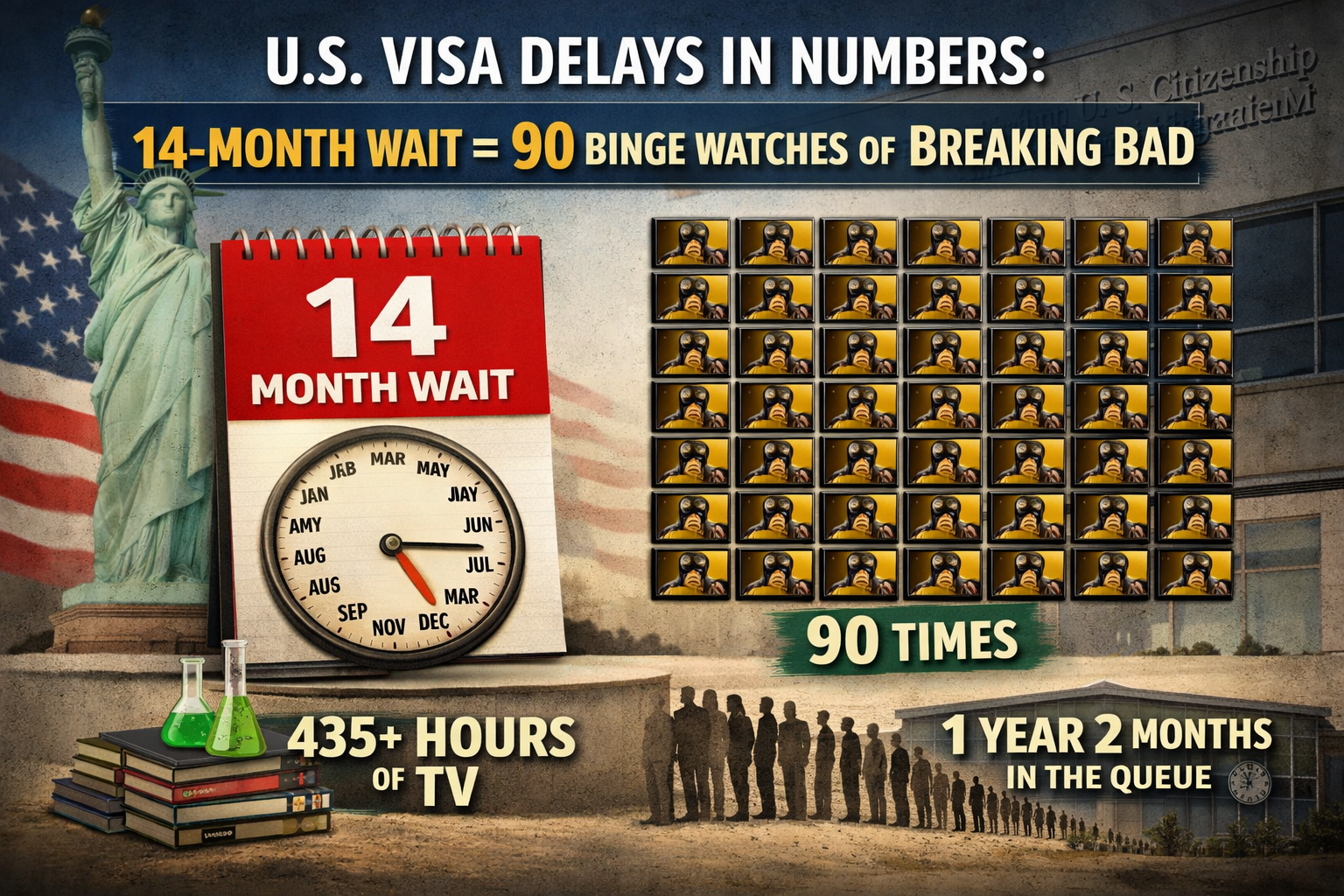
If you sat down to watch Game of Thrones, Breaking Bad, and The Sopranos back to back without a break, you would spend about 195 hours in front of a screen, just over eight days of continuous viewing. That marathon, however, is still far shorter than the time many immigrants now spend waiting for routine paperwork in the United States.
A new analysis by Mendoza Law Firm uses pop culture comparisons to highlight the scale of delays at U.S. Citizenship and Immigration Services, showing how processing timelines for common immigration applications have stretched dramatically and turned what were once routine updates into months long waits. According to the study, the average I-485 green card application is now pending for 12.5 months as of early 2026, with one in four cases waiting more than 18 months. In that time, an applicant could watch the full runs of all three series more than 50 times.
Green card renewals filed through the I-90 form now take over eight months to process, a sharp jump from under one month in early 2025. In practical terms, a lawful permanent resident who files on time could still see their card expire before the renewal arrives, despite enough time passing to rewatch Game of Thrones multiple times. Family based immigration is facing similar delays, with the I-130 petition, typically the first step for sponsoring a relative, now averaging 14.5 months for U.S. citizens. That is equivalent to watching Breaking Bad and The Sopranos roughly 90 times, or replaying Game of Thrones every week for more than a year.
The comparison highlights the scale of waiting in stark terms. The combined runtime of the three shows is about 195 hours, while an eight month green card renewal stretches to roughly 5,760 hours of calendar time. A 14.5 month wait for a family petition amounts to more than 10,000 hours. The visa backlog is not measured in episodes or seasons, but in the months that pass while applicants wait for decisions that shape their daily lives.
READ: Oracle, Amazon mass l put H-1B filings under scrutiny (April 3, 2026)
The study makes clear that these are not complex or unusual applications. Green card renewals are routine administrative updates for people who already hold lawful permanent resident status, and family petitions are foundational steps in a process that can take years but are expected to be resolved much faster. Yet more than 11 million cases remain pending at USCIS, most involving individuals already living and working in the United States, waiting for paperwork to catch up with their lives.
For many applicants, the consequences go beyond inconvenience. An expired green card can create immediate hurdles, as employers often require valid proof of status, while banks, landlords, and licensing authorities may treat an expired document as a gap in eligibility. Travel plans become uncertain. The situation has become more acute for those waiting on work authorization. After the automatic extension for Employment Authorization Documents was removed in October 2025, a delay can mean losing the legal right to work altogether. Data shows work authorization applications have dropped sharply, while long pending cases continue to rise.
USCIS processes around 10 million cases annually at full capacity, but new filings are exceeding completions, widening the gap and leaving applicants stuck in an expanding queue. For those waiting, the delay is not an abstract statistic but a missed paycheck, a stalled career, or time spent apart from family. The television comparison may make the numbers easier to grasp, but the reality behind those numbers is far more serious.