



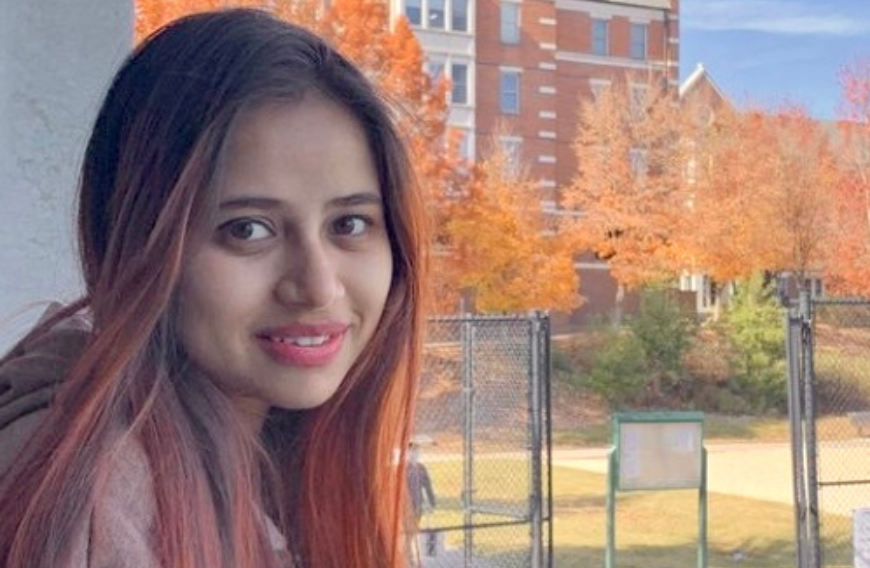
Angana Borah, an Indian-born doctoral candidate in computer science and engineering (CSE) at the University of Michigan, has been selected to receive a Rackham Predoctoral Fellowship for her research on culturally inclusive and socially responsible AI.
The award will support her ongoing dissertation research evaluating and improving large language model (LLM) behavior to better promote cultural inclusivity, truthful communication, and social well-being.
Awarded to a select group of doctoral candidates each year, the Rackham Predoctoral Fellowship recognizes students who have demonstrated outstanding accomplishments and/or progress toward the completion of their dissertations, according to a CSE release.
With a bachelor’s degree in Computer Science and Engineering from the National Institute of Technology, Silchar, Assam, Borah earned a master’s in Computer Science (Machine Learning specialization) from Georgia Tech before starting her PhD at the University of Michigan.
Read: Indian American researchers developing tool to spot AI‑generated radiology reports (March 26, 2026)
Her research addresses a fundamental challenge in modern AI: while LLMs are increasingly used on a global scale to seek information and interact, they are often trained and evaluated on data drawn disproportionately from WEIRD (Western, educated, industrialized, rich, and democratic) populations. This can lead to systems that overlook regional differences, reinforce stereotypes, and behave unpredictably in group settings.
To address these gaps, Borah’s work spans multi-agent AI systems and socially grounded evaluation of LLM and multimodal models. For instance, she led one of the first studies to distinguish implicit in multi-agent LLM interactions, showing that even when a single model appears unbiased in isolation, biased associations can resurface and escalate through agent-to-agent interactions.
In another project, Borah investigated how multi-agent systems can improve cross-cultural image captioning. She introduced a framework, called MosAIC, that uses agents with distinct cultural personas to generate richer, more culturally grounded captions, along with new datasets and metrics to assess cultural information in model outputs.
Borah’s research on these and other topics has already had a significant impact on the field, with her papers appearing at top conferences such as ACL, EMNLP, NAACL, EACL, and AAAI.
READ: Indian American researcher Rahul Kanadia decodes rare genetic sequences (April 6, 2026)
“Angana has already distinguished herself as a talented and impactful researcher,” said Rada Mihalcea, Janice M. Jenkins Collegiate Professor of Computer Science and Engineering and Angana’s advisor. “Few students at her stage can both set the research agenda by identifying open problems of global importance, and also deliver concrete, high-impact solutions that are already shaping the field.”
Beyond research, Borah actively contributes to the broader community through interdisciplinary collaboration and service. She has co-organized workshops, such as NLP for Positive Impact at ACL 2025, and has supported global engagement initiatives focused on teaching, mentorship, and outreach, including the EFH Innovation Sprint in Nairobi, Kenya, and the Eurolan Summer School in Romania.
With the support of the Rackham Predoctoral Fellowship, Borah will continue advancing research that helps ensure AI systems serve people more equitably across cultures and contexts, supporting a future in which widely deployed AI tools are not only capable, but also inclusive and socially responsible.