


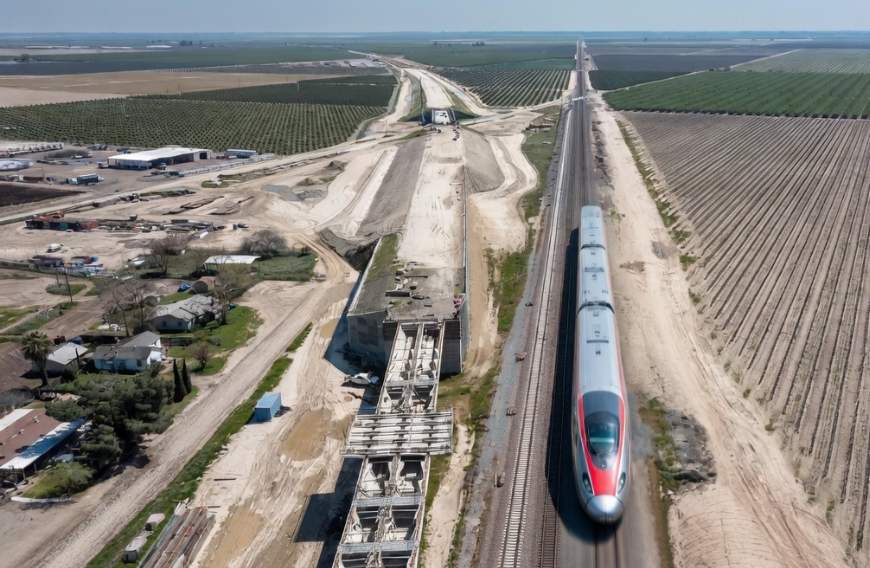
Elon Musk is not a fan of the burgeoning budget of the California High-Speed Rail project. The project has spent $14 billion so far on planning and early Central Valley work, with track-laying starting this year for a Merced-to-Bakersfield segment by 2030-2033.
“The @BoringCompany could build a Hyperloop tunnel from downtown SF to downtown LA for <5% of this cost and it would be a technological marvel exceeding any high speed rail on Earth,” wrote Musk on X.
The California High-Speed Rail project is one of the most ambitious and controversial infrastructure efforts in the U.S., with costs rising dramatically over time. Initially approved in 2008 at around $45 billion, current estimates for the full San Francisco–Los Angeles system have ballooned to roughly $100-$125 billion or more due to delays, inflation, land acquisition issues, and complex construction challenges.
The project has already spent about $13-14 billion, largely funded by a mix of California state bonds, cap-and-trade revenues, and federal grants. However, a major funding gap remains, especially for completing the full line, and inconsistent federal support has worsened delays.
In another response to an X user asking why The Boring Company cannot take this project up, Musk wrote “The real reason for the ‘high speed rail’ is money-laundering to bureaucrats, consultants & unions, not actually transport. That is where the billions spent so far have gone.
READ: Musk says Tesla may ‘tape out’ next generation AI6, continues to order Nvidia chips (March 19, 2026)
That is why they don’t want an actually cost-efficient high speed transport system.”
Musk has been one of the most prominent critics. As early as 2013, he proposed the Hyperloop as a faster and cheaper alternative, claiming it could cost as little as $6-7 billion. However, these claims are widely disputed as Hyperloop remains unproven and may face similar regulatory and engineering challenges.
Importantly, Musk later acknowledged that Hyperloop was partly intended to highlight alternatives rather than serve as a fully developed replacement. Overall, the debate reflects a broader tension between visionary innovation and the practical realities of building large-scale public infrastructure.
Projects of this magnitude often face evolving expectations, shifting priorities, and external pressures that extend far beyond initial planning assumptions. As costs rise and timelines stretch, public confidence can erode, making it harder to sustain long-term commitment and funding continuity.
In the end, the outcome will likely shape future approaches to infrastructure development, determining whether long-term, capital-intensive projects can still succeed in an era defined by technological disruption, fiscal scrutiny, and heightened public expectations.
READ: Intel joins Musk’s Terafab chip project for AI and robotics push (April 7, 2026)
What is Elon Musk’s Hyperloop?
Elon Musk’s Hyperloop is a proposed high-speed transportation system designed to move passengers and cargo in near-vacuum tubes at speeds exceeding 700 mph. First unveiled in 2013, the concept envisions pressurized pods gliding through low-pressure tubes using magnetic levitation or air bearings, significantly reducing air resistance and friction.
The goal is to offer a faster, more energy-efficient alternative to conventional trains, cars, or short-haul flights, potentially connecting cities hundreds of miles apart in minutes.
Musk initially suggested it could cost a fraction of traditional rail projects, citing the California High-Speed Rail as an example, though experts caution that the technology is largely untested and would face enormous engineering, regulatory, and safety challenges. While Musk open-sourced the concept to encourage development, his company, The Boring Company, has focused primarily on small-scale tunnel systems and proof-of-concept routes rather than a fully operational intercity Hyperloop.
1 Comment
If not overpriced– how do expect politicians to have enough to steal from!!