



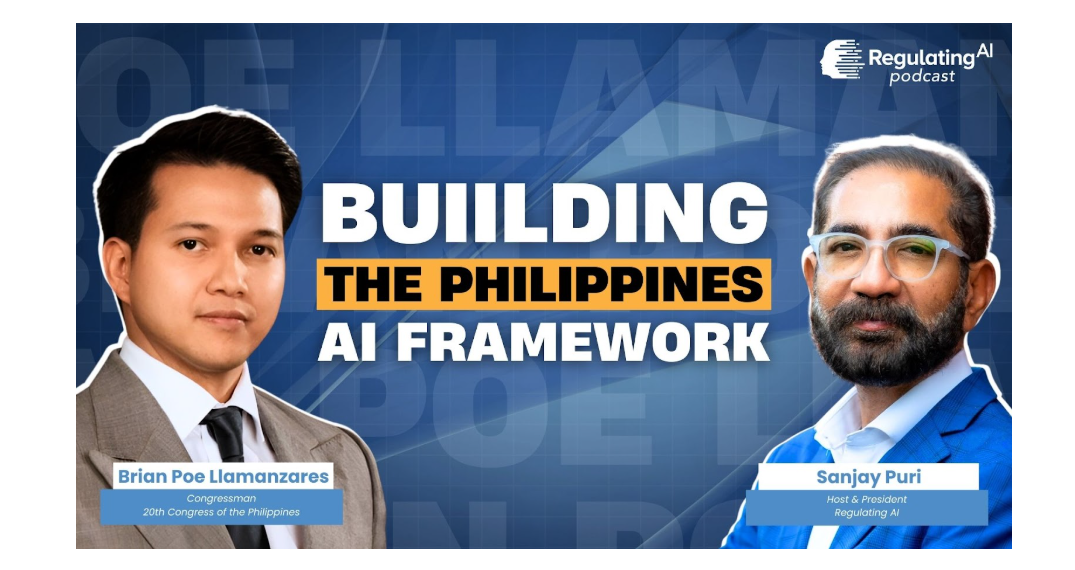
Editor’s note: This article is based on insights from a podcast series. The views expressed in the podcast reflect the speakers’ perspectives and do not necessarily represent those of this publication. Readers are encouraged to explore the full podcast for additional context.
On the “RegulatingAI” podcast, host Sanjay Puri sat down with Philippine Congressman Brian Poe for a timely and globally relevant conversation recorded live at Davos in late January.
The theme was clear: How do you regulate artificial intelligence without suffocating innovation?
For the Philippines, that question is no longer theoretical. It’s strategic.
s Poe explained, the Philippine AI ecosystem is still in its early stages, “it looks like a newborn baby, and for some people who might look at it and say, well, I guess I’m not going to invest there because it’s still very new. I’d like to remind them, as an emerging market, the potential is there.”
With a digitally native population of 120 million and a largely English-speaking workforce, the Philippines is uniquely positioned to attract global AI investment. Rather than trying to compete as a first mover with regional leaders, the country is choosing a smarter path: become an agile early adopter.
READ: Bharat Prabhakaran on reinventing education with AI at University of Cincinnati (April 9, 2026)
Unlike more mature markets, the Philippines is building its AI rulebook in real time. According to Poe, that means investors and companies have a rare opportunity to help shape the framework from the ground up.
During the discussion, a crucial issue was pressed on: Could heavy regulation scare away innovation?
Poe acknowledged the global debate around the AI Act in the European Union, where some founders argue regulation has gone too far. The Philippine approach, however, aims for balance.
The proposed AI framework bill adopts a risk-based model, categorizing systems by risk levels but pairs it with a regulatory sandbox and investment incentives. Poe describes the envisioned authority, “I would like to think of it more as a growth promotion agency rather than a regulatory agency… In the same context, government is always the greatest enforcer of rules, but also the greatest source of investment and growth.”
The signal to the international community is simple: if you want to build AI in the Philippines, do it responsibly and you’ll find a government willing to support you.
Across Asia, cybercrime and AI-powered scams are growing concerns, “There are a lot of scams that are ongoing. Deepfake is a global problem. We don’t want the Philippines to be a contributor in those fields. We want to signal to the international community that if you’re going to do business here, you’re going to do it the right way.”
Poe made it clear that the Philippines does not want to be a contributor to these risks. Instead, it wants to position itself as a credible, accountable AI hub within ASEAN and beyond.
By consolidating legislation around troll farms, deepfakes, and AI governance, Congress aims to create a coherent framework that protects democracy and consumer trust while still enabling innovation.
READ: Tukatech CEO Ram Sareen on building a business like a family (April 1, 2026)
One of the most compelling parts of the conversation centered on workforce disruption.
The Philippines has a large business process outsourcing (BPO) sector, one that AI could significantly reshape. Rather than waiting for economic fallout, Poe is advocating proactive upskilling legislation. Workers over 45 would receive priority reskilling support, and larger companies would be encouraged to absorb retrained talent.
The philosophy is pragmatic: AI is a tool. You cannot stop the wheel from turning, but you can prepare people to drive it.
Beyond economics, the Philippines is also investing in data sovereignty and localized AI systems. With over 70 dialects, the country is exploring ways to train AI models that reflect Filipino languages and culture.
As Poe emphasized on the platform, this is about more than technology. It’s about inclusion ensuring that digital transformation doesn’t erase identity.
In closing, Poe extended an open invitation, “…we are very forward-thinking, […] we are studying all the potential industries and policies that could give us a chance to make our country more accommodating to all of you to come and be a part of our digital revolution.”
For policymakers, founders, and investors watching from global stages like Davos, the message is unmistakable. The Philippines is not just regulating AI. It is designing an ecosystem where governance and growth move together and where emerging markets can shape the next chapter of artificial intelligence.