


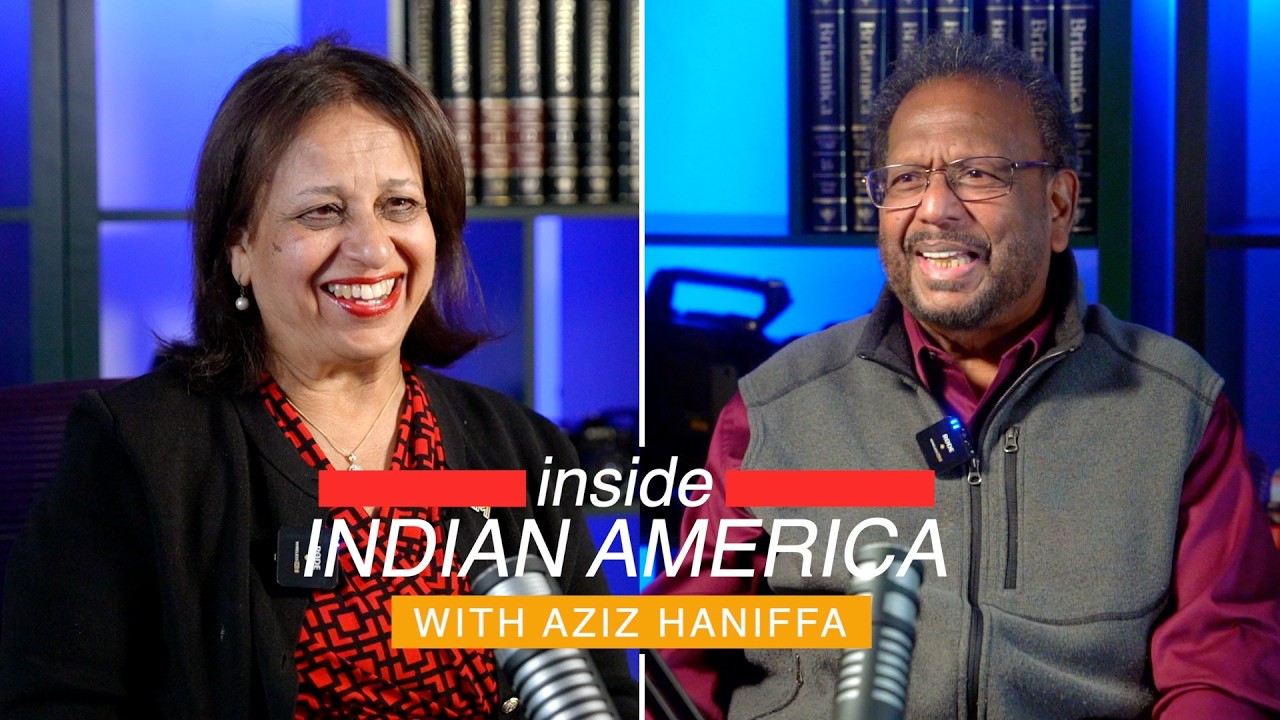
When Dolly Oberoi arrived in the United States in the early 1980s, she carried little more than a backpack, $200, and an idea that seemed, at the time, almost implausible.
“I want to see if I can … see a computer and what the capability is for education,” she recalls, describing the purpose of a journey that would ultimately define her life.
More than four decades later, Oberoi is the CEO of C2 Technologies, a major player in government contracting and technology-enabled learning. But her story — recounted in a wide-ranging conversation on Inside Indian America with Aziz Haniffa — is not one of linear success. It is a story of intuition before validation, risk before security, and persistence in the face of structural barriers.
Oberoi’s early years in New Delhi were shaped by a powerful example at home. Her mother, a refugee after Partition, had built schools for children who had little access to formal education. “She started the first school… one room schoolhouse there,” Oberoi says, recalling how her mother recognized the absence of educational infrastructure in West Delhi and set out to address it.
Over time, those efforts expanded into a network of schools serving first-generation learners—children from families with limited means and resources. “That was her mission. She wanted to be a nation builder,” Oberoi says.
For Oberoi, the experience was formative. Teaching at her mother’s schools after completing her education at Miranda House and the Delhi School of Economics, she encountered firsthand the limits of traditional education.
“They didn’t have water, they didn’t have electricity, they weren’t even living in proper housing,” she says. “No matter what I taught them… they were just not connecting the dots.”
That realization sparked a question—and eventually, a conviction—that would shape her future: could technology bridge that gap?
An idea before its time
In the early 1980s, computers were still a novelty—even in the United States. In India, they were virtually nonexistent in classrooms. Yet Oberoi found herself imagining a radically different future.
“I think we should bring computers to our schools,” she recalls telling her mother.
Her vision was expansive, even audacious.
“I said, ‘Yeah, because all these children, they can connect to kids in Africa and Japan and China…’”
There was just one problem: she had never seen a computer.
“Have you seen a computer?” her mother asked.
“No.”
What followed was a leap of faith that would define her trajectory. Using her first salary—₹22,000—Oberoi bought a round-the-world ticket.
“I had 200 bucks in a backpack,” she says.
Her goal was simple: find the technology, understand it, and bring it back.
That journey took her across the United States, where she stayed with friends, met engineers, and sought out anyone who could introduce her to computing.
The breakthrough came in Boston.
“I went to MIT and I saw this demo of big huge computer and what it could do for education,” she says.
That moment changed everything.
“I found the tree that grows the computers. I’m not coming back.”
Reinventing herself in America
Oberoi’s decision to stay in the United States marked the beginning of a long period of uncertainty. She enrolled at Boston University and later at Harvard, where she pursued a second master’s degree in innovations in education technology.
But the journey was far from easy.
“I didn’t have any money,” she says, recalling how she had to advocate for herself at every step—asking for fee waivers, negotiating alternatives to standardized tests, and taking on multiple jobs to support herself.
“I always say that’s the day when my entrepreneurial journey started because I had to raise capital to go to school.”
Even after graduation, the challenges continued. The world, it seemed, was not ready for the ideas she had spent years developing.
“People couldn’t understand it in the US either,” she says of early attempts to explain technology-driven education.
Unable to find a role aligned with her expertise, she took a job unrelated to technology—earning $12 an hour—while continuing to push her ideas forward.
Building the future before the internet
Her breakthrough came in Washington, D.C., where she was recruited to help develop a pioneering online education program for nuclear utilities.
At a time when the internet did not exist, the challenge was immense: how to deliver education to a geographically dispersed workforce.
“We didn’t have the internet… we had modems,” she says.
The solution was as innovative as it was complex—building systems that could deliver learning through early networked technologies.
“That was the first program… full scale bachelor’s degree program,” she says.
The project not only validated her ideas but also established her as a pioneer in a field that would later become mainstream.
The birth of C2 Technologies
Oberoi’s entrepreneurial journey began almost accidentally.
Working as a consultant, she was encouraged by a government client to formalize her work into a company.
“I said what do you mean?” she recalls. “You have to register… you have to do all that.”
With the help of her husband, Curtis, she took over a registered entity—C2 Technologies—and began bidding for government contracts.
Her first major breakthrough came with a contract from FEMA, where she developed distance learning solutions for training programs.
“I don’t know how to write an RFP response… but this is what I know how to do,” she says.
Despite competing against established firms, she won.
“Booz Allen and everybody else had been on it… and won it.”
The success was both exhilarating and daunting.
“My gosh, you know, we won four contracts. How am I going to execute them?” she recalls thinking.
Risk, partnership, and growth
The early years of C2 Technologies were marked by intense pressure. With limited capital and growing responsibilities, Oberoi faced a critical decision: scale the business or step back.
“I have to either go out and hire somebody… or I have to hire you,” she told her husband.
Curtis eventually joined the company, bringing operational expertise that complemented Oberoi’s vision.
“That was the best thing that happened,” she says.
Together, they navigated the challenges of scaling—winning contracts, hiring teams, and delivering on increasingly complex projects.
“We really killed ourselves to make sure we had a good reputation,” she says.
That focus on execution and customer trust became a defining feature of the company.
“Once you lose your reputation you can never recover,” she adds.
Breaking barriers
Oberoi’s journey was not just about business—it was also about navigating systemic barriers as a woman and an immigrant in a male-dominated industry.
“As a woman in a very aggressive… male dominated… and ethnically diverse… there were many challenges,” she says.
She recalls moments when clients dismissed her or misjudged her background.
“Many customers would speak to me in Spanish or dismiss me,” she says.
Yet, she refused to be deterred.
“I never felt daunted. I just felt like we have to solve the problem.”
A vision realized
Today, the ideas that once seemed futuristic—online learning, remote education, technology-enabled training—are integral to modern life.
But when Oberoi first imagined them, they were far ahead of their time.
“Online learning is something that people know today, 41 years later,” she says.
Her journey—from a young teacher in Delhi to the CEO of a technology company in the United States—reflects not just personal success, but the evolution of an entire industry.
It is also a reminder of the power of conviction.
At every stage—whether persuading a Harvard dean, navigating immigration hurdles, or pitching her first contract—Oberoi operated on a simple principle: act before the world is ready.
In doing so, she not only built a company but also helped shape the future she once imagined in a classroom in Delhi.