



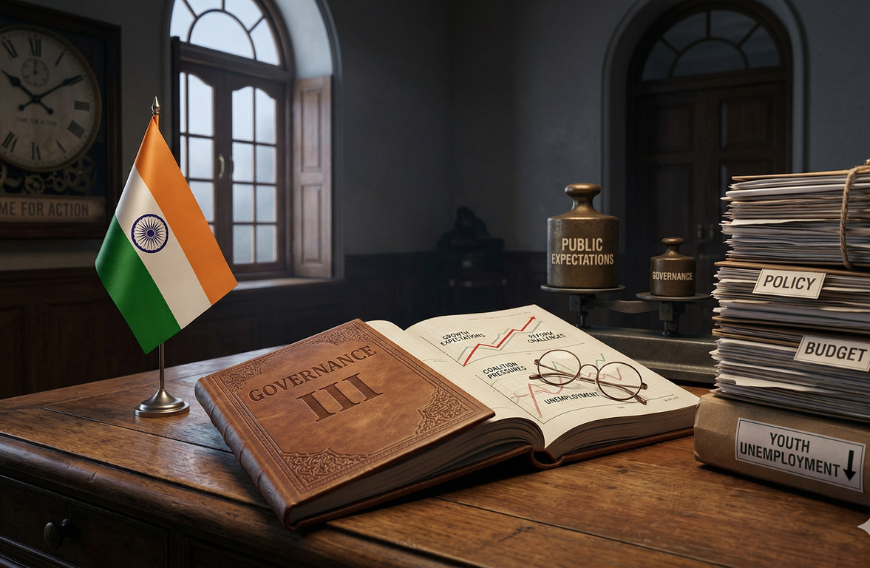
On a humid morning in Patna earlier this year, a 24-year-old engineering graduate refreshed a government job portal on his phone for the third time in an hour.
He had a degree, a certificate in data analytics, and a family that had borrowed to educate him. What he did not have was a job. Around him, millions like him form the quiet, restless substrate of India’s growth story—visible in statistics, but more acutely felt in waiting.
It is this India that Narendra Modi now governs in his third term.
Gone is the unambiguous mandate of 2019. In its place stands the arithmetic of coalition politics and the impatience of a young nation no longer satisfied with the promise of transformation, but demanding its texture.
As of April 2026, with West Asia in turmoil and global trade tensions tightening, Modi finds himself navigating not only a fragmented parliament but a more exacting public mood. The shift is subtle but profound: from commanding change to negotiating it, from announcing ambition to delivering lived outcomes.
The 2024 election verdict was less a rejection than a recalibration. Voters reduced the Bharatiya Janata Party to 240 seats—short of a majority—signaling that while macroeconomic performance remains respectable, it is no longer sufficient. Growth rates of 6.5–7 percent carry less political weight when employment does not keep pace. For young Indians, particularly the educated, the gap between aspiration and opportunity has become the defining tension of this decade.
This is not merely an economic problem. It is a structural transition that India has not yet fully acknowledged: the move from an infrastructure state to an employment state.
Over the past ten years, Modi’s government has been credited with building the visible architecture of modern India, most of them initiated during earlier governments. Highways stretch across states at unprecedented speed. Railways are electrified. Airports have multiplied. Digital public infrastructure — Aadhaar, UPI, direct benefit transfers—has redefined state capacity, bringing efficiency and scale to welfare delivery. These are not minor achievements.
READ: Satish Jha | Neighbors’ moment, our mirror (April 12, 2026)
But infrastructure, however expansive, does not automatically generate enough dignified work. Manufacturing has yet to absorb labor at scale. Logistics costs remain stubbornly high. Female labor force participation lags behind global peers. And the education system, while expanding enrollment, continues to struggle with quality and relevance.
The result is a paradox: a country that looks increasingly modern, yet feels unevenly transformed.
Coalition politics sharpens this challenge in ways that are no longer merely procedural. When Andhra Pradesh’s Telugu Desam Party secured its support for the government last year, the price included a special category status demand and accelerated funding for the Polavaram irrigation project—priorities that sit uneasily alongside the Centre’s push for uniform fiscal consolidation.
Bihar’s Janata Dal (United) has extracted similar concessions, threading caste arithmetic through infrastructure allocations. These are not peripheral negotiations; they shape the sequencing of national reform. Labor law consolidation, land acquisition amendments, skilling overhaul—each requires state-level alignment that coalition partners now hold leverage over.
For a leader whose political identity was forged on control and clarity, this is a different test—less about vision, more about accommodation.
And yet, this constraint may contain within it an opportunity. India’s next phase of reform was never going to be executed through central fiat alone. It requires political buy-in and social legitimacy that no single-party majority fully delivers. Coalition governance, if managed deftly, can become a mechanism for distributed ownership rather than diluted intent.
READ: Satish Jha | The Thali was full. The nation was not hungry enough (April 3, 2026)
The risks, however, remain real. Social cohesion continues to operate under quiet strain. Welfare expansion—housing, sanitation, cooking gas—has improved lives at the bottom of the pyramid. But rural distress, farmer anxieties, and uneven regional development persist. Inequality, while complex in measurement, is visible in perception: the sense that growth is not evenly shared.
In such an environment, economic policy is no longer judged only by efficiency, but by fairness.
Globally, the terrain is no less demanding. India’s foreign policy under Modi has been marked by energetic multi-alignment—engaging the United States, maintaining ties with Russia, deepening partnerships with Japan and Australia, and sustaining critical relationships in the Gulf. It is a strategy suited to an era of fluid power balances.
But 2026 has tightened the margins. Escalating tensions in West Asia threaten energy security and the safety of Indian expatriates. Supply disruptions translate quickly into domestic inflation. At the same time, the re-emergence of protectionism in advanced economies complicates India’s export ambitions. Strategic autonomy, long a guiding principle, now requires constant recalibration. The space for neutrality narrows as global rivalries sharpen.
All of this unfolds under conditions of relentless visibility. India’s 1.45 billion citizens are not passive observers; they are participants in a continuous national conversation—amplified by smartphones, social media, and a 24/7 news cycle. Policy is no longer consumed after the fact; it is contested in real time. For Modi, this creates a unique form of pressure: the expectation not just to act, but to constantly justify action.
What distinguishes the present moment is not simply its difficulty, but its compression. India does not have the luxury of gradualism. Its demographic window—often described as a dividend—will begin to narrow after 2030. The urgency is not rhetorical; it is structural.
READ: Satish Jha | The Full Plate: What does it mean? (March 30, 2026)
The question, then, is not whether India will grow. It is whether that growth can become meaningfully inclusive before time runs out.
This is where the narrative around Modi often becomes reductive. Critics who portray his tenure as one of unambiguous failure overlook the tangible expansions in state capacity, infrastructure, and global stature. Supporters who frame it as unqualified success risk ignoring the lived anxieties of those still waiting for opportunity. The truth, as is often the case in large democracies, lies in tension.
India today is neither stalled nor settled. It is in transition—between models of growth, between political styles, between expectations and delivery. Modi’s third term sits squarely within this transition. It will not be defined by announcements or symbolism, but by execution at depth: whether institutions are strengthened, whether skills match jobs, whether federalism becomes functional rather than frictional.
In Patna, the young graduate eventually stops refreshing the page. He will try again tomorrow. His patience is not infinite, but it is not yet exhausted either.
It is in that interval—between expectation and disillusionment—that the future of this government, and perhaps of India’s current development model, will be decided.