



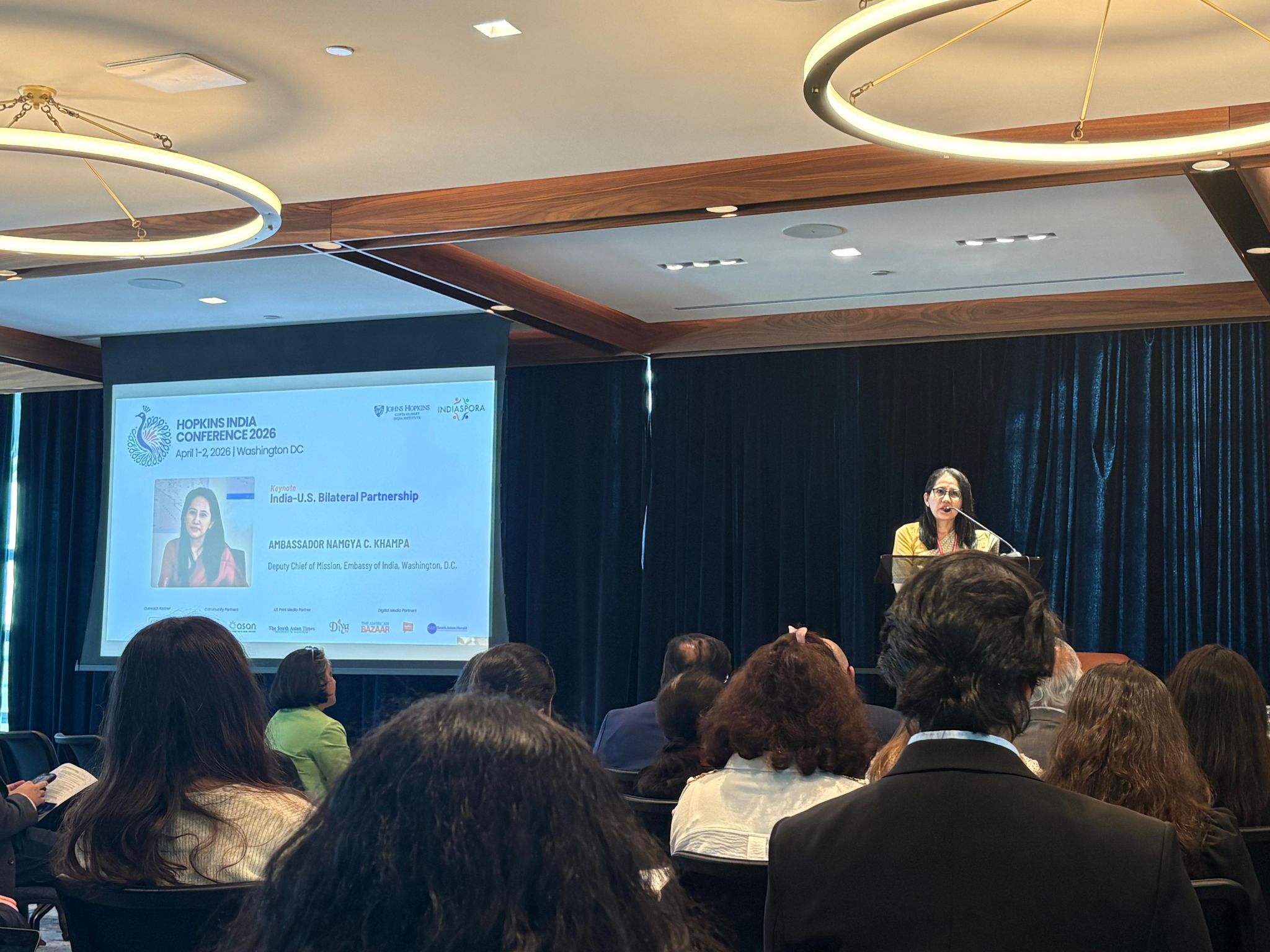
The Gupta-Klinsky India Institute (GKII) at Johns Hopkins University (JHU), in partnership with Indiaspora, convened the Hopkins India Conference 2026 at the JHU Bloomberg Center in Washington, D.C. This conference brought together leaders from government, academia, industry, and civil society to examine the future of the India-U.S. relationship in a rapidly changing global environment.
This conference is an annual flagship forum that advances international dialogue and collaboration across research, education, business, and policy. This year, it has been framed around the theme “Ideas, Innovation & Impact for a Shared Future.” The discussions focused on geopolitics, economic strategy, artificial intelligence, climate, public health, and philanthropy.
READ: From DeepTech to development: The big themes at Hopkins India Conference kicking off on April 1 (March 25, 2026)
The conference included a distinguished lineup of people, including Ambassador Namgya C. Khampa; Ambassador (Rtd.) Atul Keshap, Sunil Wadhwani, Managing Partner, SWAT Capital, President, Wadhwani AI; Lisa Curtis, Senior Fellow and Director, Indo-Pacific Security Program, Center for a New American Security; Rick Rossow, Senior Adviser and Chair, India and Emerging Asia Economics, Center for Strategic and International Studies; Anshu Gupta, Founder, Goonj; and other leaders across sectors shaping the India-U.S. corridor.
“This year, the conference convened a diverse audience to explore critical themes such as U.S.-India relations, the fast-evolving AI landscape, India’s DeepTech momentum, and reimagining systems in the climate era,” said Neetisha Besra, Director-India, Gupta-Klinsky India Institute. “The book discussion with Megha Majumdar was a particular highlight for many participants.”
Indian Union Minister Jayant Chaudhary, in a recorded message, emphasized the role of people-to-people ties, noting that talent mobility, including over 300,000 Indian students in the United States, continues to strengthen the foundation of the bilateral relationship. He said, “One of our strongest bridges is our people. With over 300,000 Indian students in the US, alongside a dynamic flow of researchers and professionals in both directions, we are seeing a powerful exchange of knowledge and skills. This movement of talent is not incidental.”
Ambassador Namgya Khampa, deputy chief of mission for the Embassy of India, described the Indian American community as a force multiplier that few bilateral relationships can match, and a reservoir of strength and goodwill for building the bilateral partnership between India and the United States.
“What was once careful, sometimes hesitant engagement has evolved into a partnership that is now central to how both countries envision the world around them—driven by intersecting interests: economic, strategic, security, and technological,” she said. “And this transformation is not sudden. It has been built steadily over years—across governments and through sustained effort on both sides.”
The conference hosted a series of high-level panels examining critical global and bilateral priorities throughout the day. Other panels included one on India in a fragmenting global economy, one on building India’s deep tech engine, and a climate-focused on reimagining systems for dignity and agency.
READ: Harvard hosts India Conference this Feb; Shashi Tharoor, Priyanka Chopra among the speakers (February 12, 2026)
In addition to the sessions on the first day, the second day convened invite-only roundtables focused on priority areas such as public health, women’s leadership in research, higher education, mental health, climate disasters, and training AI workforce, enabling deeper engagement among partners and stakeholders.
“The Conference brought together a diverse audience to explore critical themes shaping the India-U.S. corridor, from geopolitics and AI to climate and public health,” Kunal Pal, Executive Director, Gupta-Klinsky India Institute said. “The roundtables in particular enabled solutions-focused dialogue with key partners and stakeholders on how to translate ideas into action.”