



By Vinson Xavier Palathingal
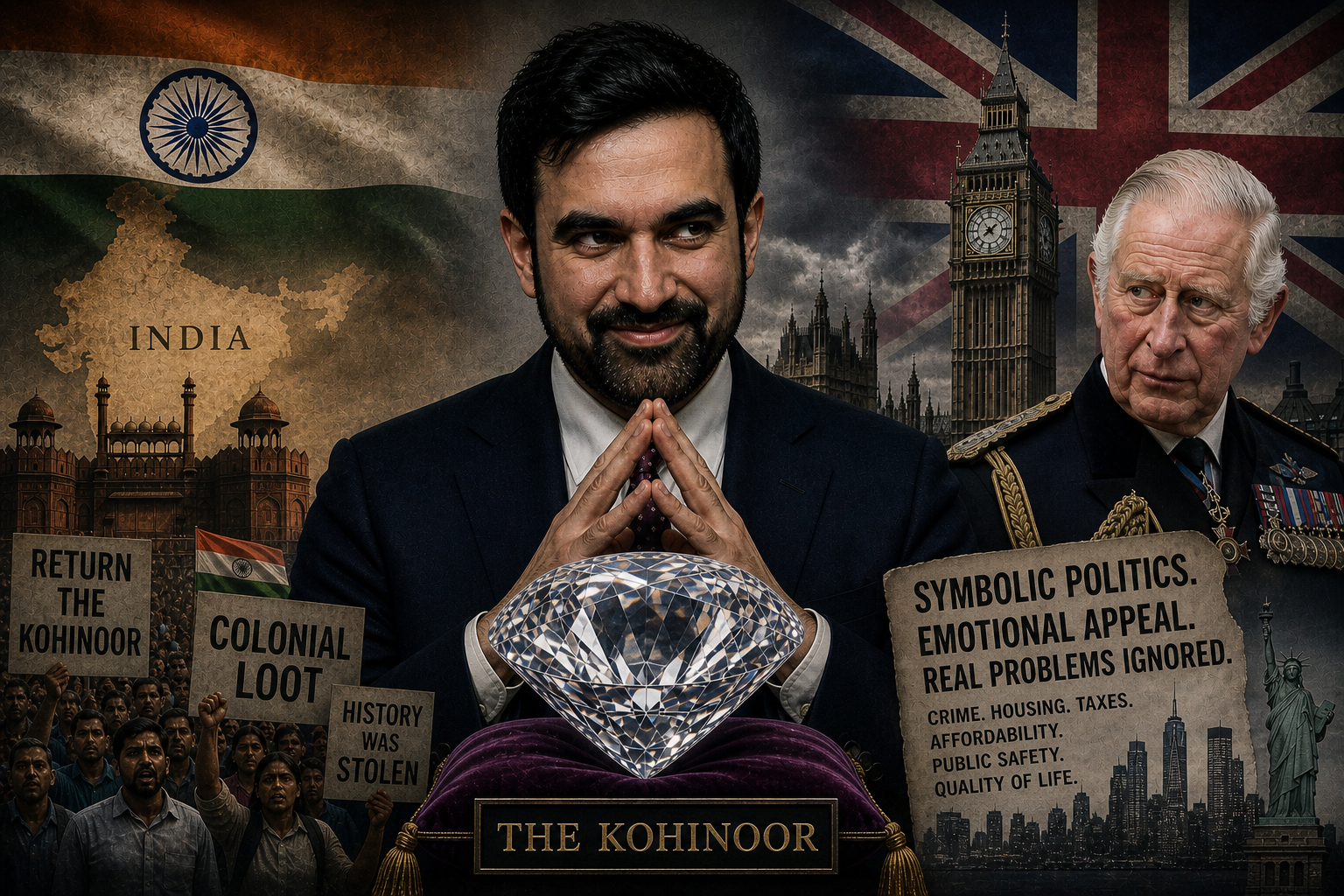
New York City’s Mayor Zohran Mamdani’s recent comments about the Kohinoor diamond and his use of Indian historical symbolism should be viewed less as a sincere concern for India and more as a calculated political strategy.
By invoking the Kohinoor, British colonialism, and even quoting Jawaharlal Nehru, he may be appealing emotionally to Indian American voters while distracting from the real consequences of his socialist policy ideas for New York City.
A politician thinking beyond New York
Mamdani is not just a New York politician making some casual comment about a historic diamond. He is a sharp, ambitious, and calculated political operator who seems to understand something very clearly: there is a leadership vacuum inside the Democratic Party, and someone like him can try to fill it.
The Democratic Party today has no single commanding national figure who can naturally hold together progressives, racial blocs, immigrants, young voters, activists, white radicals, and minority communities. Mamdani seems to see that opening. What looks like random activism may actually be the early construction of a national brand.
That is why his Kohinoor talk should not be treated as some innocent emotional comment about India. This is not really about a diamond. This is about voter targeting, emotional politics, and coalition building.
The Kohinoor is not about the Kohinoor
Mamdani knows exactly what he is doing when he talks about the Kohinoor. Many Indians, including highly educated and successful Indians, become instantly emotional when colonial history, British rule, white domination, and the Kohinoor are mentioned. Logic often takes a back seat, and ancestral sentiment takes over.
READ: NYC mayor Zohran Mamdani calls on King Charles III to return Koh-i-Noor (April 30, 2026)
That is the weak spot he is touching.
Mention colonial humiliation, mention the British, mention a stolen diamond, and suddenly, many Indians feel that someone is standing up for India. But what exactly does that do for New York? What does it do for schools, crime, taxes, housing, jobs, or public safety?
Nothing.
It is theater. But it is useful theater for a politician trying to expand his base.
A background built for identity politics
Mamdani’s own background gives him unusual political flexibility. He is the son of an Indian Hindu mother and a Ugandan Muslim father. That allows him to speak to several identity groups at once.
To Muslim voters, he can appear as a Muslim political voice. To Indians, he can appear as someone connected to India through his mother. To South Asians, he can represent immigrant success. To progressives, he can present himself as a global anti-colonial figure. To white radicals, he can sound like the next great socialist warrior against capitalism and Western guilt.
In today’s Democratic identity politics, that kind of biography is political gold. It allows one politician to speak to many tribes at the same time and make each group feel personally seen.
That is not statesmanship. That is political packaging.
The Nehru quote was no accident
Mamdani also did not randomly invoke India in his victory speech. He quoted Jawaharlal Nehru’s famous “Tryst with Destiny” speech:
“A moment comes, which comes but rarely in history, when we step out from the old to the new, when an age ends, and when the soul of a nation, long suppressed, finds utterance.”
The above line has enormous emotional power for Indians. He knew that. It was another signal, another wink, another calculated appeal to Indian-origin voters.
But Indian Americans should remember one important truth: Nehruvian socialism is not the reason for India’s modern rise. In fact, it kept India from rising for decades.
For years after independence, India was trapped under bureaucracy, centralized planning, license-permit raj economics, suffocating red tape, and suspicion toward private enterprise. India’s real rise began only when P. V. Narasimha Rao and reformers opened the economy in 1991, reduced controls, encouraged enterprise, and moved India away from the failed assumptions of Nehruvian socialism.
India rose when it moved away from socialism, not when it embraced it.
That is exactly why Mamdani’s socialism should worry New Yorkers.
What his policies could do to New York
Just as Nehruvian socialism held India back, Mamdani-style socialism can hold New York back. His ideas may sound compassionate in speeches, but the results could be destructive.
Punitive taxes on high earners and businesses may sound good to activists, but they can drive wealth creators out of the city, shrink the tax base, and push jobs and investment elsewhere.
Expanding government bureaucracy may sound like helping people, but large bureaucracies become expensive, slow, inefficient, and almost impossible to reform.
Rent-control-heavy housing policies may sound pro-tenant, but if they discourage new construction and private investment, they will only worsen housing shortages over time.
Hostility toward wealth creation may satisfy class resentment, but cities do not survive by attacking the people who create jobs, pay taxes, build businesses, and support the economy.
Soft or ideological approaches to policing may please activists, but public safety is not optional. When order breaks down, working-class neighborhoods suffer first.
Massive spending promises without clear funding eventually mean more taxes, more debt, more pressure on services, or more economic decline.
And identity politics over universal governance divides people into voting blocs instead of treating them as citizens with common interests.
New York already has serious problems: affordability, housing shortages, public safety concerns, transit failures, high taxes, and businesses questioning whether to stay. Policies that punish success and expand bureaucracy will not solve those problems. They will accelerate them.
Cities do not thrive by redistributing decline. They thrive through growth, order, competence, enterprise, and confidence.
Minority appeasement is not leadership
This is the danger of modern minority appeasement politics. Instead of uniting citizens around common values, politicians divide people into emotional groups and give each group its own political candy.
READ: Mamdani’s tax return reveals income, political strategy (April 25, 2026)


One group gets grievance language. Another gets anti-colonial symbolism. Another gets redistribution promises. Another gets religious or ethnic recognition. Another gets anti-wealth rhetoric. Everybody gets something emotionally satisfying. But the city gets bad government.
That may win elections. It does not build a great city.
When every community is being emotionally managed, nobody is being honestly led.
Indian Americans should not fall for this
Indian Americans should be especially careful. Some politicians know exactly how to manipulate immigrant emotions. Mention India, colonial wounds, British injustice, white guilt, or the Kohinoor, and many Indians immediately lower their guard.
But Indian Americans should ask practical questions.
Does talking about the Kohinoor improve schools? Does it lower crime? Does it reduce taxes? Does it create jobs? Does it make New York safer? Does it help Indian American children succeed in America?
If the answer is no, then it is theater.
And Indian Americans should not become cheap political customers who can be purchased with emotional references to their old country.
Final truth
History matters. Colonialism happened. The British took what they took. Empires rose and fell. That is history.
But obsession with reversing history makes people look foolish. Nations do not rise by endlessly crying over old wounds. They rise through strength, competence, wealth creation, discipline, military power, economic power, and serious governance.
If people truly want the Kohinoor back, stop whining and begging for it. History was decided by power. Nations that want treasures back must become strong enough to command respect, not complain endlessly.
Indian Americans should judge politicians the American way: by results, competence, policies, and what they do for the country feeding them now.
Not by diamonds.
Not by slogans.
Not by charm.
Not by emotional tricks tied to lands they left behind.