



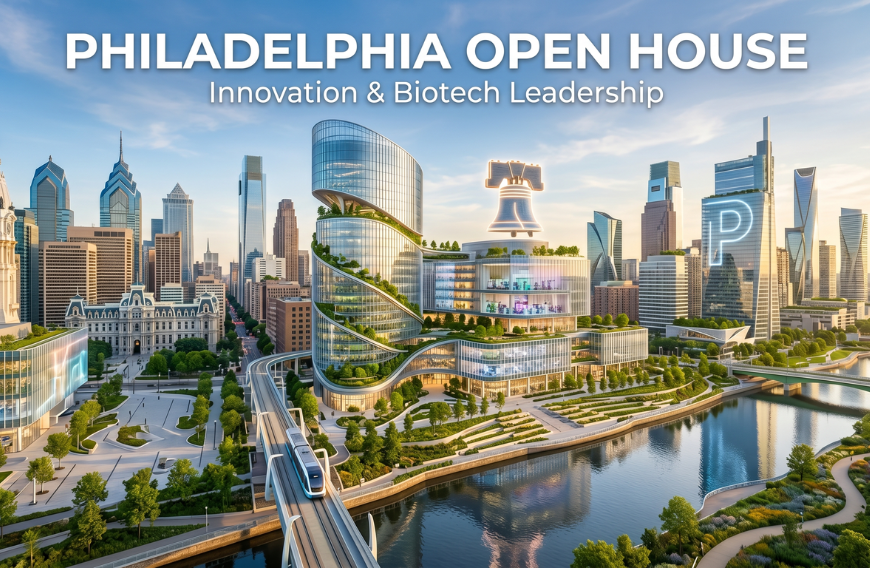
If you are a parent, you may have experienced that moment, just before a school’s open house begins, when the gymnasium fills with tension. Like other parents, you arrive carrying the quiet calculus of aspiration: what kind of child will my child become here? Which teachers will see them? What hallways will they walk? What reputation will attach itself to them like a second skin?

Cities work the same way. They hold their own open houses, though the invitations are issued less formally, through the nightly news, through a friend’s story about a weekend trip, through the accumulation of images that a place broadcasts into the collective imagination over decades. The prospective residents, investors, and talent pools of the world are sizing up every city, all the time, using the same unreliable and powerful instrument: perception. And perception, once set, tends to hold its shape long after the underlying reality has changed.
This is the paradox that confronts Philadelphia in 2026, as it stands before the world in its most consequential open house in a generation.
Zeitgeist
Every city develops a zeitgeist, a spirit of the age that becomes self-fulfilling. Tokyo’s cleanliness is not merely a municipal policy achievement; it is a cultural statement about what the Japanese people believe they owe to public space and to each other. It attracts people who value that orderliness, which reinforces the culture, which deepens the identity. Mumbai, by contrast, announces itself through controlled chaos, a city where improvisation is a survival skill, where density generates friction, and friction generates energy. Both cities are honest about their reputations and neither apologizes for its nature.
Singapore chose its identity with almost surgical deliberation. In 1959, a city-state with no natural resources and limited hinterland decided, under Lee Kuan Yew, that it would compete on order, rule of law, and human capital. Today it ranks as one of the world’s most livable cities, hosts the headquarters of global multinationals, and attracts a disproportionate share of Southeast Asian venture capital. Singapore’s zeitgeist was designed, not discovered.
Silicon Valley’s story is different in texture but identical in mechanism. What MIT’s Route 128 corridor failed to sustain in the 1980s, Stanford’s peninsula achieved through a culture of recombination, engineers leaving firms to start competitors, sharing ideas across backyard fences, tolerating failure as a credential rather than a scarlet letter. AnnaLee Saxenian, in her landmark 1994 study comparing the two corridors, traced the divergence not to patents or capital but to culture: Silicon Valley’s horizontally networked, failure-tolerant social architecture versus Route 128’s vertical, secretive corporate hierarchy. The culture determined the future.
Detroit understood steel and iron. Pittsburgh understood steel and then, with some pain, learned to understand software and medicine. Baltimore understood shipping, then discovered, too late, that the ships had left. The tragedy of post-industrial cities is not that their industries declined. All industries eventually decline, but that their identities never caught up to their new realities. They kept hosting open houses for factories that had already closed.
The Review by Ajay Raju: A Letter to the 2026 Graduating Class (May 11, 2026)
Reputation
Back to the high school open house. Think of two schools in the same city, a mile apart. One is known for its mathematics olympiad teams, its debate championship, its graduates who go on to Penn, Harvard, and MIT. The other is known, however unfairly, however partially, for violence in its hallways, for metal detectors at the entrance, for the constant churn of burned-out teachers. Imagine a student of extraordinary promise assigned to the second school by an accident of zip code. That student’s transcript, four years hence, will carry the school’s name. Graduate school applications are reviewed by humans who carry assumptions. That student must work twice as hard to overcome not their own deficits, but the institution’s reputation.
This is precisely how capital, talent, and leadership circulate in cities. The high-achieving founder choosing between Philadelphia and Austin is doing, consciously or not, the same calculation as that student’s parents at open house night. What reputation will attach itself to me here? What assumptions will others carry about my company because of where I chose to build it?
What is Philadelphia’s reputation? Depends on who shows up to give the tour.
The Philadelphia Story
If you were to let Philadelphia’s volunteers narrate its open house at random, which is, in essence, what the city does every time a visitor arrives without a curated experience, here is what you might hear, depending on your luck. One volunteer might lead you directly to Pat’s or Geno’s, narrate the great cheesesteak schism with genuine evangelical conviction, and consider the tour complete. Another might walk you through every room at Independence Hall, reciting the Constitutional Convention’s debates with the devotional intensity of a man who has memorized scripture. A third, perhaps less charitably inclined toward the city’s current condition, might start talking about the school district’s structural deficit, the still-elevated poverty rate, more than 20% of Philadelphians living below the poverty line as recently as 2023, or the years when the city averaged what amounted to nearly eleven homicides per week.
Each volunteer would be telling a truth. None would be telling the truth.
The uncomfortable reality of Philadelphia’s dual identity is that both narratives are simultaneously accurate and dangerously incomplete. The city that in 2021 recorded 562 homicides, the worst year in its recorded history, is the same city that in 2025 recorded 222 homicides, the lowest total since 1966. Homicides fell by 35% from 2023 to 2024 alone, the largest single-year decline among American cities with the highest homicide rates. And as of May 2026, the year-to-date homicide count is already running 38% below the same period last year. This is a transformation worth noting.
The city’s volunteer who leads with the old violence narrative is, in a very real sense, giving directions to a building that has been substantially rebuilt. But the city’s other volunteer, who pretends the challenges were simply resolved, ignores the fact that more than 300,000 Philadelphia residents still live in households with annual incomes of $33,000 or less for a family of four, that the unemployment rate rose to 5.1% in 2025, the city’s highest since 2021, and that population has declined, by nearly 2% since 2020, when the city briefly surpassed 1.6 million residents. The hard challenge of this open house is to hold both truths simultaneously and let the more consequential one lead.
The more consequential truth, the one that should anchor Philadelphia’s presentation to the world, is this: Philadelphia has been a laboratory of the human future since before the country had a name, and it still is.
Future Factory
From its legacy as the birthplace of cell and gene therapy to the development of the Nobel Prize-winning COVID-19 vaccine, and most recently the successful delivery of the world’s first personalized CRISPR therapy in May 2025, Greater Philadelphia continues to set the pace for life sciences innovation worldwide. This is not boosterism; it is the plain record of science conducted in West Philadelphia laboratories by researchers who chose to work here because the ecosystem is, in certain measurable ways, unmatched anywhere on earth.
Philadelphia’s life sciences sector contributes around $4.7 billion in direct economic impact and supports more than 27,000 jobs across Pennsylvania. The region attracts over $1 billion annually in National Institutes of Health funding, ranking among America’s top cities for federally backed research. It has also been designated a federal Precision Medicine Tech Hub.
The Greater Philadelphia region received $5.9 billion in NIH funding between 2019 and 2023 alone, and produced more biomedical degree completions than nearly any comparable metropolitan area. Four National Cancer Institute–designated cancer centers operate within its boundaries. In 2025, Philadelphia leapt 12 spots in the Global Startup Ecosystem Report to rank 13th among startup ecosystems worldwide.
The Review by Ajay Raju: Billboards, Gaza, and the ballot: Philadelphia’s Congressional race (May 6, 2026)
And the infrastructure is being built to match the ambition. TerraPower Isotopes recently selected Greater Philadelphia’s Bellwether District for a $450 million flagship facility, focused on producing actinium-225 for precision cancer therapies. Eli Lilly announced plans to open a new Gateway Labs incubator in Center City. Thermo Fisher Scientific opened its East Coast flagship Advanced Therapies Collaboration Center in partnership with BioLabs Philadelphia. The city’s operating costs run up to 50% below those in New York or Boston, while its location puts it within a six-hour drive of nearly 40% of the U.S. population.
But here’s the embarrassing truth. None of this is widely known within Philadelphia. It should be, of course. When Drew Weissman and Katalin Karikó won the Nobel Prize in Physiology or Medicine in 2023 for their work on mRNA technology, work conducted at the University of Pennsylvania, that prize belonged, in some meaningful sense, to Philadelphia. It was a product of the city’s peculiar genius: the dense clustering of research universities, teaching hospitals, and translational infrastructure that allows ideas to move, within years rather than decades, from a laboratory bench to a patient’s arm.
Carl June’s CAR T-cell therapy, which gave medicine its first weapon capable of hunting individual cancer cells through the immune system, that was Philadelphia, too. The first FDA-approved gene therapy, Luxturna, restoring sight to the genetically blind? Yup, Philadelphia. The city is, in the domain of human health, what Detroit once was in the domain of human mobility: the place where the future is assembled.
The high school known for academics does not typically need to advertise its reputation. The reputation advertises itself, through its graduates, through the careers they build, through the quiet pride of alumni who drop its name. But there is a period, often following a difficult stretch, when a school’s internal transformation has outpaced its external image. When that gap exists, the school must make a deliberate choice: tell its new story aggressively, or allow the old story to continue circulating.
Open House
Philadelphia sits precisely in that gap right now, as the United States marks its 250th year, and as the world arrives, for the FIFA World Cup, for NCAA March Madness, the MLB All-Star Game, and the PGA Championship, to take stock of the birthplace of the republic.
The PHL250 organizing framework, under Mayor Cherelle Parker’s vision for a “united city,” is investing across 20 neighborhoods and commercial corridors, targeting local business growth, community pride, and public space enhancements. With over $100 million invested and partnerships spanning more than 60 community and cultural organizations, the city is working to ensure residents and visitors alike can experience the vibrancy of America’s 250th anniversary. The ambition is genuine. But ambition and curation are different things. A hundred million dollars in neighborhood investment does not answer the question of which story gets told to a visitor who has six hours in the city and no guide.
That visitor will be shown around by whichever volunteers show up. And the volunteers who show up for a city’s open house, the journalists who file the crime stories or the innovation stories, the civic leaders who emphasize the deficits or the discoveries, the tour guides who walk toward the Liberty Bell or toward Penn Medicine’s Gene Therapy Innovation Center, collectively compose the city’s face to the world.
This is where the choice becomes genuinely consequential, and not just for tourism revenues or civic pride. Cities attract what they celebrate. If a city leads with its violence, it attracts residents and leaders for whom violence is simply a known quantity, a priced-in risk, a cost of doing business in a particular market. If a city leads with its intellectual infrastructure, it attracts people for whom intellectual infrastructure is the primary consideration, researchers, founders, investors, the globally mobile talent that now chooses its city with the same deliberateness that a previous generation chose its employer.
The feedback loops are not subtle. Tokyo’s culture of civic obligation did not emerge from a mayoral initiative; it was cultivated over generations, reinforced by the values that Tokyoites modeled for each other every day in every subway station. Singapore’s reputation for competent governance now constitutes a competitive advantage as significant as any natural resource.
Conversely, cities that led with their problems, that allowed their most troubled chapters to become their brand identities, discovered that the brand became self-selecting. The high-achieving student, given any choice, enrolled somewhere else.
Philadelphia’s open house in 2026 is a chance to be deliberate about selection, about which version of itself the city invites the world to see and, in seeing, to believe.
Tour Guide
I think about what an ideal volunteer guide for Philadelphia might say, standing at the corner of 34th and Spruce, in the shadow of the Penn Medicine hospital complex that treats more than a million patients a year and employs thousands of researchers chasing down diseases that have tormented humanity for centuries.
She might point west, toward the Bellwether District rising from the bones of a shuttered refinery, a thousand acres of former industrial desolation being reimagined as a campus for the next generation of medicines. She might point toward University City’s laboratory towers, where on any given day someone is working on a therapy that does not yet have a name because the disease it will treat has not yet been fully mapped. She might mention, with genuine wonder rather than practiced civic pride, that this city trained one in six of all the physicians currently practicing in America.
Then she might walk her visitor through the neighborhoods, through the Italian Market, through the murals of North Philadelphia, through the dignified rowhouse blocks of West Oak Lane, and explain that this city is not a monolith, that its genius and its grief live in close proximity, and that the proximity is not a flaw but a feature. That the diversity of condition is precisely what produces the researchers who understand disease in its full human complexity, the lawyers who understand justice from both sides of the bar, the artists who render beauty from materials that other cities would discard.
The Review by Ajay Raju: Mamdani’s NYC: Vote for hope, inherit the debt (May 4, 2026)
She might close by noting that Philadelphia has hosted revolutions before. That in 1776 it gathered the fractious, doubting, brilliant representatives of thirteen colonies and asked them to commit, in writing, to an idea that had never been tried at scale. That the document they produced was not a finished product but a proposition, a declaration of intent that the country has been arguing about and aspiring toward ever since.
This city, she might say, has always been better at beginnings than endings. We are still beginning.
A city’s image is, in the end, a collective editorial decision. Every day, Philadelphia’s residents and institutions and leaders make micro-choices about which story to tell, which achievement to amplify, which problem to confront publicly and which to manage quietly. Over time, these micro-choices aggregate into a narrative that the world receives and judges.
The cheesesteak is a fine ambassador. So is the Liberty Bell, and the Eagles, and the Rocky statue on the museum steps. They speak to something real about this city’s character, its appetite, its scrappiness, its complicated relationship with glory. But they should not be the only ambassadors in 2026, when the world is watching, and when Philadelphia has, in its University City corridor and its Bellwether District and its hospital towers, something genuinely rare: a functioning system for turning human suffering into human progress.
Last Word
Two hundred and fifty years ago, Philadelphia asked the world to believe that something new was possible. The world was skeptical. The experiment was fragile. The men who signed their names to it understood they were taking a wager against long odds.
The wager paid off.
The question before the city today is not so different. Will Philadelphia show the world its innovation factories, or its old reputation? Its mRNA laboratories, or its murder rate, which, by the way, is falling faster than nearly any comparable American city? Its gene therapies, or its cheesesteaks?
It depends, as it always does, on who shows up to give the tour.
The school known for violence will stay known for violence until the students it produces for mathematics go back and tell their own story. Philadelphia’s greatest act of civic leadership in this anniversary year might be to send the right students back to give the tour.