




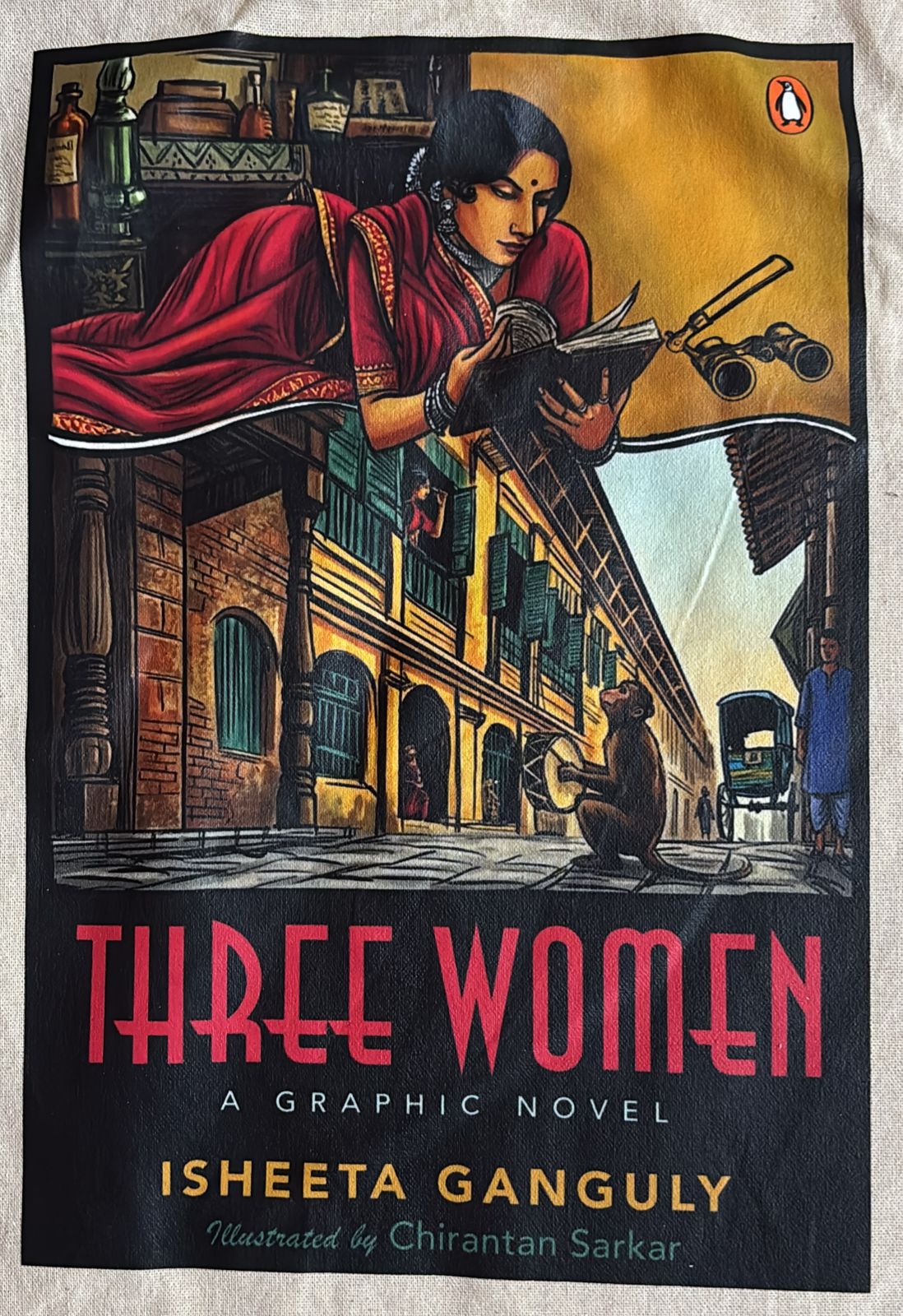
More than a century after Rabindranath Tagore wrote some of Bengali literature’s most memorable female characters, Indian American author and playwright Isheeta Ganguly is giving them a new life through a graphic novel that speaks directly to modern readers.
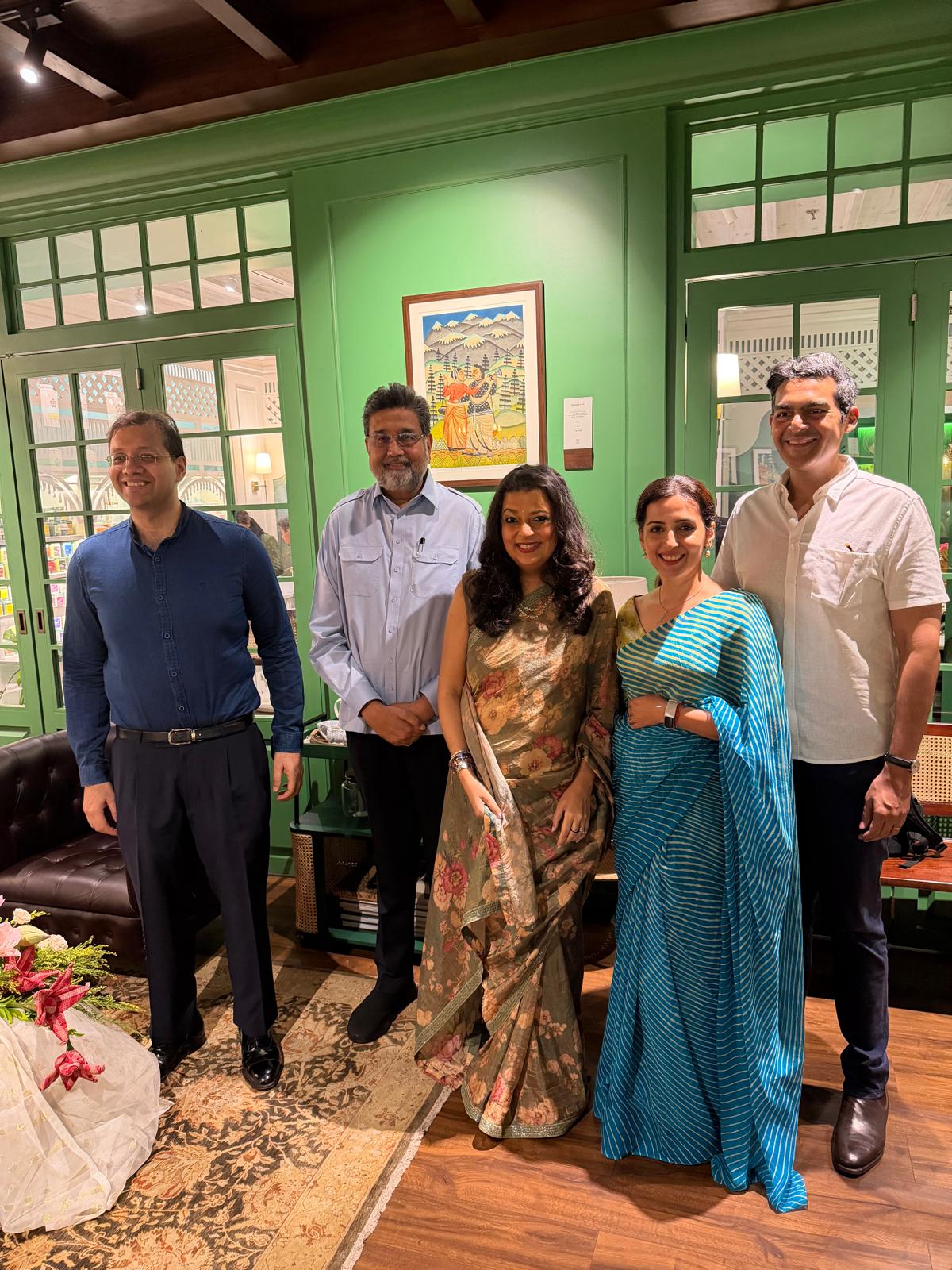
At a launch event held at the Makaibari Bungalow at Taj Bengal in Kolkata on Saturday, Ganguly introduced Three Women, a graphic novel inspired by Tagore’s writings on women and regarded as the first major publisher-backed graphic novel adaptation of his work. The event was attended by attended by industrialists Harshvardan Neotia, Rudra Chatterjee and moderated by Aritra Sarkar.
At the center of the book are two women familiar to generations of readers: Bimala from The Home and the World and Charu from The Broken Nest. Ganguly adds a third voice to the story, Kadambari Devi, Tagore’s sister-in-law, who returns as a guide and observer. Together, the three women navigate questions that continue to shape women’s lives today: Who am I? What do I want? How much of myself should I sacrifice for love, ambition, or society’s expectations?

For Ganguly, those questions are just as relevant in 2026 as they were in Tagore’s time.
Speaking at the launch, she said, “…I feel in 2026, in different ways we are all still, as women, negotiating different aspects of identity. Who am I? How relevant am I? Do I matter?’ While men were distracted by their newspapers in Bhupati’s time, in the 21st century, they’re distracted by their iPads and their iPhones, right? So, it’s more of the same, but women are still aspiring towards defining their identity.”
During an exclusive conversation with The American Bazaar, Ganguly was asked how she would introduce these characters to readers in the United States.
“So, this play has been performed widely all over the US with a tremendous response in NYC, Dallas and Chicago alike. Women all over the world relate to other complex women and don’t have to necessarily have to know anything about Tagore or Satyajit Ray. The beauty that I have found of this production, I don’t want to say the beauty of my work, but the beauty of the audiences around the world is that even in a city like Bombay, which doesn’t particularly know Tagore or Ray, this play has found huge audiences of packed houses over years because it’s ultimately about men and women and the complexities that exist in aspiration, desire and ambition.
“American Bazaar, as always has a multiplier effect in reaching audiences in my home base as an Indian American. We just did a soft launch in New York City last week and we’re doing another larger one on July 23rd at the AICON gallery downtown in NYC. Drama, humor and women-centric issues are global, just like we can relate to Virginia Woolf and Anna Karrena from wherever we are, people can relate to Tagore’s heroines from all corners of the world as they are global women.”
Ganguly believes audiences connect with the characters not because they are Bengali, but because their struggles with love, ambition, loneliness, and self-discovery are universal.
One of the most intriguing aspects of Three Women is the role of Kadambari Devi. Rather than treating her as a tragic historical figure, Ganguly imagines her returning with the wisdom of hindsight to help Charu and Bimala avoid the mistakes that shaped her own life.
“Kadambari returns to the 19th century with a cosmopolitan glass, with the insight of what a “90s rulebook woman” is. Is she living by the “rules” or not? And she guides her two fictional counterparts, Charu & Bimala, which are of course in part recreations of her real-life character. What if she guides them to better, less catastrophic outcomes? And she comes and says that, ‘Look, don’t make the same mistake I did and kick the bucket and pop it. Don’t fall in love pointlessly.’ And I used love as a sort of metaphor. So, of course, there’s the romantic love, but there’s also the aspect of don’t aspire for anything where you lose yourself in the process.
“And Kadambari comes back with this wisdom to guide Charu and Bimala to become more realistic more “with it” and more pragmatic, so that they don’t end up like falling all over themselves and committing suicide as she did. And there’s a certain dark comedy in that tragedy. So, I think I like tragic comedies. So, that was sort of what, in part, inspired me to create a ghost out of her.”
But Ganguly said the book is equally about Kadambari’s own journey.
“The grief was not in vain. I personally believe that Rabindranath became Rabindranath because of Kadambari. He became prolific, his songs, poetry, novels, paintings that were sparked by the grief and I think the sense of abandonment that he felt by Kadambari’s death because she was a mother, a sister, perhaps a romantic companion, all of those things in one. There was a deep sense of abandonment that it haunted him until the last days of his life before he passed away. The last paintings were of her and so in my fictional recreation, Kadambari realizes that her death was not in vain, that it in fact created the genius that Tagore became for the world. Underappreciated to the world, I still feel, but a genius nevertheless.”
That realization becomes a turning point in the story, forcing Kadambari to question whether she is trying to save Charu and Bimala or herself.
“So is Kadambari saving Charu and Bimala or is she trying across time to save herself through them? So I think she starts the journey in the book thinking that she’s saving them and then they break her down and they sort of say, listen, who are you to be telling us that we should be doing A, B and C when you committed suicide and threw the towel in?”
“And at that point, Kadambari takes a step back and realizes that she thinks she had the answers but she really didn’t and that her grief as a ghost is something that’s encapsulated inside of her and the rest people sort of have to read to discover.”
“But yes, she starts thinking that she’s saving Charu and Bimala and then in the end she does save herself of sorts. I think that’s really a very beautiful theme of not really knowing and yet at the same time your own journey through the unknown leads you to the answer. I think that’s come out very beautifully”
The story also looks back at Bengal’s Renaissance period, when women were beginning to enter public life but remained constrained by social expectations.
“The Bengali Renaissance was during a time where Bengal’s freedom movement were first enabling women to come out of the kitchen. You know, there was that certain movement where they had taken their pots and pans and come out onto the streets and sort of to march for the movement, for the freedom movement. And Bimala and Charu are a product of that great intellectual Renaissance, yet completely unexpressed, silenced, and told to stick to their hobbies, you know.”
While much has changed since then, Ganguly believes many women still feel pressure to live up to standards created by others.
“…still in that circle and cycle. As far as we have come, we are defined by… I don’t want to call it the patriarchy, but we are defined by a larger reality which is… which we feel we have to measure up to.”
The discussion also touched on beauty, self-worth, and ambition.
“I think one of the things that the graphic novel and the play tackles is what is beauty? You know, we live in a time still where women are so defined by beauty.”
Ganguly said another theme connecting women across generations is the tendency to feel guilty for wanting more.
READ: Six Indian Americans among Fortune’s 2026 Most Powerful Women (June 3, 2026)
“And for wanting it. Why do we feel bad? What is there to feel bad about? If you want to achieve more in a particular sphere, or you want… Exactly. And there is that constant sense amongst the most liberated women, who are urban women, like all of us in this room, who are apologetic for wanting more. And I think that theme drew me very deeply about these characters.”
Asked whether younger women face the same challenge, she said Gen Z women appear more confident and self-assured.
“Do you think that’s a particular problem, or this is something which, let’s say, is also affecting younger women today, the Gen Zs and the alphas, or is it something which has, which is restricted to maybe our generation? I think that’s a great question. What I find with working with Gen Z women, they are far less, they’re far less apologetic. I think they have a much more self-possessed view of the world.”
“There’s a line in the play where, I think Charu and Bimala are saying at the end, why can’t we learn from Gen Z women? They’re all about what does the world, instead of thinking about what does the world think of me, what do I think of the world? I think Gen Z women are like that.”
At the same time, she expressed concern about body image pressures amplified by social media.
“But I think what disturbs me about some of the realities I see Gen Z women negotiating are things with body image, beauty, again, if I look at these Instagram reels of Gen Z women, why are they disappearing? Why have we gone back to being size zero and size negative 0.5? I mean, where are we in the women’s movement? If there is that much pressure for this generation to feel like they need to be that thin in order to be considered beautiful, right?”
“For all the liberation in terms of career, I think they are much more self possessed than I was, there is a setback in terms of body image and self concept which feels regressive.”
Another major theme in the book is desire. For Charu and Bimala, love is not simply about romance but a pathway to creativity and self-discovery.
READ: Two Indian Americans professors win UMass Women’s Faculty Committee Awards (May 25, 2026)
“Ah… Do they love too much? I think they both are in a cycle of addictive desire in a particular sense. So, in that sense, they both love too much. Uh but, love is their doorway certainly for owning their better, higher selves. I think of Audre Lorde, the poet, who wrote about desire and love as a means to self-actualize. And I think both Charu and Bimala, in their narratives, love has be- became their vehicle to create and to sort of, as Kadambari says, ‘great love gives birth to great contributions and ideas.’ So, in that sense, love is the—perhaps the only vehicle that they knew they could access in that time.”
Whether in nineteenth-century Bengal, modern-day Kolkata, or New York City, the questions facing Charu, Bimala, and Kadambari remain familiar. Through Three Women, Ganguly argues that the search for identity, ambition, love, and belonging continues to connect women across generations.