



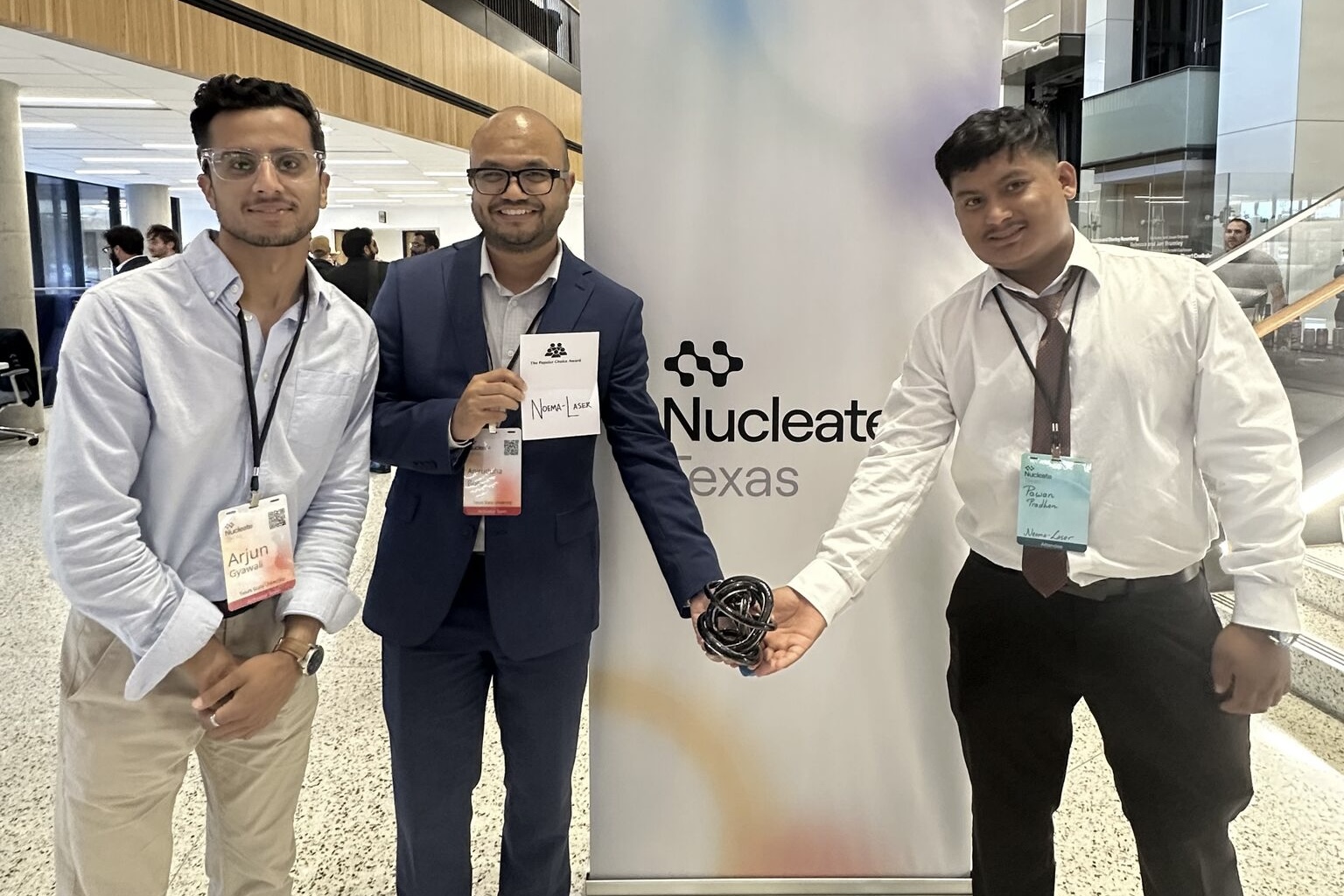
Texas State University’s Indian American researcher Aniruddha Bora and his Noema-Laser team won the Popular Choice Award at the Nucleate Texas Demo Day Final, showcasing the university’s growing strength in biotech innovation.
Competing as one of just eight finalists selected from accelerator chapters across Texas, the team’s achievement supports Texas State’s position in the region’s promising biotech innovation and research ecosystem, according to a university release.
Along with Bora, an assistant professor in the Texas State Department of Computer Science, his team, dubbed Noema-Laser, was made up of undergraduate students Arjun Gyawali and Pawan Pradhan, alongside Hope Fiadjoe and Simar Singh.
Bora’s achievement capped off Texas State’s inaugural participation in the Nucleate Texas Activator program—an equity-free startup accelerator designed to help academic trainees and early-stage faculty bridge the gap between laboratory research and commercialization.
READ: Anish Pyne wins Carnegie Mellon’s People’s Choice Award (April 2, 2026)
“This new partnership with the Nucleate Activator program highlights Texas State’s drive to turn lab discoveries into real‑world solutions that improve lives,” said Shreek Mandayam, vice president for Research at Texas State.
At the final event on May 29, students connected directly with investors, scientists, and founders, gaining firsthand insight into the life sciences industry while building valuable relationships and exploring future career pathways.
Bora earned his PhD in Computational Analysis and Modelling from Louisiana Tech University and was previously a Postdoctoral Research Associate in the Division of Applied Mathematics at Brown University.
His research focuses on numerical methods, data-driven scientific computing, physics-informed machine learning, and scientific machine learning for multiscale physical systems. In particular, he develops novel neural-operator frameworks, hybrid numerical–machine learning solvers, and multi-fidelity operator approaches, with applications in turbulence, climate science, nanoscale heat transfer, and metamaterials.
Read: Indian American students lead in UT Dallas startup awards (March 23, 2026)
He is also actively interested in interpretable machine learning, aiming to build models that not only achieve high predictive accuracy but also provide insights into the underlying physical and statistical mechanisms.
Bora’s contributions have appeared in prestigious venues such as International Journal of Heat and Mass Transfer; Proceedings of the Royal Society A; Advanced Materials; Applied Mathematics and Computation; Communications in Computational Physics; Neural Networks; and AAAI.
His recent co-authored work includes an ICLR 2025 CCAI Workshop paper and an AI4X conference paper on explainable-AI frameworks for extreme weather.
He also serves the scientific community as an external reviewer for leading journals and conferences in machine learning, scientific computing, and applied mathematics.