



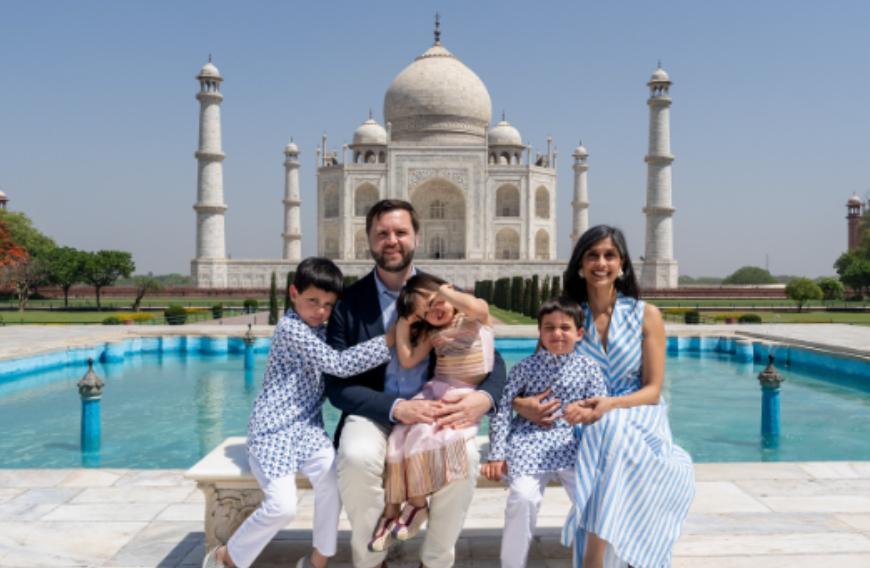
Vice President JD Vance and his wife Usha Vance, who are expecting their fourth child, recently shared candid insights into their family life, faith, and interfaith marriage during an interview with CBS News’ “Sunday Morning.”
Speaking with national correspondent Robert Costa, the vice president reflected on his journey from atheism to Catholicism and the pivotal role his wife played in that transformation.
When asked why he dedicated his book “Communion: Finding My Way Back to Faith” to Usha, JD Vance said, “Well because one she was the person who encouraged me most to do it. You know Usha said very early on that the business of thinking about my faith, thinking about converting was good for me. And so I think that her encouragement was one of the things that needed to happen because when I started dating I was sort of a proud atheist.”
Vance explained that he initially worried his growing interest in religion might strain their relationship.
“I was worried that you were going to be, you know, not supportive of that journey. But she was very supportive of the journey,” he said.
Usha, responding to a reference that “therapy didn’t work for you. Church does,” offered her perspective on her husband’s search for meaning and direction.
READ: ‘Going strong’: JD Vance and Usha Vance celebrate 12 years of marriage (June 16, 2026)
“I do think that’s true. And it’s not that therapy doesn’t work for other people. But JD just didn’t have the right kind of trust in that process,” she said. “He just didn’t feel at home in it, really exploring some of the feelings that he had and trying to figure out how he wanted to be the person that he wanted to be for the rest of his life.”
The conversation also touched on how the couple has managed religious differences throughout their marriage. Usha Vance, an attorney who clerked for Supreme Court Chief Justice John Roberts, was raised in a Hindu household in Southern California by Indian immigrant parents.
Addressing public speculation about her religious beliefs, Usha said many people incorrectly assumed that her husband was trying to convert her.
“Well, I mean, I think people really cottoned on to the idea, at one point, that JD was interested in my conversion,” she said. “And I think that was misunderstood for the fundamental reason that he is Catholic. Part of his faith is wanting to spread his faith. But it’s not like he’s proselytizing to me every day.”
While Vance’s book chronicles his personal return to faith, Usha described her own experience as less of a religious transformation and more of a journey within their relationship.
“I grew up in a household, a Hindu household, a very stable household and I’ve not felt the same sense of need to seek something different that he has,” she said. “So, I think the journey has been more in our relationship, right? Trying to understand where he is, the different ways he’s thinking about things, how that fits into the life that we have together. And less a religious journey of my own.”
The couple also discussed how they approach raising children in an interfaith household. Vance acknowledged that differing religious backgrounds have brought unique perspectives into their family life.
READ: Usha Vance launches “Storytime with the Second Lady” for children (March 31, 2026)
“Well, it’s very it’s actually very easy,” he said when asked about interfaith marriage. “There’s a certain dynamism to it because she comes at things from a different perspective than I do, and so it always leads to very interesting conversations.”
Vance said they have chosen to raise their children in the Christian church while also ensuring they understand their mother’s beliefs and family traditions.
“We don’t want to confuse little kids,” he said. “We also haven’t hidden anything about her understanding of the world or her parents, how they think about religious faith.”
The vice president noted that their six-year-old child was baptized on Easter Sunday this year. He also pointed to how their differing backgrounds have subtly influenced family decisions, including allowing their children to choose baptism when they are older, a practice shaped by both his evangelical upbringing and discussions within their family.
Reflecting on their marriage, Vance emphasized that shared values have mattered more than religious differences.
“It’s two people who love each other, two people who usually see the world in very similar ways, but not always,” he said. “And I think that’s true for most marriages. And it’s made it very fun.”