



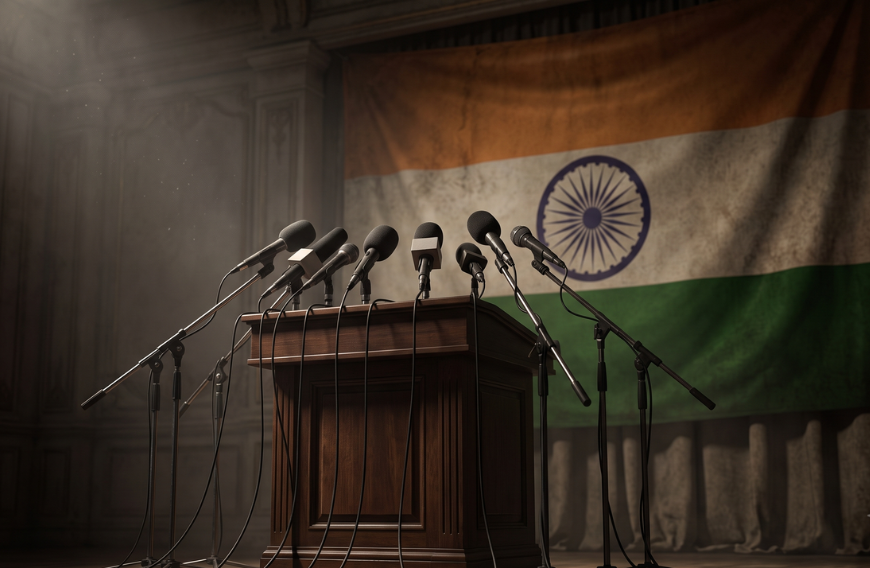
A revealing account from the United States ambassador to India, Sergio Gor, has turned an apparently minor matter of diplomatic protocol into a larger question about Indian democracy.
Speaking about the June meeting between Prime Minister Narendra Modi and President Donald Trump, Gor said India’s Ministry of External Affairs had conveyed a preference for admitting the media but taking no questions. Trump reportedly agreed. Then, after the prepared remarks, he looked toward the assembled journalists and asked: “Any questions?” What followed, according to Gor, was an extended press interaction with Modi seated beside him.
The Indian government has since described such discussions over media formats as normal protocol for high-level visits. That clarification is relevant: one episode cannot, by itself, establish the motives or abilities of an entire government. Nor is every diplomatic appearance required to become a press conference.
But Gor’s account matters because it does not stand alone. It falls into an established pattern in which the Indian prime minister communicates abundantly but submits rarely to sustained, unscripted questioning by an independent press. The distinction is fundamental. Communication can be controlled; accountability cannot.
This is the paradox at the centre of contemporary Indian power. The government projects strength through disciplined imagery, direct broadcasts, choreographed public events and relentless message management. Yet the more completely power controls the stage, the more vulnerable it becomes to anything outside the script. A single unexpected question can expose the elaborate machinery required to prevent questions from being asked.
That is not strength. It is the fragility produced by performance.
There is nothing inherently wrong with political theatre. Every government uses symbolism. Clothing, ceremony, gesture and spectacle have always formed part of diplomacy. A summit is partly negotiation and partly image. But imagery becomes a liability when it begins to substitute for intellectual authority.
International diplomacy is an intellectual contact sport. It demands knowledge, memory, composure, judgement and the ability to respond when the next sentence has not been written in advance. A leader must be able to explain a contradiction, defend a compromise, acknowledge uncertainty and persuade a sceptical audience in real time. The world’s serious capitals are not impressed indefinitely by embraces, slogans or photographic choreography.
READ: Satish Jha |The follower factory revolts (August 21, 2026)
They listen for conceptual clarity. They test whether a country’s representatives can explain not merely what their nation wants, but why its position deserves to prevail.
India should be exceptionally well equipped for this encounter. Its intellectual tradition developed a sophisticated technology for this very challenge. Shastrarth and related forms of vāda were rigorous, rule-bound practices in which a proposition acquired stature by surviving challenge.
They operated within courts and scholarly assemblies, among elites, within hierarchical social structures—not as mass democratic contestation. Yet the principle was unmistakable: intellectual authority arose from surviving interrogation, not from suppressing the questioner. That principle was later marginalized in India’s educational and administrative culture.
Contemporary institutional practice has largely abandoned it while retaining democratic form.
A political culture that treats difficult questions as ambushes therefore diminishes not only democratic practice but India’s own intellectual inheritance. The substitution of broadcast for dialogue, proclamation for explanation and applause for scrutiny represents a narrowing of the civilization invoked so frequently in official rhetoric.
Defenders of the present system argue that press conferences belong to an earlier media age. A leader, they say, can now communicate directly through radio, video and social platforms without submitting to journalists who may be biased, theatrical or poorly informed.
The criticism of the media is sometimes justified. Journalism can be shallow, partisan and self-important. But the defects of the questioner do not eliminate the obligation of the powerful to answer. Direct communication allows a government to say exactly what it wishes to say. A free press asks what it would prefer not to discuss. Democracy requires both.
A recorded address may demonstrate command over a message. It cannot demonstrate command over a subject. That is revealed only when another mind enters the room.
Other democracies have navigated press relationships differently. A U.S. president faces hostile press conferences as routine. A British prime minister submits to weekly parliamentary interrogation. A French president conducts unscripted press engagements. India itself has operated under different press protocols in different eras. The pattern is consistent: democracies that systematically avoid sustained, unscripted scrutiny of their leadership pay a price in accountability and institutional learning. They claim democratic form while practicing managed communication. A state cannot indefinitely maintain both.
READ: Satish Jha |The Ceremony and the Citizen: On Patriotism, Duration, and Democratic Consent (August 18, 2026)
The consequences extend beyond political optics. Institutions teach through example. A country cannot credibly tell children to think independently, universities to encourage dissent, civil servants to speak candidly and entrepreneurs to challenge convention while its highest offices model insulation from inquiry.
A political culture that systematically avoids unscripted scrutiny signals that challenge carries cost; subordinates rationally internalize caution. Whether this pattern is universal or merely widespread deserves study. But the transmission is visible, and it merits serious attention. In Indian bureaucracies, visible failure is punished more heavily than inaction; a researcher publishes inconvenient findings at career cost; a civil servant hedges recommendations to avoid exposure; an entrepreneur seeks permission rather than forgiveness. These are not theories. They are the everyday story of how Indian institutions operate.
This is where executive transparency and human capability meet. India’s educational system has long rewarded reproduction over reasoning, obedience over argument and the correct answer over the difficult question. Public life frequently reinforces the same hierarchy: authority speaks; everyone else listens. The result is not merely a democratic deficit. It is a developmental constraint.
An economy aspiring to lead in science, technology and innovation cannot be built by citizens trained to await instructions. Capability begins with the freedom to ask why. A government serious about cultivating independent minds must be willing to encounter them.
The issue is therefore larger than whether one leader holds a formal press conference. It is whether India wishes to be represented as a civilisation confident enough to think aloud before the world.
A confident leader does not need to possess an instant answer to every question. Indeed, the willingness to say “I do not know,” “we made a mistake,” or “the matter remains unresolved” can communicate greater authority than a flawless script. Democratic leadership is not omniscience. It is the courage to remain accountable when certainty is unavailable.
READ: Satish Jha |The Mechanics of Sovereign Packaging (August 17, 2026)
Nor should this standard be reduced to a partisan weapon. It must apply to every prime minister, every government and every political formation. India should never again accept a model in which electoral victory is interpreted as a five-year exemption from interrogation. A mandate confers the right to govern; it does not confer the right to govern without explanation.
No foreign ambassador can settle this debate, and no single anecdote should be forced to carry more evidence than it contains. Gor’s account is valuable because it offers a glimpse into the architecture surrounding power: the careful negotiation of exposure, the preference for cameras without questions, the desire for visibility without unpredictability.
The contradiction is almost perfect. Power wants to be seen everywhere, yet questioned nowhere.
India deserves better than that contradiction. It deserves leaders who can face hostile questions without treating them as hostility; who can defend policy without a protective choreography; who can meet journalists, citizens and foreign counterparts as intellectual equals; and who understand that national dignity is not preserved by preventing scrutiny. It is preserved by surviving it.
This is where choice emerges. A rising power can govern through controlled visibility and managed narrative. It will produce compliance and order. But it will not produce the independent reasoning, adaptive capacity, or conceptual depth required for genuine eminence. India must eventually choose between theatre and thought.
The test of that choice will not be at a bilateral summit. It is what happens when the script runs out.