



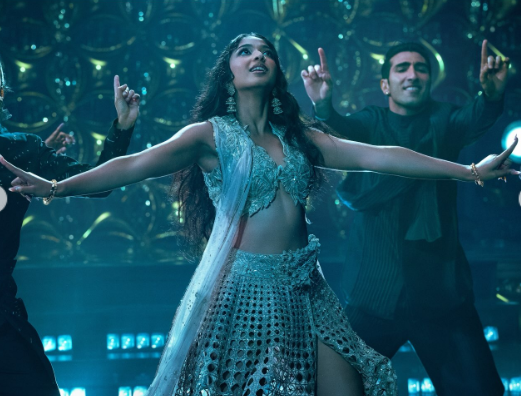
Maitreyi Ramakrishnan’s Best of the Best may look like another Hollywood dance competition movie on the surface. But underneath the Bollywood songs, wedding choreography and high-energy dance battles is a story that speaks directly to a generation of South Asians growing up between cultures.
Directed by Lena Khan, known for Flora & Ulysses, and now streaming on Netflix, the film follows best friends Maya, played by Ramakrishnan, and Anjali, played by Kedia, as they join UCLA’s competitive Bollywood-fusion dance team with hopes of winning a U.S. championship.
The competition, however, is only one part of the story.
For South Asian audiences, especially immigrants and children of immigrants, Best of the Best feels less like a film explaining desi culture to Hollywood and more like a film that assumes its audience already understands it. Indian American names, the South Asian Students Association, Bollywood songs, wedding dances and references to the Kohinoor are woven into the story without constantly stopping to explain what they mean.
That is where the film finds much of its charm.
At its core, Best of the Best is a coming-of-age story about friendship, family expectations and learning to accept yourself. Maya is moving from high school adolescence into the uncertainty of young adulthood. Along the way, she encounters pressures that will feel familiar to many South Asian families: the expectation that education is the safest route to success, the pressure to build a respectable career, body-shaming while growing up and the idea that there is a particular way a “good” or “sanskari” South Asian woman is expected to look and behave.
The screenplay by Hasan Minhaj and Prashanth Venkataramanujam uses Bollywood-fusion dance as its central vehicle, but the story extends well beyond the competition floor. It explores the complicated process of growing up when family, culture and personal ambitions do not always point in the same direction.
The film does not turn those pressures into a heavy-handed cultural lesson. Instead, it folds them into the humor, friendships and everyday chaos of young adulthood.
READ: How Dhurandhar became a diaspora blockbuster (
The winning performance brings one of the film’s most striking cultural references into focus through the history of the Kohinoor diamond. Drawing on the colonial-era taking of the diamond from India by the British, the performance begins with the idea that there are things that cannot be taken away from a people or their culture before building toward the line, “We are not here to take the Kohinoor diamond.”
The moment carries a broader meaning for the South Asian diaspora in the U.S. The characters are not rejecting America or suggesting that embracing their cultural roots means they cannot call the country home. Instead, the performance reflects immigrants and children of immigrants who have built their lives in the U.S. while continuing to hold on to their languages, traditions, music, memories and cultural connections. The Kohinoor becomes more than a historical reference. It becomes a symbol of heritage that cannot simply be taken away.
That balance between history and contemporary life gives the dance sequence some of the film’s emotional weight.
At the same time, Best of the Best understands the lighter side of growing up desi in America. Bollywood songs, competitive dance battles and wedding choreography give the film a playful rhythm that will feel particularly familiar to South Asian millennials and Gen Z viewers. The cultural references are not simply nostalgic additions. They are part of the world in which these characters live.
There is also a clear tension between tradition and individuality. For many children of South Asian immigrants, adulthood can involve negotiating expectations around education, career, appearance and family while trying to determine what success looks like personally. The film places those expectations alongside the universal uncertainty of growing up.
Maya’s friendships become an important part of that journey. The dance team gives her a community where ambition, competition and vulnerability can exist alongside one another. It is also where the film finds its strongest sense of sisterhood.
The writers brought personal experience to the screenplay. Minhaj and Venkataramanujam had connections to competitive performance circuits while growing up, giving the film an understanding of the discipline and intensity behind these teams. The dance competition therefore works as more than a Hollywood backdrop. It becomes a way to explore ambition, pressure, teamwork and the desire to prove yourself.
And that is what makes Best of the Best more than a Bollywood dance movie.
Its most interesting moments come when the spectacle gives way to the experiences behind it: the pressure to live up to expectations, the friendships that make growing up easier and the freedom that comes from deciding who you want to become.
For South Asian viewers, the film offers something increasingly familiar in American entertainment: a story where desi culture is not the explanation for the plot, but simply part of the characters’ everyday lives.
The result is a lively coming-of-age film that uses Bollywood dance to tell a much broader story about family, friendship, ambition and the complicated process of growing up South Asian in America.