



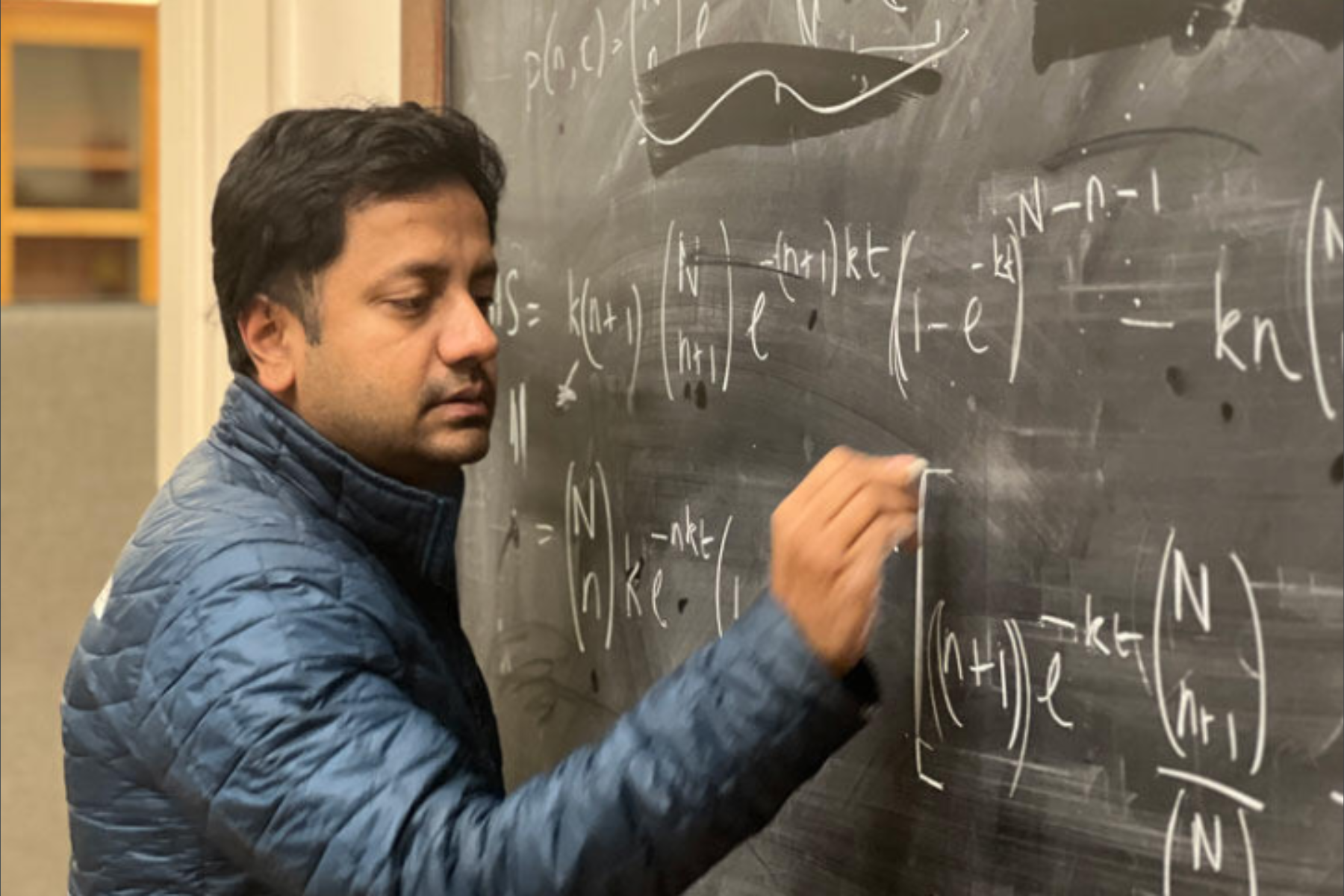
Karthik Shekhar, an assistant professor of chemical and biomolecular engineering at the University of California, Berkeley, has received the 2026 Philomathia Prize for research investigating the physical principles behind bioelectricity and neural activity.
The $200,000 award from the Philomathia Foundation recognizing his work at the intersection of neuroscience, genomics and biophysics will support his collaborative research over three years.
Shekhar is the John F. Heil Jr. Professor and a member of Berkeley’s Helen Wills Neuroscience Institute. His research combines genomics, computational analysis and theoretical approaches to investigate how neural systems are organized, develop and evolve.
Working with Kranthi Mandadapu, an associate professor in Berkeley’s Department of Chemical and Biomolecular Engineering, Shekhar is developing a theoretical framework to explain how electrical processes at microscopic scales produce broader neural responses.
Read: Indian American professor Rita Mitra earns 2026 teaching award (October 23, 2026)
The project grew out of conversations between the researchers during the COVID-19 pandemic. Their work examines the electrochemical dynamics associated with ion channels in biological membranes, seeking to establish a more fundamental understanding of how biological electricity operates.
Electrical signaling in neurons depends on the movement of charged particles, including sodium and potassium ions. However, the mechanisms connecting these microscopic processes to larger electrical responses remain incompletely understood.
Shekhar and Mandadapu aim to develop a framework that accounts for ion transport, the physical properties of biological membranes and other physicochemical factors. Their approach combines theoretical analysis and computation to investigate how these elements interact and generate complex electrical behavior.
According to UC Berkeley’s account of the research, the longer-term objective is to develop a model capable of explaining emergent bioelectric phenomena and predicting new ones that can subsequently be tested experimentally.
The researchers’ work remains at an early stage, and the project focuses on developing fundamental scientific understanding rather than an established clinical application.
Read: Five Indian Americans elected to National Academy of Medicine (October 23, 2026)
Shekhar has also received recognition for his teaching. In 2023, he was awarded the Donald Sterling Noyce Prize for Excellence in Undergraduate Teaching in the physical sciences. He has also received departmental teaching awards at Berkeley.
The 2026 Philomathia Prize will be formally presented Nov. 5 during Philomathia Day, a one-day symposium titled “Bioelectricity at the Interface: Molecules, Membranes, and Models.”
The symposium will bring together researchers using experimental, computational and theoretical approaches to examine bioelectricity and membrane biology across different scales.
Established in 2021 through an endowment gift from the Philomathia Foundation, the annual prize recognizes early-career UC Berkeley faculty members demonstrating distinction and promise in their academic fields. Shekhar is the fifth recipient of the award.