



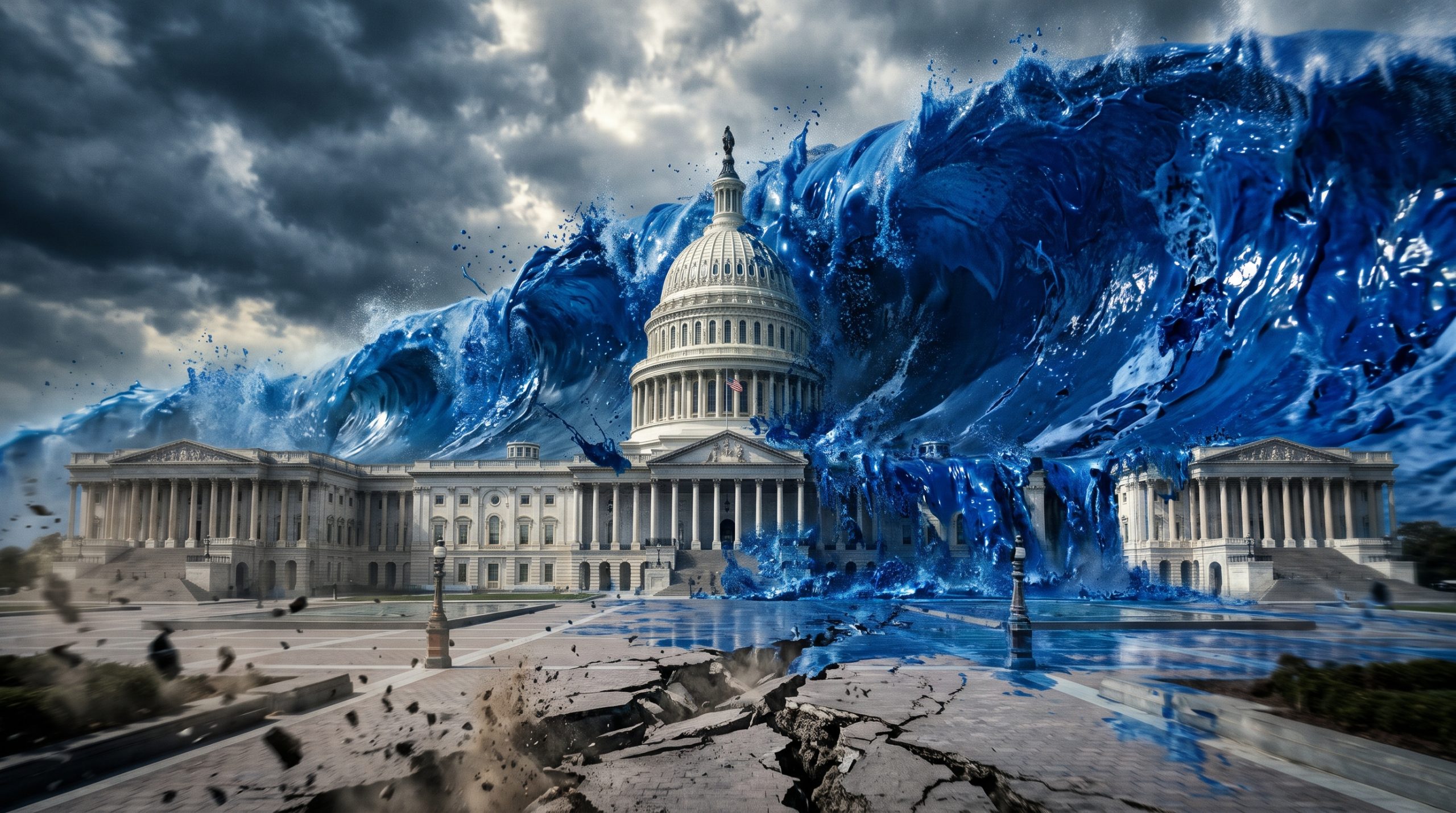
The blue tsunami that swept across the country on Nov. 3 was more than an electoral repudiation of the Republican Party. It was the visible consequence of an earthquake that has been building beneath America’s political landscape for years. The election produced the wave, but the forces generating it were already in motion. They were economic, social, technological and, increasingly, existential for millions of Americans who feel that the country is moving forward without them.
A tsunami is not caused by the wave itself. It is caused by an earthquake beneath the ocean floor, often far from where the devastation eventually occurs. The water simply carries the energy of that disruption to the shoreline. American politics is experiencing something similar. The election results are the wave. The real story is the seismic activity underneath.
For too long, both political parties have mistaken the visible symptoms of public dissatisfaction for the underlying problem. Campaigns are built around cultural grievances, immigration, identity, abortion, crime and ideological divisions. These issues matter, but they do not adequately explain the growing anxiety of the American household. The deeper fractures are much more fundamental: the cost of healthcare, the price of food, the affordability of housing, the security of employment and the growing uncertainty about whether hard work will still translate into a reasonably secure life.
Healthcare is perhaps the clearest example. While the government’s broad measure of health inflation was around 3 percent, employer healthcare costs increased 6.4 percent over the year, the fastest growth in at least a decade. Employer health insurance contributions rose an average of 16 percent for individuals and 9 percent for families. Employers are responding by shifting more costs to workers through premiums, deductibles and copayments, while wage increases are being squeezed by the rising cost of benefits.
This is the kind of economic pressure that rarely makes a campaign advertisement but is experienced every time a family opens an insurance statement or receives a medical bill.
The Affordable Care Act, which expanded coverage to millions, is itself facing a serious affordability crisis. The expiration of enhanced subsidies has raised premiums for many marketplace enrollees, while higher deductibles have made coverage increasingly difficult to use. The problem is not simply whether someone has insurance. It is whether having insurance actually makes healthcare affordable.
READ: Sreedhar Potarazu | What truly made America great for 250 years also made us blind (June 24, 2026)
For a family struggling to pay rent, buy groceries and meet a mortgage payment, healthcare is not an abstract policy debate. It is another monthly obligation that competes with everything else. And when people feel that even basic necessities are becoming inaccessible, their frustration eventually finds its way into the voting booth.
Housing and food have become equally powerful sources of insecurity. A paycheck that once supported a household now struggles to cover rent, utilities, groceries, transportation and childcare. Homeownership, long considered an essential component of the American promise, is increasingly out of reach for younger generations. People do not necessarily measure economic progress through GDP, stock market performance or corporate earnings. They measure it through what remains in their bank account at the end of the month.
The same disconnect was evident in Ohio, where Vivek Ramaswamy lost to Democrat Amy Acton, and in other traditionally Republican strongholds. Ramaswamy’s defeat is particularly instructive. His wealth, national profile, technological credentials and association with the administration did not translate into an understanding of the anxieties confronting ordinary Ohioans. Acton made affordability, healthcare and public education central to her campaign. The lesson is not that voters rejected technology, entrepreneurship or economic growth. It is that they rejected the idea that economic success at the top automatically translates into a better life at the bottom.
This is where the Republican Party misread the ground beneath its feet. It assumed that cultural alignment, political loyalty and national messaging could compensate for the everyday experience of economic insecurity. They could not. People may agree with a candidate on immigration, taxes or social issues, but when they cannot afford healthcare or housing, those positions become secondary.
But Democrats should be careful about interpreting this election as a mandate for everything they have proposed. Winning an election because voters are dissatisfied with the other party does not mean voters have embraced an entirely different ideological direction. There is a difference between wanting healthcare to be affordable and believing that Medicare for All, in its proposed form, is necessarily the answer. There is a difference between wanting government to address inequality and wanting government to assume responsibility for every aspect of economic life.
The Affordable Care Act itself illustrates the complexity. It expanded access to insurance, but the underlying economics of healthcare remain deeply troubled. As the Commonwealth Fund’s October 2026 survey found, half of working-age adults reported going without needed care because of cost, and nearly half were inadequately insured, whether because they lacked coverage or because their insurance offered insufficient financial protection.
The expiration of enhanced subsidies has compounded the problem. Simply expanding the government’s role without addressing the underlying cost structure of healthcare delivery, pharmaceutical pricing, administrative inefficiency and provider economics risks treating the symptoms without fixing the disease.
The next earthquake is already forming, and it has a name: artificial intelligence.
The debate about AI has largely been framed around productivity, innovation, investment and America’s ability to compete with China. Those are important considerations. But there is another side to this transformation that political leaders have barely begun to address. AI will change the nature of employment, eliminate certain categories of work, restructure professions and concentrate economic power in organizations that control the technology.
Even before the full employment impact becomes apparent, the infrastructure supporting this transformation is creating its own tensions. Data centers require enormous amounts of electricity and water. Their construction can put pressure on local energy systems, increase utility costs and alter communities that may receive relatively few permanent jobs in return. The backlash against data centers became an electoral issue in Texas and Georgia, where Democratic candidates who called for restrictions on their development won major victories.
People want innovation, but they also want to know who benefits from it and who pays for it. If the gains from AI accrue to a handful of companies while the costs are distributed across communities through higher electricity bills, disrupted employment and environmental pressures, resistance is inevitable.
READ: Sreedhar Potarazu | The silent victory: How Indian Americans are quietly weaving the new pattern of society (November 7, 2025)
The political earthquake, therefore, is not exclusively about the economy as we have traditionally understood it. It is about the changing relationship between economic progress and individual security. A country can lead the world in artificial intelligence, produce record corporate profits and build extraordinary infrastructure while its citizens feel increasingly powerless over their own economic futures.
There is also a more troubling institutional dimension to this election. If we are already moving toward an autocratic style of governance, the blue tsunami may appear to offer a necessary counterweight. A Democratic Congress can restore checks and balances, investigate executive overreach and challenge the concentration of presidential power. That is an important function of a constitutional democracy.
But restoring balance is not the same as restoring effective governance. We could end up with an even more fragmented political system in which opposing centers of power govern through vetoes, executive orders, administrative actions and litigation, with each administration reversing what the previous one established. One side builds a policy framework; the other dismantles it.
The result is not a stronger democracy. It is a collection of isolated islands of leadership, each convinced that its own mandate justifies undoing the work of the other. The country becomes trapped in a cycle of political retaliation rather than problem-solving. Voters may have demanded a correction, but they did not necessarily ask for another four years of institutional paralysis.
The real wake-up call from Nov. 3 is for both red and blue America. Republicans need to understand that political loyalty cannot be sustained indefinitely by asking people to ignore the pressures of daily life. Democrats need to understand that an electoral victory is an opportunity to demonstrate competence, not an invitation to move the ideological pendulum as far as possible in the opposite direction.
Neither party owns the earthquake. Neither party can claim to have fully understood it. And neither can solve it by simply repainting the political landscape in a different color.
The cracks beneath America are becoming wider. Healthcare is increasingly unaffordable. Food and housing consume a disproportionate share of household income. AI is changing the relationship between work and economic security. Energy demands are rising. And trust in institutions is eroding as political leaders appear more interested in defeating one another than in addressing these realities.
A tsunami can change the shoreline, but it does not repair the earthquake beneath the ocean floor. The blue tsunami may have changed the political map overnight. Whether it changes the lives of ordinary Americans remains to be seen.
The most dangerous mistake either party can make is to believe that the election was the solution. It was a warning. The underlying seismic shifts are still happening, and no matter how many layers of political paint are applied, the cracks will remain.