



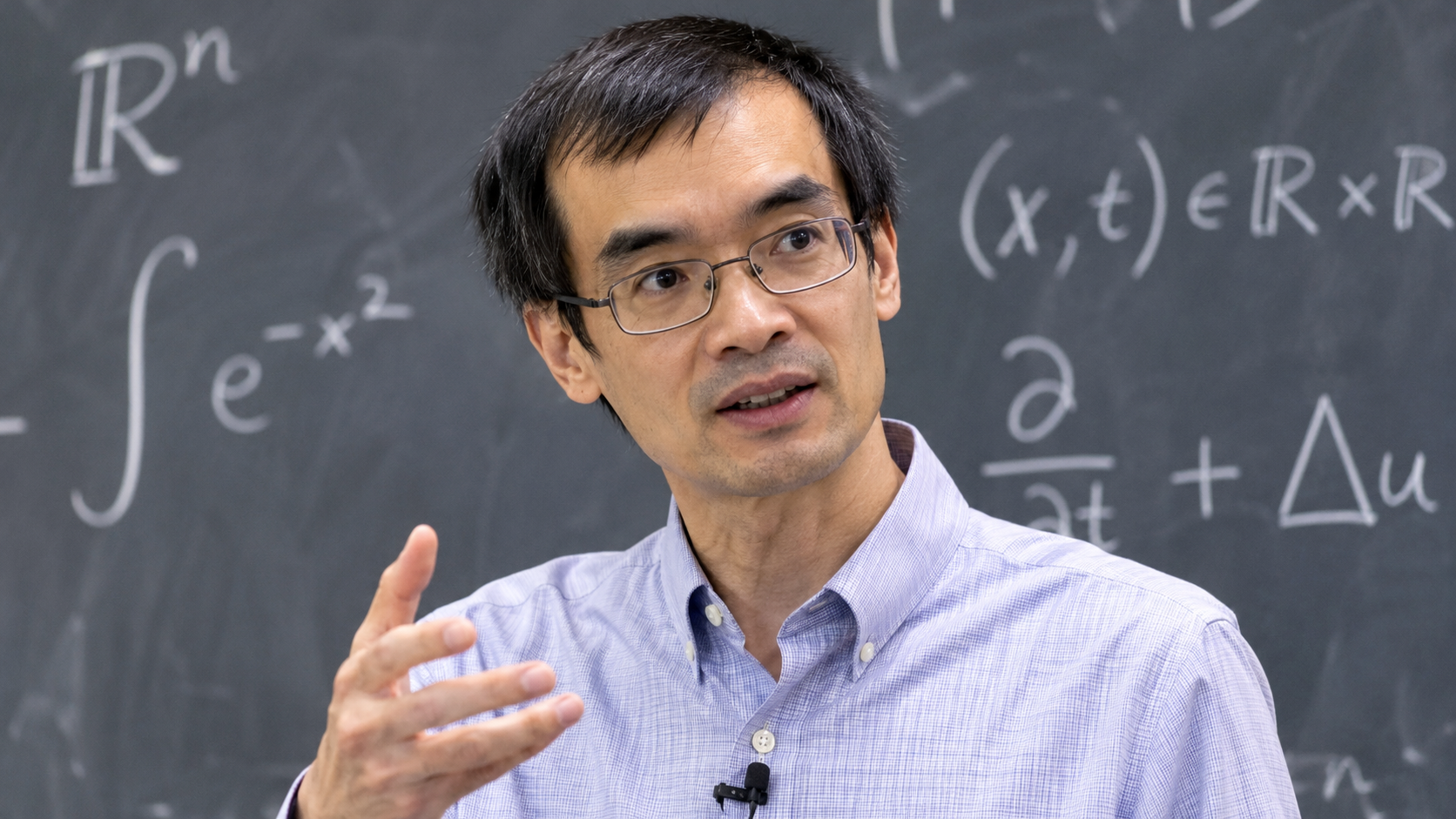
Artificial intelligence is changing the pace of mathematical research, prompting Fields Medalist Terence Tao to call for a new approach that places human understanding at the center of the discipline.
Tao, a professor of mathematics at the University of California, Los Angeles, outlined his vision of “Math 2.0” in an essay published in Nature on Oct. 22.
He argued that mathematicians must adapt to a period in which artificial intelligence can generate solutions to problems that once required extensive human research.
In recent months, AI-assisted mathematical proofs have emerged across several areas of mathematics.
Tao wrote that hundreds of solutions to longstanding problems had been released, with some requiring months of work by mathematicians to understand their underlying arguments and implications.
READ: Apple Black Friday 2026: Discounts on AirPods, MacBooks, iPads and Apple watch (November 26, 2026)
The shift presents a challenge to traditional mathematical research, where producing and establishing proofs has been a central part of the discipline.
Tao described this earlier environment as one of “proof scarcity,” in which obtaining a proof was often the most difficult part of solving a problem.
However, the increasing availability of AI-generated solutions has raised questions about how researchers should evaluate, explain and build upon mathematical results.
Tao identified several concerns, including poorly presented AI-generated arguments, insufficient acknowledgment of earlier mathematical work and researchers moving on to new problems without adequately explaining their previous results.
He also warned that mathematicians could become reluctant to share unsolved problems because of concerns that researchers equipped with advanced AI systems might reach solutions before others.
The scale of recent AI-assisted research became particularly visible on Oct. 6, when OpenAI released 722 mathematical manuscripts generated by an internal AI model. Tao discussed the release in a Nov.13 blog post, noting that many of the papers had not been verified by human researchers and that some lacked accompanying formal verification.
The debate intensified following an announcement by Levent Alpöge, a mathematician at Anthropic, who said he had developed a proof of the Riemann hypothesis with assistance from the company’s AI assistant, Claude.
The hypothesis, formulated by Bernhard Riemann in 1859, concerns the distribution of prime numbers and remains one of the seven Millennium Prize Problems.
Alpöge released a four-page explanation alongside a formalization containing approximately 17 million lines of Lean code.
READ: 26-year-old Google employee earns $323,000 but lives on less than $20,000 a year (November 25, 2026)
The announcement has prompted mathematicians to examine the proposed proof and determine whether its reasoning can be understood independently.
On Nov. 24, Tao’s blog outlined a collaborative effort involving mathematicians Anurag Sahay, Will Sawin and Lior Silberman to coordinate verification work and develop a human-readable explanation of the claimed proof.
Tao’s Math 2.0 proposal is not a rejection of artificial intelligence, instead, he wants researchers to use AI to expand mathematical exploration while preserving the ability of people to understand and evaluate discoveries.
In a Nov. 20 appearance at Harvard University, Tao reiterated that AI could help mathematicians summarize existing arguments and generate large datasets for research.
He also stressed that mathematical problem-solving involves more than reaching an answer.
The challenge, therefore, is not simply whether AI can produce mathematical proofs, but whether the mathematical community can understand, verify and communicate the knowledge those systems generate.