


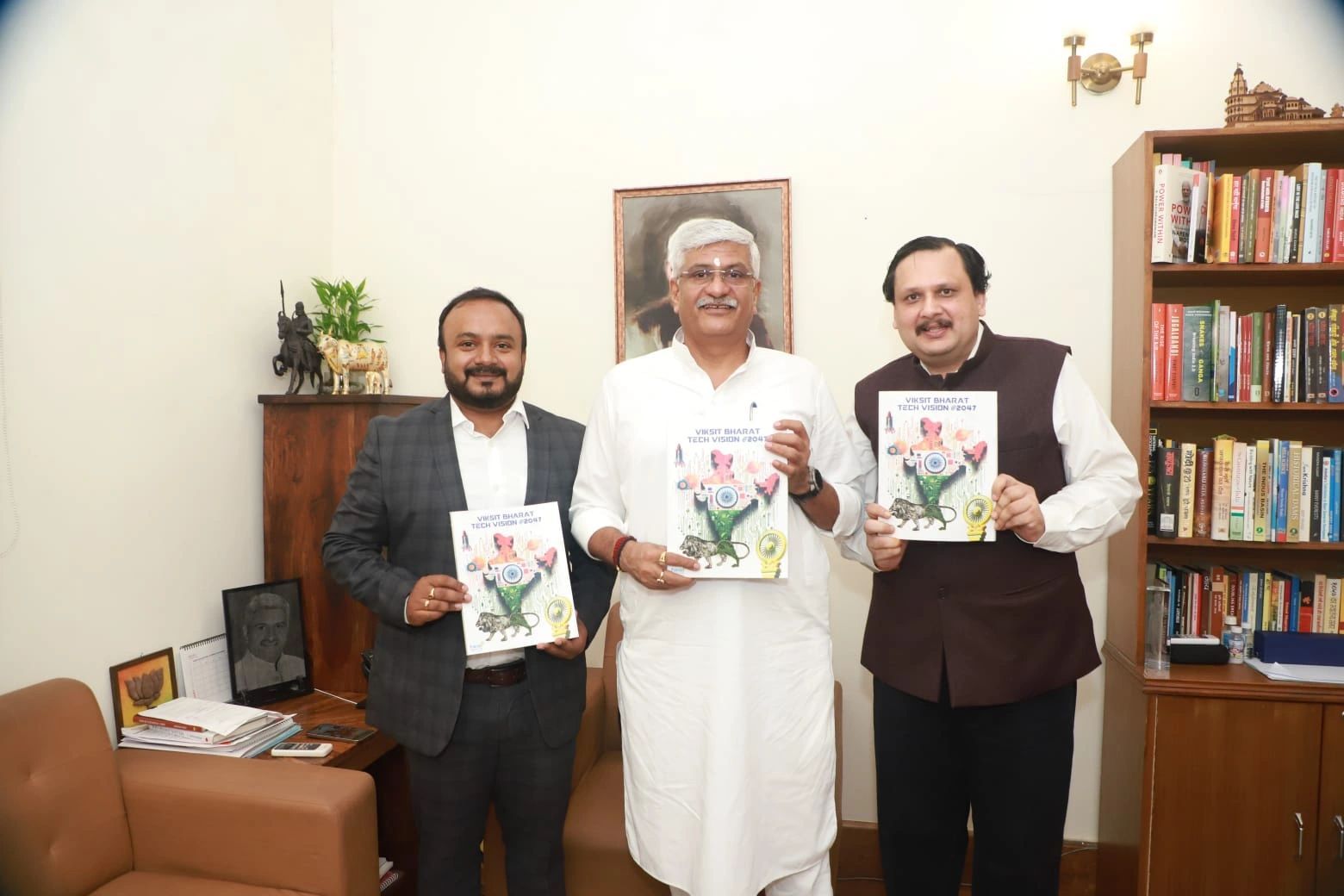
Viksit Bharat compendium showcases India’s technology strides, with insights from Indian Americans, industry leaders, policymakers, and global experts.
By Shubham Ghosh
India’s culture and tourism minister Gajendra Singh Shekhawat on October 2 released in New Delhi “Viksit Bharat – Tech Vision @2047,” a compendium edited by Rajesh Mehta, a leading Indian international business consultant, entrepreneur and columnist, and Krishanu Ranwan, founder of Public Policy Network & IR Hub. It was commissioned by Head Digital Works. Mehta is a columnist for The American Bazaar.
After the document’s release, Shekhawat said it showcased the South Asian nation’s “remarkable rise” in the global technology landscape, achieved under Prime Minister Narendra Modi.
“Through insightful interviews and articles from renowned tech leaders and experts, this publication highlights India’s emergence as a strong player in the global tech arena,” he said.
India will turn 100 as an independent nation in just over two decades. Given the advancement the country has seen in various fields over the past many years, the optimism over its success in becoming a developed nation by 2047 has only grown bigger. The last decade under the leadership of Modi has been particularly eye-catching, thanks to several initiatives his government has taken.
The “Viksit Bharat” compendium features interviews and viewpoints of some of the country’s top experts, policymakers, diplomats, international personalities, thought and business leaders and even a Nobel laureate who put forth their thoughts on several issues.
While eminent scientist R.A. Mashelkar said in the foreword that India must raise its aspirations to become a developed nation by 2047 and lead in fields such as science, technology and innovation and not just remain a follower, Kailash Satyarthi, who won the Nobel Peace Prize in 2014, wrote the preface where he stressed the significance of compassion in contributing to India’s “Viksit Bharat” journey.
The compendium features five segments: government and policy, industry, next-generation skills & capacity building, global perspectives and international precedence and research and innovation.
Emphasizing that “Viksit Bharat” by 2047 outlined in Modi’s Independence Day speech in 2021 formed the blueprint to follow during the Amrit Kaal, former Indian foreign secretary Harsh Vardhan Shringla said in an interview that various efforts undertaken by India, including Digital India, Skill India, Make in India, Atal Innovation Mission, and Beti Bachao Beti Padhao – are tailored to ensure a sound foundation on which a “Viksit Bharat” can be erected.
Like government policy, industry is vital for India’s goal of becoming a “Viksit,” “Aatmanirbhar” (self-reliant) nation by 2047. It boosts economic growth, productivity, and employment while driving innovation. Strengthening industry will diversify the economy, reduce agricultural dependency, and improve living standards, Dr. Mukesh Aghi, president & CEO at the US-India Strategic Partnership Forum, highlighted in his interview.
“US-India relations hit an apex year in 2023. The joint statement during the state visit showed deeper areas of collaboration in clean energy, critical and emerging technologies, education, and healthcare. As we’ve seen with the launch of INDUS-X and iCET, the focus is on AI, quantum, cyber, and space, as defense and technology coalesce to counter some state and non-state actors,” he said.
Dr. Satyam Priyadarshy, chief AI and Quantum expert at Reignite Future, also emphasized on industry to write in his article that India is at the cusp of exponential transformation, leading to its regaining its place as Vishwaguru (world leader) and becoming the global power center for the next century.
He said India’s growth trajectory is propelled by its young population and the youthful energy, combined with a mixed economy and a diverse range of industries, lays the foundation for India’s ascent.
Ricky Kej, 3X Grammy Award winner, United Nations goodwill ambassador and environmentalist, spoke about the significance of next-generation skills and capacity-building where from the viewpoint of an educationist and activist, he hailed Modi’s LiFE mission to encourage people to take initiatives to protect the environment. According to him, the plan focuses on the importance of individual actions in bringing change within our capacities.
A global perspective is also key to India’s path to becoming “Viksit” by 2047. Shombi Sharp, UN resident coordinator in India, said in his interview, “India’s G20 presidency last year, held under the theme of “One Planet, One Family, One Future,” really encapsulated the country’s efforts to support and strengthen multilateralism. India made a number of timely contributions to global governance, not least by bringing together countries across deep divides to agree on a consensus declaration that few thought possible.”
Additionally, a global outlook promotes cultural exchange and innovation, enriching India’s socio-economic landscape, as highlighted by Erik Solheim, green politician, diplomat and peace negotiator, and M.R. Rangaswami, founder and chairman of the nonprofit Indiaspora.
While Solheim praised Modi for making technology central to India’s future, be it in terms of digital revolution or green and renewable revolution, Rangaswami said the Indian prime minister demonstrated a visionary approach in leveraging technology for national development.
Research and innovation are also pivotal to India’s aspiration of becoming a developed nation by 2047 and accomplished names such as Dr. Anurag Mairal and Deepa Prahalad vouched for the same.
Dr. Mairal, director of Global Outreach Programs at the Stanford Byers Center for Biodesign at Stanford University, said in his interview that technology innovation is the only way India can bend the cost-outcome curve, creating faster and more extensive access to these benefits.
Prahalad, author, innovation leader and design strategist, said she found the “Vikshit Bharat” vision quite inspiring with a balanced view on growth, innovation, and inclusion.
“India has some advantages in this new phase of the journey along with the challenges. First, the talent and capacity to innovate have been shown – from big projects like the Chandrayaan to slower, more painful administrative reform. The first phase of technology deployment is usually about creating consumption. The next is about creating connection. This will be critical for sustaining entrepreneurial spirit at all levels,” she said.
(Shubham Ghosh is a senior journalist based in Bangalore, India.)