



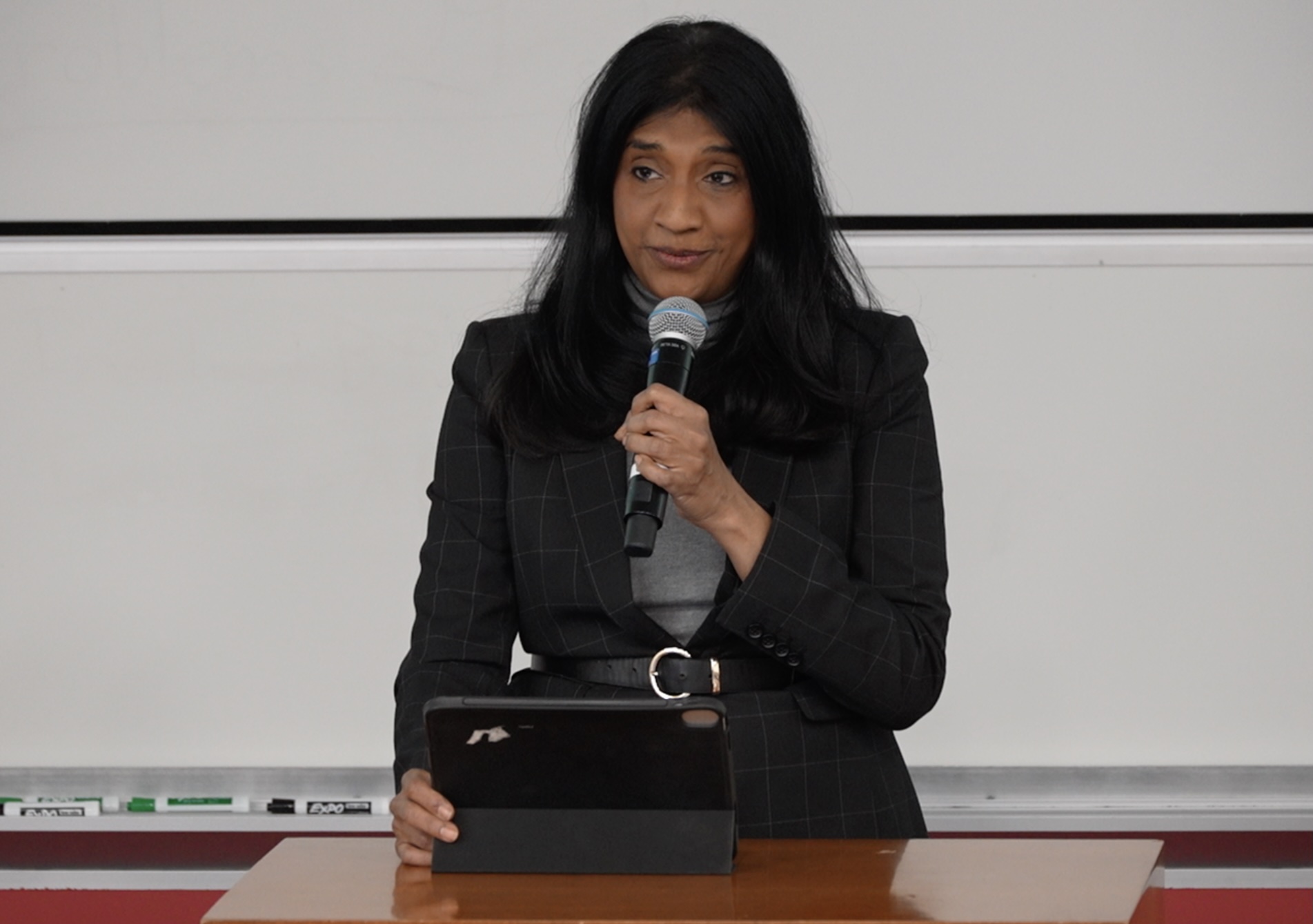
COLLEGE PARK, MD. — In a keynote that was equal parts inspirational and policy-rich, Maryland Lt. Gov. Aruna Miller delivered a passionate call to action for the state’s next generation of entrepreneurs, technologists, and innovators at the Startup Bazaar held Saturday at the University of Maryland’s Robert H. Smith School of Business.
Addressing a packed room of entrepreneurs, investors, professionals, startup founders, and students, Miller used the American Bazaar platform to showcase Maryland’s innovation credentials, blending humor and humility with a clear-eyed vision of the state’s assets and ambitions.
While she jokingly admitted to not having a startup of her own — “I’m not working out of a garage, though I do work a lot in our government SUV” — she shared a polished pitch for Maryland as an innovation hub.
“We are number one in the country for the highest concentration of employed PhD scientists and engineers,” she noted. “We’re number one in the nation for state minority businesses… number two as the most educated state overall.”
She pointed to the University of Maryland’s Discovery District as a beacon of quantum innovation, now home to more than 200 researchers and companies like IonQ, the first pure-play quantum computing firm to go public. “Forbes has dubbed University of Maryland the epicenter of quantum technology in the United States,” she said proudly.
Miller, only the second woman and first woman of color to hold the state’s second-highest position, highlighted that Maryland also boasts 74 federal research labs — “that’s twice as many as any other state” — along with 60 federal agencies, 20 military installations, and 57 colleges and universities. “This is a small but mighty state,” she said.
And in perhaps the most unexpected geography lesson of the day, she teased the audience with a fun fact. “Do you know where one of the highest concentration of aerospace engineers are? California. Not the state of California — California, Maryland!”
READ: Lt. Gov. Aruna Miller to headline Startup Bazaar at University of Maryland on April 12 (April 10, 2025)
This is the second year that the Smith School’s Dingman-Lamone Center for Entrepreneurship has hosted the Startup Bazaar, a signature American Bazaar event. The theme of this year’s gathering centered around AI, quantum computing, and life sciences and medtech — areas where Maryland is rapidly gaining national prominence.
In addition to Miller, speakers included Dr. Sanjay Rai, Secretary of the Maryland Higher Education Commission, Atif Chaudry, Secretary of the Department of General Services, and Smith School Dean Prabhudev Konana. They were joined by a dynamic lineup of speakers, all contributing to a day rich in insight, exchange, and collaboration.
A vision for AI
Turning to one of the day’s key themes — artificial intelligence — Miller offered both an aspirational and cautionary message.
“This moment we’re in — it’s not just about what technology can do. It’s about what we choose to do with it,” she said. “AI is not just the future. It is the now.”
Referencing futurist Ray Kurzweil’s predictions from “The Singularity is Nearer,” Miller emphasized the pace at which AI is evolving. “By 2029, artificial intelligence will reach or surpass human intelligence… and by 2045, we will reach Singularity, where non-biologic intelligence will be a billion times more powerful than all human intelligence combined.”
“Whether that excites you or gives you pause,” she said, “AI isn’t the future. It is the present. It’s shaping everything from ethics to economics, from public policy to personal lives.”
To meet this moment, Miller said Maryland is moving fast. “Gov. Wes Moore and I are committed to integrating artificial intelligence into state government responsibly, ethically, equitably, and transparently.”
She pointed out that Moore has appointed Nishan Shah as Maryland’s first senior advisor for responsible AI. His mission: “To ensure AI is used responsibly, equitably, and productively, and to raise our own state’s AI IQ.”
READ: Next frontier of AI: Explainability, ethics, and the future of intelligent systems (February 4, 2025)
Earlier this year, the state convened its first Academia-AI Roundtable, bringing together agency leaders and university researchers to unlock new applications and collaborations.
“We know that AI is only as powerful as the data behind it,” she said. “In Maryland, the state government has that data. But when the data’s locked in silos across numerous departments, it cannot reach its full potential.”
The three pillars of future growth
Drawing on a popular economist’s theory, the lieutenant governor outlined three key levers for America’s — and Maryland’s — long-term competitiveness: innovation, immigration, and procreation.
“Innovation,” she said, “this audience understands.”
On immigration, the India-born Miller shared striking figures. “Immigrants make up 16.7% of Maryland’s population, 21% of the workforce, and nearly 30% of entrepreneurs,” she said. “In fact, immigrants founded or co-founded 55% of U.S. startups valued at over $1 billion.”
She issued a call to action to the private sector. “We want to make sure that when we get that brain trust here in the state of Maryland, there are companies out there that are sponsoring these students so they can continue to serve the people of Maryland.”
Turning to procreation — a term that drew laughter — Miller cited a demographic shift. “In the 1960s, there were six working-age people for every retired person. Today, that ratio is closer to 3 to 1… and by 2035 it’s expected to be 2 to 1.”
To reverse that trend, she stressed the importance of affordable housing and family-friendly workplace policies. “We passed the ‘Family Leave Act,’ which guarantees 12 weeks paid leave for a father and mother after the birth or adoption of a child.”
Quantum and biotech:
Highlighting the state’s investment in emerging tech, Miller called Maryland “ground zero for quantum innovation.”
“We’re building the quantum corridor, stretching from College Park to Baltimore,” she said, combining “academic experience, national labs, federal funding, and private capital.” The Moore administration, she added, is investing in not just the idea, but the infrastructure — “roads, fiber optics, lab space, and workforce pipelines.”
READ: Maryland Lt. Gov. Aruna Miller talks AI vision for state at UPenn (October 8, 2024)
In biotech, Maryland already leads. “Time Magazine has referred to our I-270 corridor as DNA Alley,” she said. “We have more than 3,000 life science companies here, employing over 54,000 people.”
“These are companies that helped develop COVID-19 vaccines, pioneered cancer immunotherapies, and are now exploring gene editing and precise medicine.”
Miller credited the state’s geographic compactness as a core advantage. “Where else can you find in the nation a biotech startup, a federal lab, a top university, and a VC firm all within 30 miles of each other? This proximity is not just geographic. It’s collaborative. It’s Maryland’s unique superpower.”
The lieutenant governor, an engineer by professor, acknowledged that groundbreaking technologies are only as powerful as the workforce behind them. “We can have the most exciting technologies in the world, but if we don’t have a workforce to match it, we’re just spinning our wheels.”
She emphasized the Moore-Miller administration’s commitment to equity and inclusion in tech. “We’re expanding apprenticeships in tech, biotech, and cybersecurity… partnering with community colleges and HBCUs to ensure students of color are connected to the industries of tomorrow.”
She spotlighted the state’s Equitech Growth Fund as one such initiative: “Because innovation doesn’t just belong to a certain group. It belongs to everyone.”
To the students in the room, Miller offered words of encouragement. “If you’re wondering if your idea is good enough — don’t wait to feel ready. Start now… You don’t get ready. You stay ready.”
And to founders navigating the grind, she reminded them: “Rejection doesn’t mean you stop. It means keep building until they can’t look away.”
In her closing, Miller called on attendees to anchor their work in something deeper than profit.
“Use your talent, your ideas, and your innovation in service of something greater than yourself,” she said. “Because the two most important days of your life are the day that you’re born and the day you discover why.”
“When you lead with purpose,” she concluded, “you won’t just change markets. You’ll change lives. And that is how you leave your fingerprints on the world.”
Second home
Earlier, introducing Miller, Smith School Dean Prabhudev Konana recalled the lieutenant governor’s career at “the local Department of Transportation in Montgomery County to improve the safety of the public alleviate traffic and create equitable transportation access to connect people to opportunities.”
The lieutenant governor began her speech drawing an immediate connection to the campus community, calling the university her “second home” and reflecting on her personal ties to the school.
“I’m a proud mom of two Terps?” she said with a smile. “And because of the fantastic education that they received here at the University of Maryland they turned out to be my favorite kind of people — taxpayers.”
Thanking the Smith School for hosting the event, she singled out Konana for his “extraordinary innovative leadership,” noting the personal and professional roots they share. “We’re both from India. We’re both engineers and we both had brilliant fathers who really pushed us hard… But Dean Konana broke the mold,” she added. “He not only studied engineering but he also went on to become a national leader in business education, a world class scholar and a relentless champion for students.”