



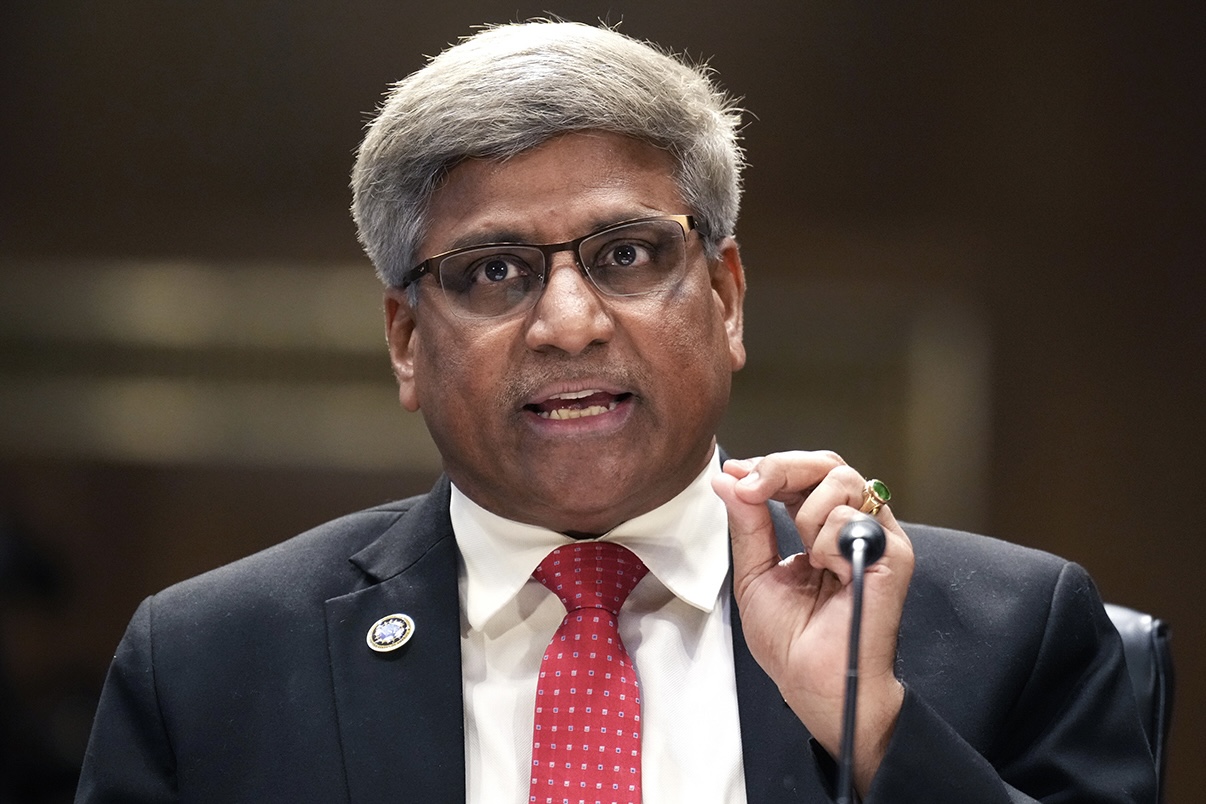
Indian American computer scientist, Sethuraman Panchanathan, who was appointed as director of the National Science Foundation (NSF) by President Donald Trump during his first term, has resigned, 16 months before his 6-year term ends.
“I believe I have done all I can to advance the critical mission of the agency and feel that it is time for me to pass the baton to new leadership,” wrote Panchanathan, known as Panch, without giving a reason for his sudden departure.
“I came to NSF inspired by its mission, with a desire to serve the scientific community alongside the exceptional people of the agency,” stated the scientist who was confirmed by the Senate in August 2020 and continued in the post under President Joe Biden.
“This has motivated me every day over the last five years. I have always believed that innovation and opportunities must be unleashed everywhere at speed and scale, thereby nurturing talent in every corner of our great nation. This will ensure we remain competitive and innovative on a global scale.
READ: Trump 2.0 highlights growing influence of Indian Americans (January 20, 2025)
“This is a pivotal moment for our nation in terms of global competitiveness. NSF is an extremely important investment to make U.S. scientific dominance a reality. We must not lose our competitive edge,” Panchanathan stated.
“I am deeply grateful to both Presidents for the opportunity to serve our nation. I am also thankful for the strong bipartisan support of Congress and the tireless efforts of the amazing staff at NSF,” he added wishing “the very best for the agency and will always look proudly at the numerous accomplishments and impact we have had.”
Although Panchanathan didn’t give a reason for his resignation, Science suggested orders from the White House to accept a 55% cut to the agency’s $9 billion budget next year and fire half its 1700-person staff “may have been the final straws in a series of directives Panchanathan felt he could no longer obey.”
On April 14, staffers from Elon Musk’s Department of Government Efficiency (DOGE) set up shop for the first time at NSF and triggered a series of events that appear to have culminated in Panchanathan’s resignation, it said.
Two days later, NSF announced it was halting any new awards for grants that had been recommended for funding by program officers and were in the final stages of approval by agency officials.
NSF also said pending proposals that appeared to violate any of Trump’s executive orders—in particular those banning efforts to increase diversity in the scientific workforce, foster environmental justice, and study the spread of misinformation on social media sites—would be returned for “mitigation.”
On April 18, NSF announced it was terminating what could be more than $1 billion in grants already awarded because they clashed with those directives and “were no longer priorities” for the agency.
“That most recent disruption to NSF’s well-regarded grantmaking system was done on orders from DOGE,” Science reported citing a knowledgeable source . The same day, DOGE told Panchanathan to prepare a plan for massive layoffs across the agency.
Earlier in the month, the White House Office of Management and Budget had told him the president would be requesting only $4 billion for the agency in his upcoming spending request to Congress for the 2026 fiscal year that begins on Oct. 1, according to Science.
Panchanathan refers obliquely to that draconian reduction in his resignation letter. “While NSF has always been an efficient agency,” he writes, “we still took [on] the challenge of identifying other possible efficiencies and reducing our commitments to serve the scientific community even better.
In 2014, then President Barack Obama appointed him as a member of the National Science Board, NSF’s oversight body, “through which I had the opportunity to help shape the national strategy for science, technology, and innovation as well as the advancement of NSF,” he wrote.
Before leading NSF, Panchanathan spent 20 years as a faculty member and then senior research administrator at Arizona State University.