



By Soumoshree Mukherjee
Editor’s note: This article is based on insights from a podcast series. The views expressed in the podcast reflect the speakers’ perspectives and do not necessarily represent those of this publication. Readers are encouraged to explore the full podcast for additional context.
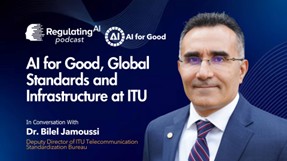
In an era defined by crises from climate change and food insecurity to pandemics and disinformation, artificial intelligence is emerging not just as a tool, but as a transformative force for global good. At the heart of this vision is Dr. Bilel Jamoussi, chief of the Study Groups Department at the International Telecommunication Union (ITU), whose leadership in the “AI for Good” initiative is drawing the world’s attention to technology’s capacity to solve humanity’s most urgent problems.
Speaking in a recent episode of “Regulating AI” podcast, in a world grappling with challenges from healthcare disparities to climate-driven disasters, Jamoussi passionately outlined how AI, when guided by international standards and collaborative efforts, can address pressing global issues in healthcare, agriculture, and disaster management.
READ: Regulating AI: Sanjay Puri on policy, challenges, and ethical innovation (November 1, 2024)
Dr. Jamoussi mentioned that AI is evolving rapidly but we must ensure it evolves responsibly. This delicate balance between innovation and ethical governance defines the “AI for Good” movement, which brings together stakeholders across sectors; from start-ups in Rwanda to policymakers in Geneva to develop solutions with far-reaching social impact.
In Rwanda, AI is already revolutionizing healthcare. Local coding academies are developing machine learning tools tailored to community needs, enabling faster diagnoses in areas with limited access to doctors. “The diagnostics or predictions AI is making can actually help people in low-income settings where they don’t have access to doctors and nurses and hospitals,” Jamoussi noted, highlighting initiatives that bridge the gap in medical care.
Collaborative efforts with organizations like the World Health Organization (WHO) and the World Intellectual Property Organization (WIPO) are ensuring these tools meet rigorous standards, making them reliable across diverse healthcare systems.
Agriculture is another sector where AI, powered by the Internet of Things (IoT), is making a tangible difference. Sensors and drones feed real-time data into AI systems that help farmers detect crop diseases early, optimize water usage, and increase yields. With support from organizations like the FAO and ITU, governments are being equipped with reports and training materials to incorporate these technologies into national food security strategies.
In disaster management, AI’s ability to analyze vast datasets from satellites and IoT devices is proving life-saving. By predicting natural hazards, AI enables timely warnings, potentially protecting thousands. Jamoussi emphasized ITU’s work with the World Meteorological Organization (WMO) to set standards that enhance these predictive tools, ensuring their global applicability.
Yet, the path to responsible AI isn’t without hurdles. Deep fakes, especially during election years, threaten trust in media. ITU, alongside ISO and IEC, is crafting standards for multimedia authenticity, including watermarking solutions to verify content. “Trust the use of AI to have these underpinning standards and guidance,” Jamoussi asserted, underscoring their role in combating misinformation. Meanwhile, low-income countries face resource constraints, lacking data centres for AI innovation. ITU’s Innovation Factories address this by offering cloud services and pitching competitions, empowering start-ups in places like Africa to scale their solutions.
Equity and inclusion are recurring themes in Dr. Jamoussi’s message. From AI tools for people with disabilities to initiatives tackling Africa’s digital gender divide, AI for Good is focused on ensuring that no community is left behind. The AI Skills Coalition, offering free online courses, is one example of how digital literacy is being expanded across age groups and geographies.
Looking ahead, the AI for Good Global Summit promises to showcase the next wave of transformative technologies—from quantum-powered agricultural analytics to autonomous flying vehicles. But beyond the flash of innovation lies a deeper mission: to develop international standards, combat threats like deep fakes, and foster collaboration across public and private sectors.
As Dr. Jamoussi concludes by stating that AI must be guided by humanity’s values. With the right frameworks and partnerships, it has the potential to become one of our most powerful allies in building a better, more equitable world.